

7 Ionic Liquid–Liquid Chromatography: A Novel Separation Method
171
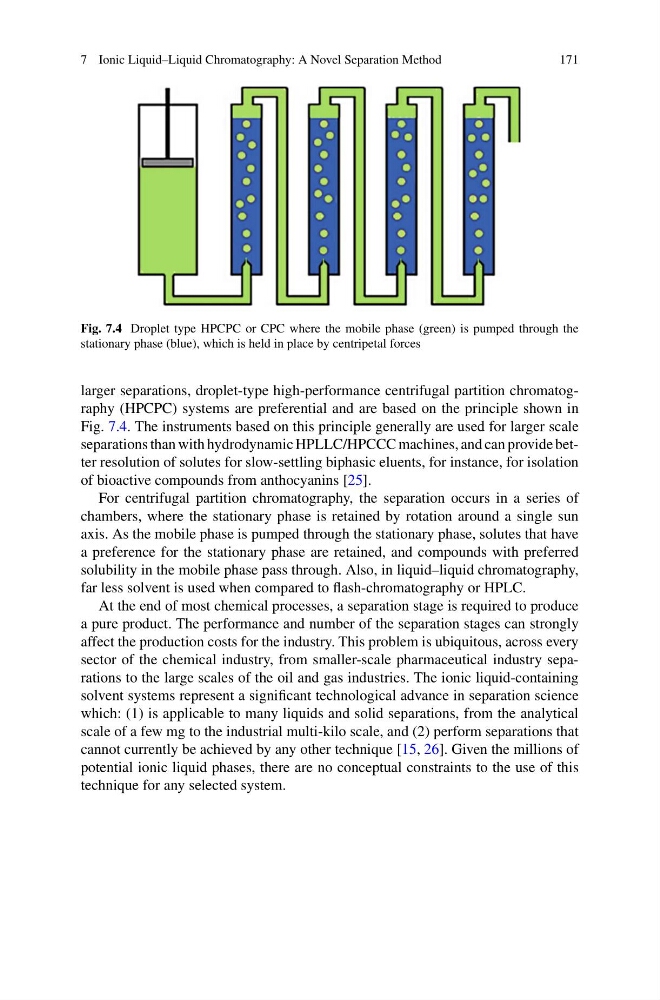
Fig. 7.4 Droplet type HPCPC or CPC where the mobile phase (green) is pumped through the
stationary phase (blue), which is held in place by centripetal forces
larger separations, droplet-type high-performance centrifugal partition chromatography (HPCPC) systems are preferential and are based on the principle shown in
Fig. 7.4. The instruments based on this principle generally are used for larger scale
separations than with hydrodynamic HPLLC/HPCCC machines, and can provide better resolution of solutes for slow-settling biphasic eluents, for instance, for isolation
of bioactive compounds from anthocyanins [25].
For centrifugal partition chromatography, the separation occurs in a series of
chambers, where the stationary phase is retained by rotation around a single sun
axis. As the mobile phase is pumped through the stationary phase, solutes that have
a preference for the stationary phase are retained, and compounds with preferred
solubility in the mobile phase pass through. Also, in liquid–liquid chromatography,
far less solvent is used when compared to flash-chromatography or HPLC.
At the end of most chemical processes, a separation stage is required to produce
a pure product. The performance and number of the separation stages can strongly
affect the production costs for the industry. This problem is ubiquitous, across every
sector of the chemical industry, from smaller-scale pharmaceutical industry separations to the large scales of the oil and gas industries. The ionic liquid-containing
solvent systems represent a significant technological advance in separation science
which: (1) is applicable to many liquids and solid separations, from the analytical
scale of a few mg to the industrial multi-kilo scale, and (2) perform separations that
cannot currently be achieved by any other technique [15, 26]. Given the millions of
potential ionic liquid phases, there are no conceptual constraints to the use of this
technique for any selected system.
171
Fig. 7.4 Droplet type HPCPC or CPC where the mobile phase (green) is pumped through the
stationary phase (blue), which is held in place by centripetal forces
larger separations, droplet-type high-performance centrifugal partition chromatography (HPCPC) systems are preferential and are based on the principle shown in
Fig. 7.4. The instruments based on this principle generally are used for larger scale
separations than with hydrodynamic HPLLC/HPCCC machines, and can provide better resolution of solutes for slow-settling biphasic eluents, for instance, for isolation
of bioactive compounds from anthocyanins [25].
For centrifugal partition chromatography, the separation occurs in a series of
chambers, where the stationary phase is retained by rotation around a single sun
axis. As the mobile phase is pumped through the stationary phase, solutes that have
a preference for the stationary phase are retained, and compounds with preferred
solubility in the mobile phase pass through. Also, in liquid–liquid chromatography,
far less solvent is used when compared to flash-chromatography or HPLC.
At the end of most chemical processes, a separation stage is required to produce
a pure product. The performance and number of the separation stages can strongly
affect the production costs for the industry. This problem is ubiquitous, across every
sector of the chemical industry, from smaller-scale pharmaceutical industry separations to the large scales of the oil and gas industries. The ionic liquid-containing
solvent systems represent a significant technological advance in separation science
which: (1) is applicable to many liquids and solid separations, from the analytical
scale of a few mg to the industrial multi-kilo scale, and (2) perform separations that
cannot currently be achieved by any other technique [15, 26]. Given the millions of
potential ionic liquid phases, there are no conceptual constraints to the use of this
technique for any selected system.