

7 Ionic Liquid–Liquid Chromatography: A Novel Separation Method
169
Liquid
Mobile Phase
Liquid-Liquid
Chromatography
Liquid-Solid
Chromatography
Form of
Chromatography
Stationary Phase
Liquid
Solid
Normal
Phase
Reversed
Phase
Polar Mobile Phase
Non-Polar Stationary Phase
Non-Polar Mobile Phase
Polar Stationary Phase
Normal
Phase
Reversed
Phase
Fig. 7.1 Distribution of analytes in different forms of liquid chromatography
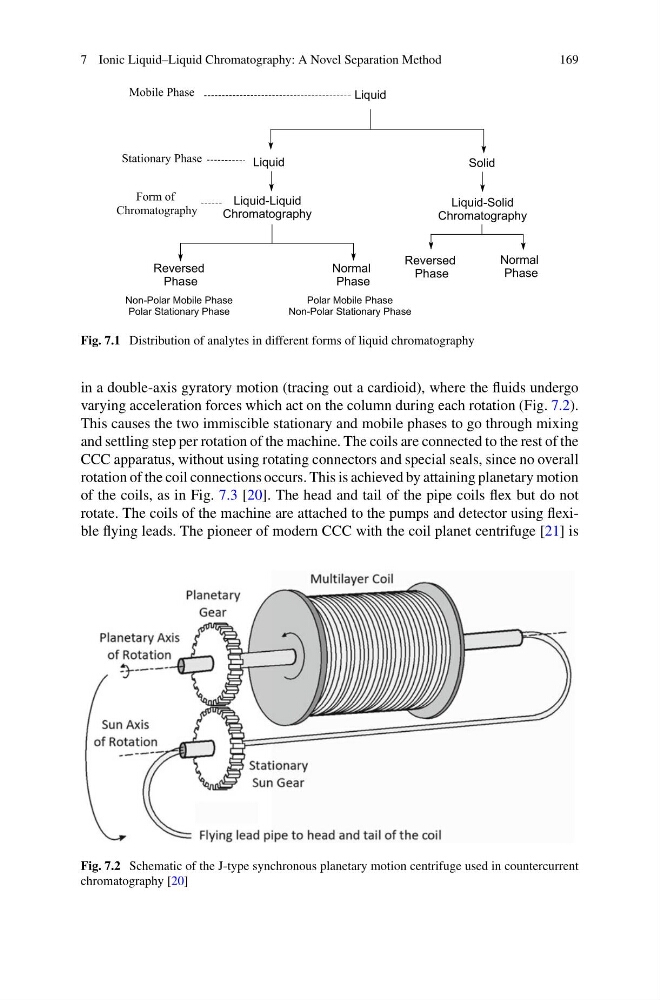
in a double-axis gyratory motion (tracing out a cardioid), where the fluids undergo
varying acceleration forces which act on the column during each rotation (Fig. 7.2).
This causes the two immiscible stationary and mobile phases to go through mixing
and settling step per rotation of the machine. The coils are connected to the rest of the
CCC apparatus, without using rotating connectors and special seals, since no overall
rotation of the coil connections occurs. This is achieved by attaining planetary motion
of the coils, as in Fig. 7.3 [20]. The head and tail of the pipe coils flex but do not
rotate. The coils of the machine are attached to the pumps and detector using flexible flying leads. The pioneer of modern CCC with the coil planet centrifuge [21] is
Fig. 7.2 Schematic of the J-type synchronous planetary motion centrifuge used in countercurrent
chromatography [20]
169
Liquid
Mobile Phase
Liquid-Liquid
Chromatography
Liquid-Solid
Chromatography
Form of
Chromatography
Stationary Phase
Liquid
Solid
Normal
Phase
Reversed
Phase
Polar Mobile Phase
Non-Polar Stationary Phase
Non-Polar Mobile Phase
Polar Stationary Phase
Normal
Phase
Reversed
Phase
Fig. 7.1 Distribution of analytes in different forms of liquid chromatography
in a double-axis gyratory motion (tracing out a cardioid), where the fluids undergo
varying acceleration forces which act on the column during each rotation (Fig. 7.2).
This causes the two immiscible stationary and mobile phases to go through mixing
and settling step per rotation of the machine. The coils are connected to the rest of the
CCC apparatus, without using rotating connectors and special seals, since no overall
rotation of the coil connections occurs. This is achieved by attaining planetary motion
of the coils, as in Fig. 7.3 [20]. The head and tail of the pipe coils flex but do not
rotate. The coils of the machine are attached to the pumps and detector using flexible flying leads. The pioneer of modern CCC with the coil planet centrifuge [21] is
Fig. 7.2 Schematic of the J-type synchronous planetary motion centrifuge used in countercurrent
chromatography [20]