

6.3 Physical Environmental Impact
Assessment
6.3.1 Sand Splay Problem
The most prominent effect of the breaching of
embankment and the occurrences of flood is the
sand splay as post flood hazard (Mukhopadhyay
2010). Sand splay affects land both in short term
and long-term basis. Due to breaching of
embankments, thick deposition of sand takes
place on the river astride areas. So, the fertile
alluvial land is converted into sterile sandy land.
Along the both sides of Mundeswari and
Darakeswar Rivers, sand splay problems are
found particularly downstream of Chanpadanga
and Arambagh respectively. Sand depositions
have been taken place in isolated pockets as a
result of breaching of embankment. Approximately 150 acres of agricultural land were converted into barren land by sand splay at
Balidayanganj in 1978. The sand splay was also
deposited at Balidanga (1983), Jagatpur (1987),
Srimantapur (1993) and Balarampur (2007) in
Khanakul-I Block and Ranjitbati (2000), Baligori
(2009), Doulotchak (2009), Narendrapur and
Harischak (2009) in Khanakul-II Block. The
areas converted into sand splay were 20–30 acres
in Srimantapur and 40 acres in Balarampur.
The maximum thickness of Sand splays has
been found up to 6 ft. On the basis of field survey
conducted at Baligori Mouza, a cross-section has
been drawn (Fig. 6.6). It shows that the depth of
sand deposition is inversely proportional to distance from riverbank. It has been observed that at
the breaching place of embankment, the thickness
of sand deposition is not considerably higher, but
immediately after the breaching place at about
50–75 meters distance towards countryside, the
thickness of sand deposition is maximum and the
thickness gradually decreases with distance from
the embankment. From the laboratory analysis of
sample collected from the field, it has been found
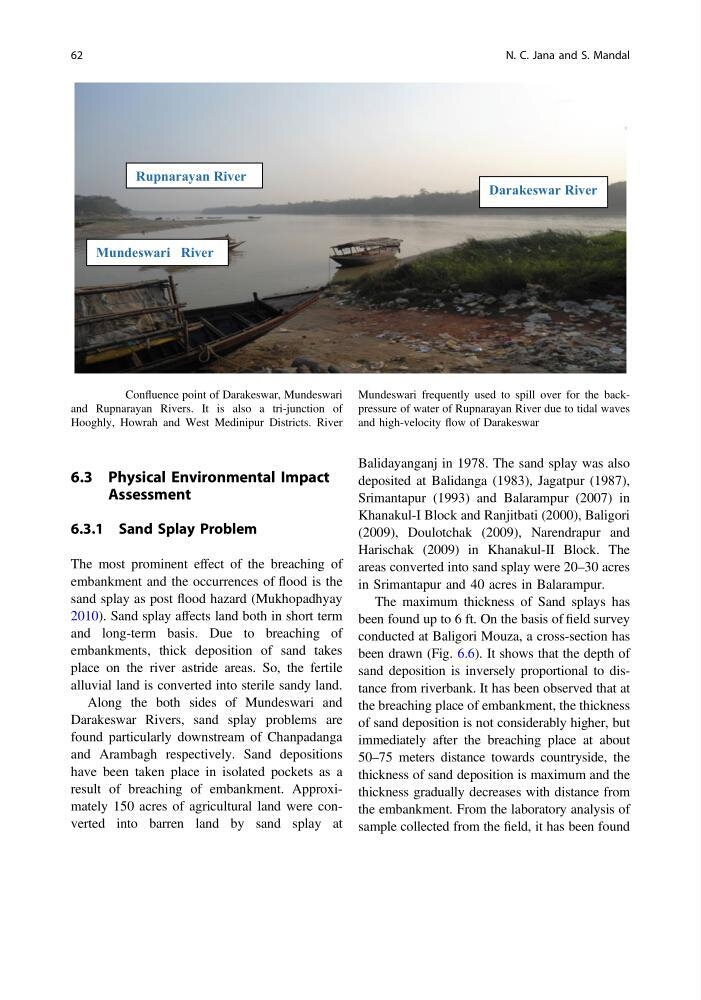
Mundeswari River
Darakeswar River
Rupnarayan River
Plate 6.7 Confluence point of Darakeswar, Mundeswari
and Rupnarayan Rivers. It is also a tri-junction of
Hooghly, Howrah and West Medinipur Districts. River
Mundeswari frequently used to spill over for the backpressure of water of Rupnarayan River due to tidal waves
and high-velocity flow of Darakeswar
62
N. C. Jana and S. Mandal
Assessment
6.3.1 Sand Splay Problem
The most prominent effect of the breaching of
embankment and the occurrences of flood is the
sand splay as post flood hazard (Mukhopadhyay
2010). Sand splay affects land both in short term
and long-term basis. Due to breaching of
embankments, thick deposition of sand takes
place on the river astride areas. So, the fertile
alluvial land is converted into sterile sandy land.
Along the both sides of Mundeswari and
Darakeswar Rivers, sand splay problems are
found particularly downstream of Chanpadanga
and Arambagh respectively. Sand depositions
have been taken place in isolated pockets as a
result of breaching of embankment. Approximately 150 acres of agricultural land were converted into barren land by sand splay at
Balidayanganj in 1978. The sand splay was also
deposited at Balidanga (1983), Jagatpur (1987),
Srimantapur (1993) and Balarampur (2007) in
Khanakul-I Block and Ranjitbati (2000), Baligori
(2009), Doulotchak (2009), Narendrapur and
Harischak (2009) in Khanakul-II Block. The
areas converted into sand splay were 20–30 acres
in Srimantapur and 40 acres in Balarampur.
The maximum thickness of Sand splays has
been found up to 6 ft. On the basis of field survey
conducted at Baligori Mouza, a cross-section has
been drawn (Fig. 6.6). It shows that the depth of
sand deposition is inversely proportional to distance from riverbank. It has been observed that at
the breaching place of embankment, the thickness
of sand deposition is not considerably higher, but
immediately after the breaching place at about
50–75 meters distance towards countryside, the
thickness of sand deposition is maximum and the
thickness gradually decreases with distance from
the embankment. From the laboratory analysis of
sample collected from the field, it has been found
Mundeswari River
Darakeswar River
Rupnarayan River
Plate 6.7 Confluence point of Darakeswar, Mundeswari
and Rupnarayan Rivers. It is also a tri-junction of
Hooghly, Howrah and West Medinipur Districts. River
Mundeswari frequently used to spill over for the backpressure of water of Rupnarayan River due to tidal waves
and high-velocity flow of Darakeswar
62
N. C. Jana and S. Mandal