

obtained during model calibration. The calculation of the water balance is tailored to the specific
characteristics of the studied river. The simulation results indicate high accuracy of the calculation of the water balance for both practical
applications and theoretical studies that tested for
a lot of rivers in Belarus with basin area of about
1000 km
2 (Volchak and Parfamuk 2007).
Thus, the developed computer program with
available data on precipitation, air temperature,
air humidity deficits and modern values of the
water runoff, as well as hydrographic parameters
of the basin provide forecast values of the water
balance of rivers.
The technique of simulation has been tested
on almost all climatic parameters that gave the
opportunity to attract additional large amount of
hydrometeorological information that are included in the balance equations.
When setting up models by the proposed
method have problems with the definition of
parameters for the winter months. The fact that the
model did not accurately include the thaw for the
recent years. Therefore, we conducted an adjustment model taking into account the thaw. The
obtained difference between measured and calculated runoff treated runoff formed during thaws,
which were recorded in the settings of the model.
When forecasting runoff, this component was
added directly to the runoff and its value was
subtracted from precipitation. The values of runoff during thaws were adjusted for the predicted
temperature of the corresponding month. In the
first approximation, the value of runoff can be
taken from the ratio of monthly air temperatures
and runoff during the period of thaw.
Forecasting changes of river runoff for the
Neman River basin were carried out by the following scheme. The model was adjusted for
average long-term data on river runoff, atmosphere precipitation, air temperature and deficits
of air humidity, obtained parameters remained in
computer. Then entered forecast value for those
weather stations that were used in the setting
model. The last stage was reading the settings of
the model and carrying out the runoff forecast.
3.4 Discussion of the Results
Runoff forecasts for 24 rivers in the Neman River
basin for two scenarios of A1B and B1 climate
change were done in two options. The first option
is forecasting without considering the thaw and
the second option with regard to thaw. The
results consist of the model configuration as well
as modern and forecast calculated values of the
river runoff. Based on the analysis of the
obtained forecasts, the changes in river runoff for
the Neman River basin preference should be
given to the second option.
Tables 3.3 and 3.4 show the forecasted values
of runoff changes for the two scenarios of climate
change in percent to the modern level.
b
a
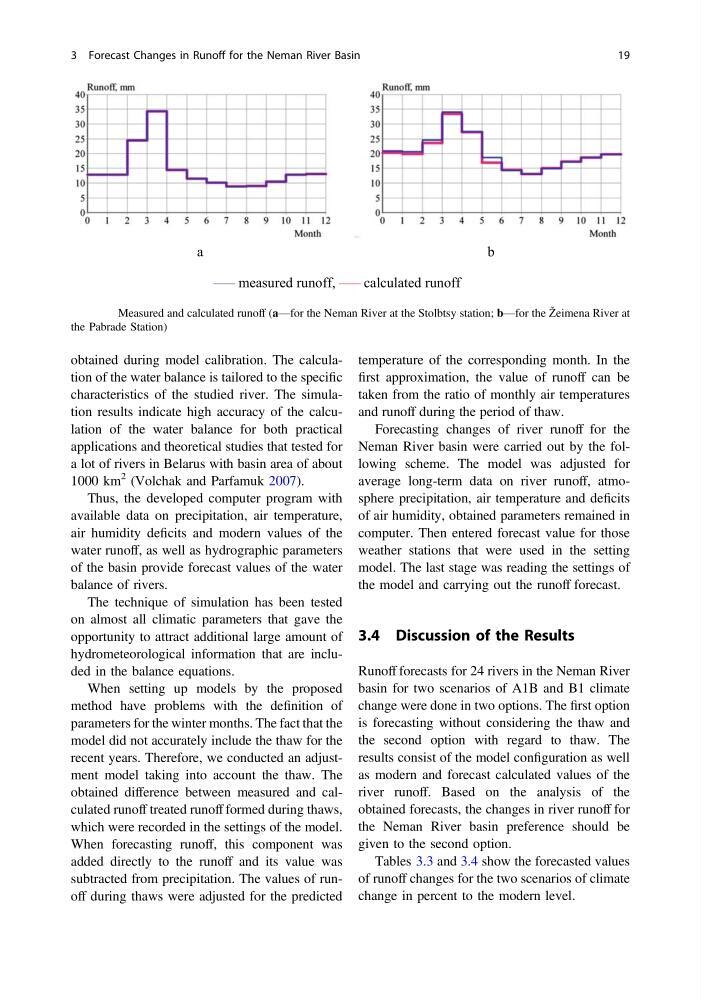
––– measured runoff, ––– calculated runoff
Fig. 3.2 Measured and calculated runoff (a—for the Neman River at the Stolbtsy station; b—for the Žeimena River at
the Pabrade Station)
3 Forecast Changes in Runoff for the Neman River Basin
19
characteristics of the studied river. The simulation results indicate high accuracy of the calculation of the water balance for both practical
applications and theoretical studies that tested for
a lot of rivers in Belarus with basin area of about
1000 km
2 (Volchak and Parfamuk 2007).
Thus, the developed computer program with
available data on precipitation, air temperature,
air humidity deficits and modern values of the
water runoff, as well as hydrographic parameters
of the basin provide forecast values of the water
balance of rivers.
The technique of simulation has been tested
on almost all climatic parameters that gave the
opportunity to attract additional large amount of
hydrometeorological information that are included in the balance equations.
When setting up models by the proposed
method have problems with the definition of
parameters for the winter months. The fact that the
model did not accurately include the thaw for the
recent years. Therefore, we conducted an adjustment model taking into account the thaw. The
obtained difference between measured and calculated runoff treated runoff formed during thaws,
which were recorded in the settings of the model.
When forecasting runoff, this component was
added directly to the runoff and its value was
subtracted from precipitation. The values of runoff during thaws were adjusted for the predicted
temperature of the corresponding month. In the
first approximation, the value of runoff can be
taken from the ratio of monthly air temperatures
and runoff during the period of thaw.
Forecasting changes of river runoff for the
Neman River basin were carried out by the following scheme. The model was adjusted for
average long-term data on river runoff, atmosphere precipitation, air temperature and deficits
of air humidity, obtained parameters remained in
computer. Then entered forecast value for those
weather stations that were used in the setting
model. The last stage was reading the settings of
the model and carrying out the runoff forecast.
3.4 Discussion of the Results
Runoff forecasts for 24 rivers in the Neman River
basin for two scenarios of A1B and B1 climate
change were done in two options. The first option
is forecasting without considering the thaw and
the second option with regard to thaw. The
results consist of the model configuration as well
as modern and forecast calculated values of the
river runoff. Based on the analysis of the
obtained forecasts, the changes in river runoff for
the Neman River basin preference should be
given to the second option.
Tables 3.3 and 3.4 show the forecasted values
of runoff changes for the two scenarios of climate
change in percent to the modern level.
b
a
––– measured runoff, ––– calculated runoff
Fig. 3.2 Measured and calculated runoff (a—for the Neman River at the Stolbtsy station; b—for the Žeimena River at
the Pabrade Station)
3 Forecast Changes in Runoff for the Neman River Basin
19