

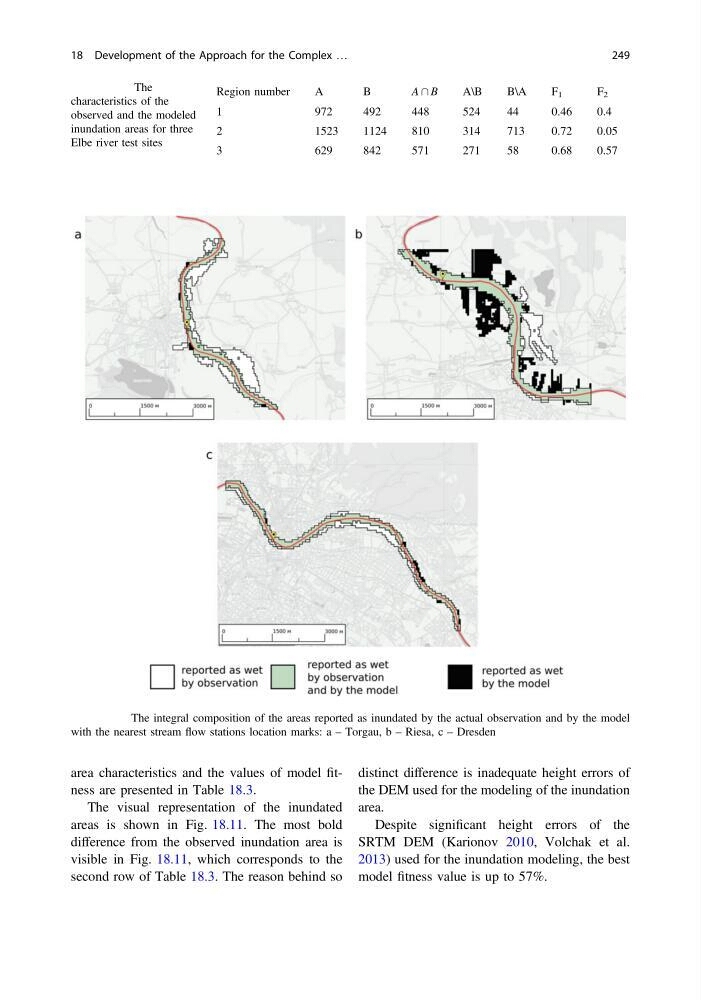
area characteristics and the values of model fitness are presented in Table 18.3.
The visual representation of the inundated
areas is shown in Fig. 18.11. The most bold
difference from the observed inundation area is
visible in Fig. 18.11, which corresponds to the
second row of Table 18.3. The reason behind so
distinct difference is inadequate height errors of
the DEM used for the modeling of the inundation
area.
Despite significant height errors of the
SRTM DEM (Karionov 2010, Volchak et al.
2013) used for the inundation modeling, the best
model fitness value is up to 57%.
Table 18.3 The
characteristics of the
observed and the modeled
inundation areas for three
Elbe river test sites
Region number
A
B
A \ B
A\B
B\A
F 1
F 2
1
972
492
448
524
44
0.46
0.4
2
1523
1124
810
314
713
0.72
0.05
3
629
842
571
271
58
0.68
0.57
Fig. 18.11 The integral composition of the areas reported as inundated by the actual observation and by the model
with the nearest stream flow stations location marks: a – Torgau, b – Riesa, c – Dresden
18 Development of the Approach for the Complex …
249
The visual representation of the inundated
areas is shown in Fig. 18.11. The most bold
difference from the observed inundation area is
visible in Fig. 18.11, which corresponds to the
second row of Table 18.3. The reason behind so
distinct difference is inadequate height errors of
the DEM used for the modeling of the inundation
area.
Despite significant height errors of the
SRTM DEM (Karionov 2010, Volchak et al.
2013) used for the inundation modeling, the best
model fitness value is up to 57%.
Table 18.3 The
characteristics of the
observed and the modeled
inundation areas for three
Elbe river test sites
Region number
A
B
A \ B
A\B
B\A
F 1
F 2
1
972
492
448
524
44
0.46
0.4
2
1523
1124
810
314
713
0.72
0.05
3
629
842
571
271
58
0.68
0.57
Fig. 18.11 The integral composition of the areas reported as inundated by the actual observation and by the model
with the nearest stream flow stations location marks: a – Torgau, b – Riesa, c – Dresden
18 Development of the Approach for the Complex …
249