

Na
þ
þ 1=2Ca
2 þ
À X 2 ! 1=2Ca
2 þ
þ Na À X
where X is the natural ion exchange. For this reaction, Na
+ is taken up by the exchange, while Ca
2+ is
released into the water for the reason that the chloride
remains the same, a depletion of Na
+ relatively to
chloride in groundwater is therefore observed when
seawater intrudes the previously fresh groundwater
aquifer. On the other hand, if seawater intrusion is
stopped for some reason and the fresh groundwater
flushes the aquifer, the reverse cation exchange
reaction takes place as follows, resulting in enrichment of Na
+ relative to Cl
−
1 = 2 Ca
2 þ
þ Na
þ
À X ! 1=2Ca À X 2 þ Na
þ
The freshwater intrusion into mixing zone
leads to absorption of Ca
2+ and Mg
2+ by the ion
exchangers with simultaneous release of Na
+
.
This reaction can increase the Na
+
/Cl
− value and
reduce the (Ca
2+ /Mg
2+ )/Cl
− ratio. In general, the
Cl
− does not remove from the system because of
its more solubility and high residence time.
A depletion of sodium relative to chloride indicated in the coastal groundwater aquifer in the
area is contaminated by saline intrusion; enrichment of sodium ion indicated gradual freshening.
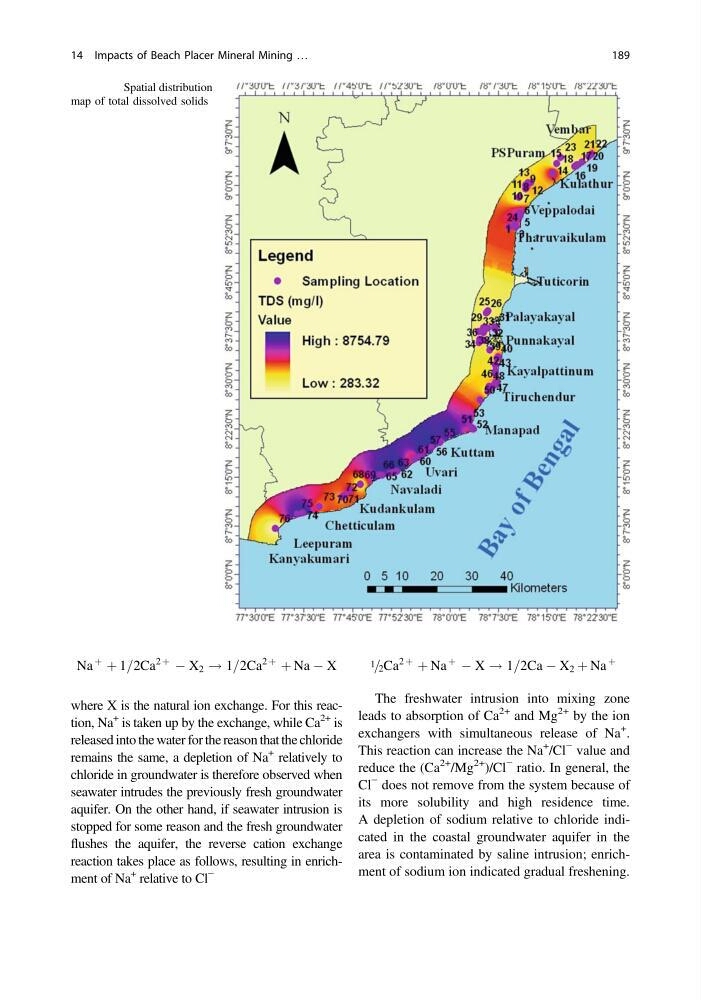
Fig. 14.2 Spatial distribution
map of total dissolved solids
14 Impacts of Beach Placer Mineral Mining …
189
þ
þ 1=2Ca
2 þ
À X 2 ! 1=2Ca
2 þ
þ Na À X
where X is the natural ion exchange. For this reaction, Na
+ is taken up by the exchange, while Ca
2+ is
released into the water for the reason that the chloride
remains the same, a depletion of Na
+ relatively to
chloride in groundwater is therefore observed when
seawater intrudes the previously fresh groundwater
aquifer. On the other hand, if seawater intrusion is
stopped for some reason and the fresh groundwater
flushes the aquifer, the reverse cation exchange
reaction takes place as follows, resulting in enrichment of Na
+ relative to Cl
−
1 = 2 Ca
2 þ
þ Na
þ
À X ! 1=2Ca À X 2 þ Na
þ
The freshwater intrusion into mixing zone
leads to absorption of Ca
2+ and Mg
2+ by the ion
exchangers with simultaneous release of Na
+
.
This reaction can increase the Na
+
/Cl
− value and
reduce the (Ca
2+ /Mg
2+ )/Cl
− ratio. In general, the
Cl
− does not remove from the system because of
its more solubility and high residence time.
A depletion of sodium relative to chloride indicated in the coastal groundwater aquifer in the
area is contaminated by saline intrusion; enrichment of sodium ion indicated gradual freshening.
Fig. 14.2 Spatial distribution
map of total dissolved solids
14 Impacts of Beach Placer Mineral Mining …
189