

because of rainfall, and this state receives rainfall
from monsoonal winds as well as from western
disturbances (Singh 2004). It receives
1700 mm/year. The average volume of water
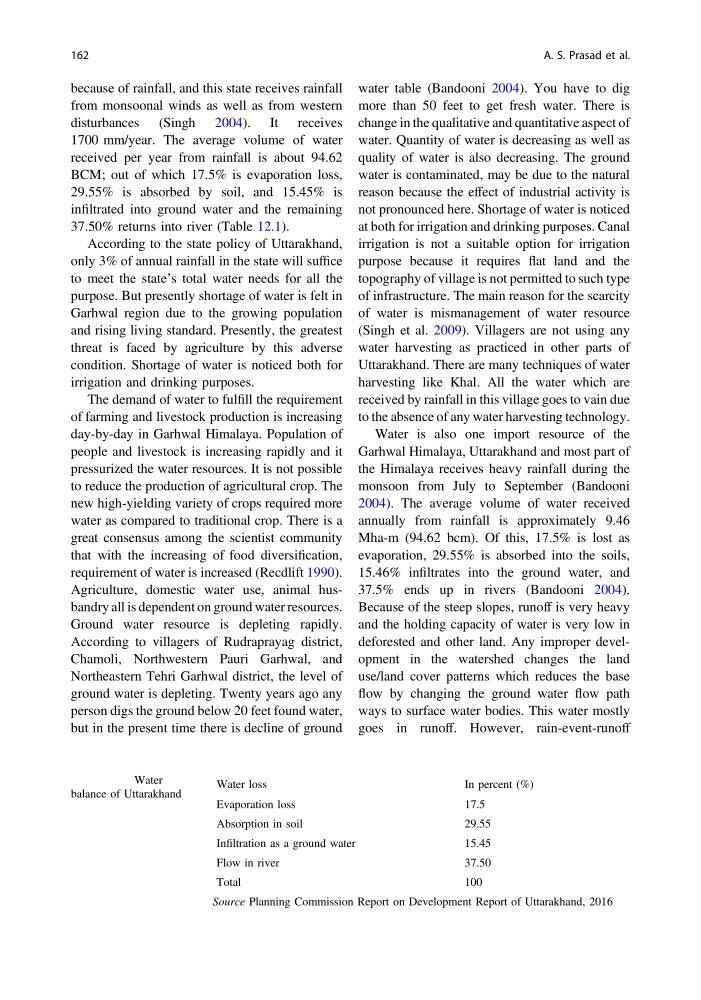
received per year from rainfall is about 94.62
BCM; out of which 17.5% is evaporation loss,
29.55% is absorbed by soil, and 15.45% is
infiltrated into ground water and the remaining
37.50% returns into river (Table 12.1).
According to the state policy of Uttarakhand,
only 3% of annual rainfall in the state will suffice
to meet the state’s total water needs for all the
purpose. But presently shortage of water is felt in
Garhwal region due to the growing population
and rising living standard. Presently, the greatest
threat is faced by agriculture by this adverse
condition. Shortage of water is noticed both for
irrigation and drinking purposes.
The demand of water to fulfill the requirement
of farming and livestock production is increasing
day-by-day in Garhwal Himalaya. Population of
people and livestock is increasing rapidly and it
pressurized the water resources. It is not possible
to reduce the production of agricultural crop. The
new high-yielding variety of crops required more
water as compared to traditional crop. There is a
great consensus among the scientist community
that with the increasing of food diversification,
requirement of water is increased (Recdlift 1990).
Agriculture, domestic water use, animal husbandry all is dependent on ground water resources.
Ground water resource is depleting rapidly.
According to villagers of Rudraprayag district,
Chamoli, Northwestern Pauri Garhwal, and
Northeastern Tehri Garhwal district, the level of
ground water is depleting. Twenty years ago any
person digs the ground below 20 feet found water,
but in the present time there is decline of ground
water table (Bandooni 2004). You have to dig
more than 50 feet to get fresh water. There is
change in the qualitative and quantitative aspect of
water. Quantity of water is decreasing as well as
quality of water is also decreasing. The ground
water is contaminated, may be due to the natural
reason because the effect of industrial activity is
not pronounced here. Shortage of water is noticed
at both for irrigation and drinking purposes. Canal
irrigation is not a suitable option for irrigation
purpose because it requires flat land and the
topography of village is not permitted to such type
of infrastructure. The main reason for the scarcity
of water is mismanagement of water resource
(Singh et al. 2009). Villagers are not using any
water harvesting as practiced in other parts of
Uttarakhand. There are many techniques of water
harvesting like Khal. All the water which are
received by rainfall in this village goes to vain due
to the absence of any water harvesting technology.
Water is also one import resource of the
Garhwal Himalaya, Uttarakhand and most part of
the Himalaya receives heavy rainfall during the
monsoon from July to September (Bandooni
2004). The average volume of water received
annually from rainfall is approximately 9.46
Mha-m (94.62 bcm). Of this, 17.5% is lost as
evaporation, 29.55% is absorbed into the soils,
15.46% infiltrates into the ground water, and
37.5% ends up in rivers (Bandooni 2004).
Because of the steep slopes, runoff is very heavy
and the holding capacity of water is very low in
deforested and other land. Any improper development in the watershed changes the land
use/land cover patterns which reduces the base
flow by changing the ground water flow path
ways to surface water bodies. This water mostly
goes in runoff. However, rain-event-runoff
Table 12.1 Water
balance of Uttarakhand
Water loss
In percent (%)
Evaporation loss
17.5
Absorption in soil
29.55
Infiltration as a ground water
15.45
Flow in river
37.50
Total
100
Source Planning Commission Report on Development Report of Uttarakhand, 2016
162
A. S. Prasad et al.
from monsoonal winds as well as from western
disturbances (Singh 2004). It receives
1700 mm/year. The average volume of water
received per year from rainfall is about 94.62
BCM; out of which 17.5% is evaporation loss,
29.55% is absorbed by soil, and 15.45% is
infiltrated into ground water and the remaining
37.50% returns into river (Table 12.1).
According to the state policy of Uttarakhand,
only 3% of annual rainfall in the state will suffice
to meet the state’s total water needs for all the
purpose. But presently shortage of water is felt in
Garhwal region due to the growing population
and rising living standard. Presently, the greatest
threat is faced by agriculture by this adverse
condition. Shortage of water is noticed both for
irrigation and drinking purposes.
The demand of water to fulfill the requirement
of farming and livestock production is increasing
day-by-day in Garhwal Himalaya. Population of
people and livestock is increasing rapidly and it
pressurized the water resources. It is not possible
to reduce the production of agricultural crop. The
new high-yielding variety of crops required more
water as compared to traditional crop. There is a
great consensus among the scientist community
that with the increasing of food diversification,
requirement of water is increased (Recdlift 1990).
Agriculture, domestic water use, animal husbandry all is dependent on ground water resources.
Ground water resource is depleting rapidly.
According to villagers of Rudraprayag district,
Chamoli, Northwestern Pauri Garhwal, and
Northeastern Tehri Garhwal district, the level of
ground water is depleting. Twenty years ago any
person digs the ground below 20 feet found water,
but in the present time there is decline of ground
water table (Bandooni 2004). You have to dig
more than 50 feet to get fresh water. There is
change in the qualitative and quantitative aspect of
water. Quantity of water is decreasing as well as
quality of water is also decreasing. The ground
water is contaminated, may be due to the natural
reason because the effect of industrial activity is
not pronounced here. Shortage of water is noticed
at both for irrigation and drinking purposes. Canal
irrigation is not a suitable option for irrigation
purpose because it requires flat land and the
topography of village is not permitted to such type
of infrastructure. The main reason for the scarcity
of water is mismanagement of water resource
(Singh et al. 2009). Villagers are not using any
water harvesting as practiced in other parts of
Uttarakhand. There are many techniques of water
harvesting like Khal. All the water which are
received by rainfall in this village goes to vain due
to the absence of any water harvesting technology.
Water is also one import resource of the
Garhwal Himalaya, Uttarakhand and most part of
the Himalaya receives heavy rainfall during the
monsoon from July to September (Bandooni
2004). The average volume of water received
annually from rainfall is approximately 9.46
Mha-m (94.62 bcm). Of this, 17.5% is lost as
evaporation, 29.55% is absorbed into the soils,
15.46% infiltrates into the ground water, and
37.5% ends up in rivers (Bandooni 2004).
Because of the steep slopes, runoff is very heavy
and the holding capacity of water is very low in
deforested and other land. Any improper development in the watershed changes the land
use/land cover patterns which reduces the base
flow by changing the ground water flow path
ways to surface water bodies. This water mostly
goes in runoff. However, rain-event-runoff
Table 12.1 Water
balance of Uttarakhand
Water loss
In percent (%)
Evaporation loss
17.5
Absorption in soil
29.55
Infiltration as a ground water
15.45
Flow in river
37.50
Total
100
Source Planning Commission Report on Development Report of Uttarakhand, 2016
162
A. S. Prasad et al.