

Udalova et al. 2009). Numerous studies of various aquatic animal species indicate the relationship between their functional state and the
presence of circadian activity (Bojsen et al. 1998;
Udalova et al. 2009; Kuznetsova et al. 2010;
Sladkova et al. 2016). Our studies on crayfish
confirmed existence of such relationship and also
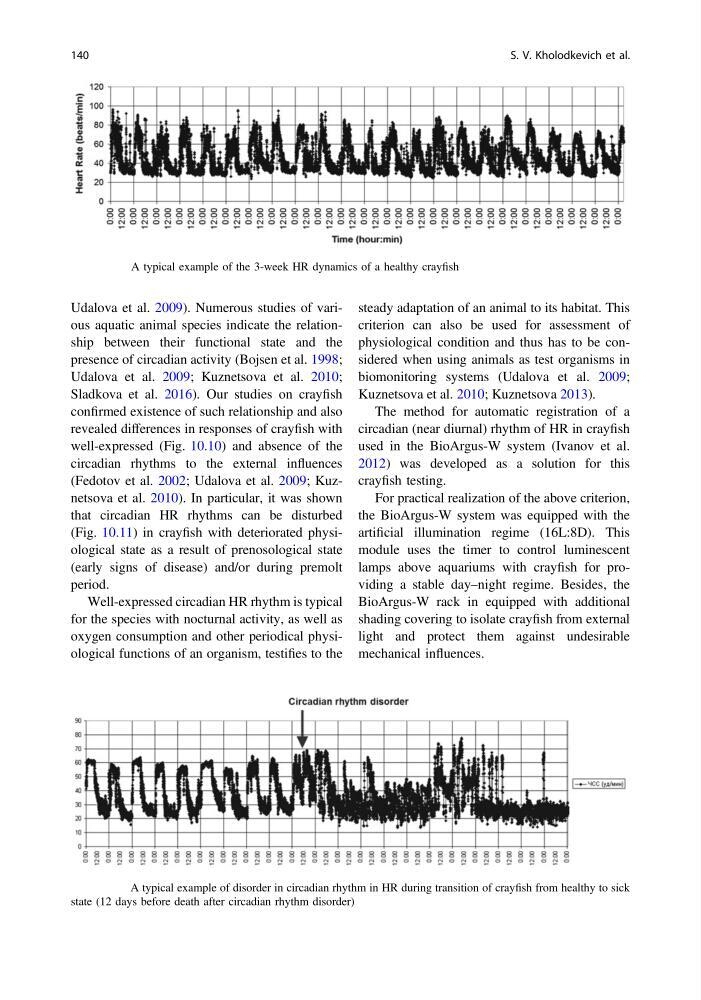
revealed differences in responses of crayfish with
well-expressed (Fig. 10.10) and absence of the
circadian rhythms to the external influences
(Fedotov et al. 2002; Udalova et al. 2009; Kuznetsova et al. 2010). In particular, it was shown
that circadian HR rhythms can be disturbed
(Fig. 10.11) in crayfish with deteriorated physiological state as a result of prenosological state
(early signs of disease) and/or during premolt
period.
Well-expressed circadian HR rhythm is typical
for the species with nocturnal activity, as well as
oxygen consumption and other periodical physiological functions of an organism, testifies to the
steady adaptation of an animal to its habitat. This
criterion can also be used for assessment of
physiological condition and thus has to be considered when using animals as test organisms in
biomonitoring systems (Udalova et al. 2009;
Kuznetsova et al. 2010; Kuznetsova 2013).
The method for automatic registration of a
circadian (near diurnal) rhythm of HR in crayfish
used in the BioArgus-W system (Ivanov et al.
2012) was developed as a solution for this
crayfish testing.
For practical realization of the above criterion,
the BioArgus-W system was equipped with the
artificial illumination regime (16L:8D). This
module uses the timer to control luminescent
lamps above aquariums with crayfish for providing a stable day–night regime. Besides, the
BioArgus-W rack in equipped with additional
shading covering to isolate crayfish from external
light and protect them against undesirable
mechanical influences.
Fig. 10.10 A typical example of the 3-week HR dynamics of a healthy crayfish
Fig. 10.11 A typical example of disorder in circadian rhythm in HR during transition of crayfish from healthy to sick
state (12 days before death after circadian rhythm disorder)
140
S. V. Kholodkevich et al.
presence of circadian activity (Bojsen et al. 1998;
Udalova et al. 2009; Kuznetsova et al. 2010;
Sladkova et al. 2016). Our studies on crayfish
confirmed existence of such relationship and also
revealed differences in responses of crayfish with
well-expressed (Fig. 10.10) and absence of the
circadian rhythms to the external influences
(Fedotov et al. 2002; Udalova et al. 2009; Kuznetsova et al. 2010). In particular, it was shown
that circadian HR rhythms can be disturbed
(Fig. 10.11) in crayfish with deteriorated physiological state as a result of prenosological state
(early signs of disease) and/or during premolt
period.
Well-expressed circadian HR rhythm is typical
for the species with nocturnal activity, as well as
oxygen consumption and other periodical physiological functions of an organism, testifies to the
steady adaptation of an animal to its habitat. This
criterion can also be used for assessment of
physiological condition and thus has to be considered when using animals as test organisms in
biomonitoring systems (Udalova et al. 2009;
Kuznetsova et al. 2010; Kuznetsova 2013).
The method for automatic registration of a
circadian (near diurnal) rhythm of HR in crayfish
used in the BioArgus-W system (Ivanov et al.
2012) was developed as a solution for this
crayfish testing.
For practical realization of the above criterion,
the BioArgus-W system was equipped with the
artificial illumination regime (16L:8D). This
module uses the timer to control luminescent
lamps above aquariums with crayfish for providing a stable day–night regime. Besides, the
BioArgus-W rack in equipped with additional
shading covering to isolate crayfish from external
light and protect them against undesirable
mechanical influences.
Fig. 10.10 A typical example of the 3-week HR dynamics of a healthy crayfish
Fig. 10.11 A typical example of disorder in circadian rhythm in HR during transition of crayfish from healthy to sick
state (12 days before death after circadian rhythm disorder)
140
S. V. Kholodkevich et al.