

authorities and the federal subjects of Russia
authorities; the legal regulation of the access to
water objects and water objects ownership; cardinally changed the protection regime of water
objects and surrounding areas. In fact, the water
resource state management system reform was
conducted.
However, the water management system still
requires improvement and further development.
In particular, various usage conditions for the
same water body in different Russian regions
give rise to social conflicts and escalation of
negative public sentiment. Moreover, different
Russian regions may establish various sanctions
for the same offense for the same water object,
for example, violation of the human life protection rules on water or the rules for the use of
small boats equipped with motors.
Besides, there is the water strategy of the
Russian Federation up to 2020, which includes
the development of principles for integrated
water resource management system as main
directions of state water protection system
improvement (Government of Russia 2009).
Integrated water resource management is a process that promotes the comprehensive
development and management of water, land,
and other resources to maximize economic and
social welfare in an equitable manner without the
sustainability of vital compromising ecosystems.
Adoption and implementation of management
solutions provide the greatest social and economic
benefit and allow exploiting the water resources
most efficiently and without compromising its
quality, possible only if the cooperation and
interaction of all participants of water relations
exist. Therefore, it seems reasonable to organize
the water resource management system within the
river basin boundaries and to give prerogative of
making management decisions to basin councils,
whose actions are coordinated with local authorities, water users, and public associations.
Besides, integrated management should be based
on regional (territorial) features and individual
characteristics of water objects.
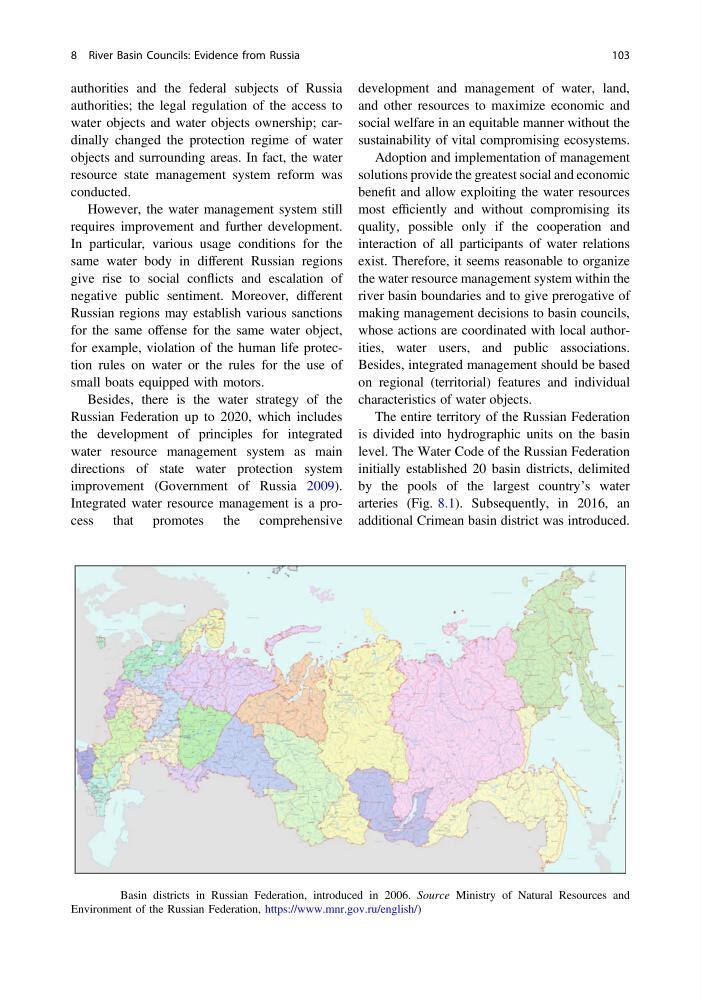
The entire territory of the Russian Federation
is divided into hydrographic units on the basin
level. The Water Code of the Russian Federation
initially established 20 basin districts, delimited
by the pools of the largest country’s water
arteries (Fig. 8.1). Subsequently, in 2016, an
additional Crimean basin district was introduced.
Fig. 8.1 Basin districts in Russian Federation, introduced in 2006. Source Ministry of Natural Resources and
Environment of the Russian Federation, https://www.mnr.gov.ru/english/)
8 River Basin Councils: Evidence from Russia
103
authorities; the legal regulation of the access to
water objects and water objects ownership; cardinally changed the protection regime of water
objects and surrounding areas. In fact, the water
resource state management system reform was
conducted.
However, the water management system still
requires improvement and further development.
In particular, various usage conditions for the
same water body in different Russian regions
give rise to social conflicts and escalation of
negative public sentiment. Moreover, different
Russian regions may establish various sanctions
for the same offense for the same water object,
for example, violation of the human life protection rules on water or the rules for the use of
small boats equipped with motors.
Besides, there is the water strategy of the
Russian Federation up to 2020, which includes
the development of principles for integrated
water resource management system as main
directions of state water protection system
improvement (Government of Russia 2009).
Integrated water resource management is a process that promotes the comprehensive
development and management of water, land,
and other resources to maximize economic and
social welfare in an equitable manner without the
sustainability of vital compromising ecosystems.
Adoption and implementation of management
solutions provide the greatest social and economic
benefit and allow exploiting the water resources
most efficiently and without compromising its
quality, possible only if the cooperation and
interaction of all participants of water relations
exist. Therefore, it seems reasonable to organize
the water resource management system within the
river basin boundaries and to give prerogative of
making management decisions to basin councils,
whose actions are coordinated with local authorities, water users, and public associations.
Besides, integrated management should be based
on regional (territorial) features and individual
characteristics of water objects.
The entire territory of the Russian Federation
is divided into hydrographic units on the basin
level. The Water Code of the Russian Federation
initially established 20 basin districts, delimited
by the pools of the largest country’s water
arteries (Fig. 8.1). Subsequently, in 2016, an
additional Crimean basin district was introduced.
Fig. 8.1 Basin districts in Russian Federation, introduced in 2006. Source Ministry of Natural Resources and
Environment of the Russian Federation, https://www.mnr.gov.ru/english/)
8 River Basin Councils: Evidence from Russia
103