

4.3.3 Phosphazene-Based FRs
Phosphazenes contain P and N in their structure and hence exhibit good FR activity;
furthermore, they can possibly exhibit a synergetic effect to enhance the FR activity.
Therefore, phosphazenes have been utilized for the synthesis of FR polymers and
copolymers; they are introduced into polymer backbone via chemical bonding.
These phosphazenes exhibit good physical properties, which favor an increase in
the FR activity, such as high flexibility [90], thermal stability [91, 92], high LOI
values [93–95], low smoke-releasing property [96], and flame resistance [93, 95,
97, 98].
However, these compounds are not much commercialized due to their high cost
compared to halogenated FRs. The chemical structure of phosphazene includes –
P=N– repeating units, either in a linear or cyclic form. Therefore, it shows high
thermal stability, FR activity, and self-extinguishing ability. Allcock [99, 100], in
their review on the synthesis and applications of poly(phosphazene) and their
derivative compounds, reported that poly(phosphazene) compounds are generally
synthesized from hexachloro cyclotriphosphazenes by ring-opening polymerization
to form linear, branched, or cyclic structures; the chlorine atoms in these structures
are highly susceptible to nucleophilic substitution. Therefore, –Cl can be replaced
with a variety of substituents such as –OH, –NH 2 , aryl, and vinyl groups; some
examples are shown in Scheme 4.9.
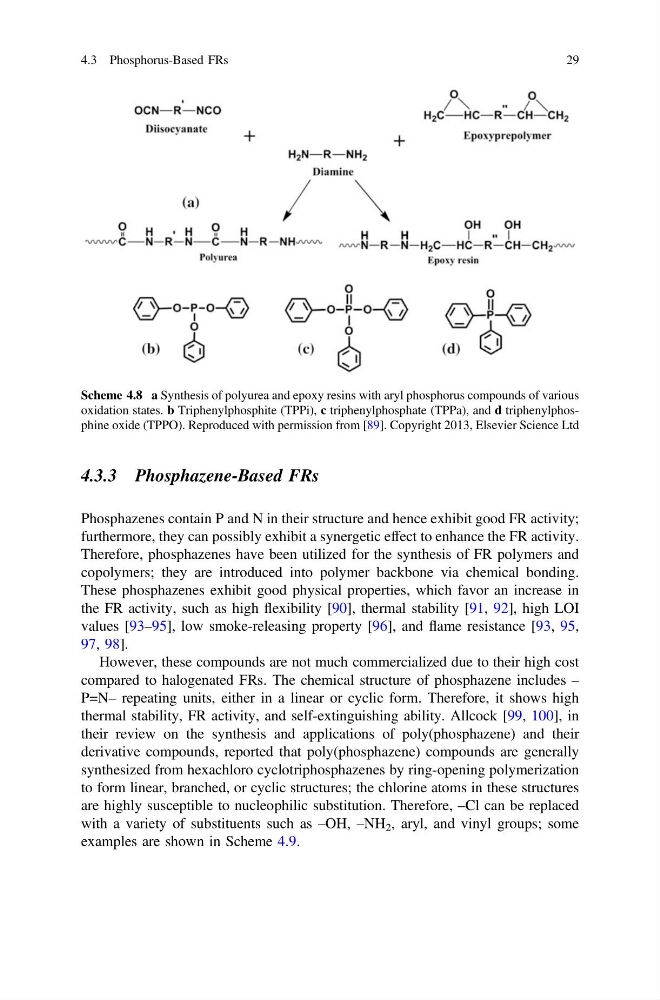
Scheme 4.8 a Synthesis of polyurea and epoxy resins with aryl phosphorus compounds of various
oxidation states. b Triphenylphosphite (TPPi), c triphenylphosphate (TPPa), and d triphenylphosphine oxide (TPPO). Reproduced with permission from [89]. Copyright 2013, Elsevier Science Ltd
4.3 Phosphorus-Based FRs
29
Phosphazenes contain P and N in their structure and hence exhibit good FR activity;
furthermore, they can possibly exhibit a synergetic effect to enhance the FR activity.
Therefore, phosphazenes have been utilized for the synthesis of FR polymers and
copolymers; they are introduced into polymer backbone via chemical bonding.
These phosphazenes exhibit good physical properties, which favor an increase in
the FR activity, such as high flexibility [90], thermal stability [91, 92], high LOI
values [93–95], low smoke-releasing property [96], and flame resistance [93, 95,
97, 98].
However, these compounds are not much commercialized due to their high cost
compared to halogenated FRs. The chemical structure of phosphazene includes –
P=N– repeating units, either in a linear or cyclic form. Therefore, it shows high
thermal stability, FR activity, and self-extinguishing ability. Allcock [99, 100], in
their review on the synthesis and applications of poly(phosphazene) and their
derivative compounds, reported that poly(phosphazene) compounds are generally
synthesized from hexachloro cyclotriphosphazenes by ring-opening polymerization
to form linear, branched, or cyclic structures; the chlorine atoms in these structures
are highly susceptible to nucleophilic substitution. Therefore, –Cl can be replaced
with a variety of substituents such as –OH, –NH 2 , aryl, and vinyl groups; some
examples are shown in Scheme 4.9.
Scheme 4.8 a Synthesis of polyurea and epoxy resins with aryl phosphorus compounds of various
oxidation states. b Triphenylphosphite (TPPi), c triphenylphosphate (TPPa), and d triphenylphosphine oxide (TPPO). Reproduced with permission from [89]. Copyright 2013, Elsevier Science Ltd
4.3 Phosphorus-Based FRs
29