

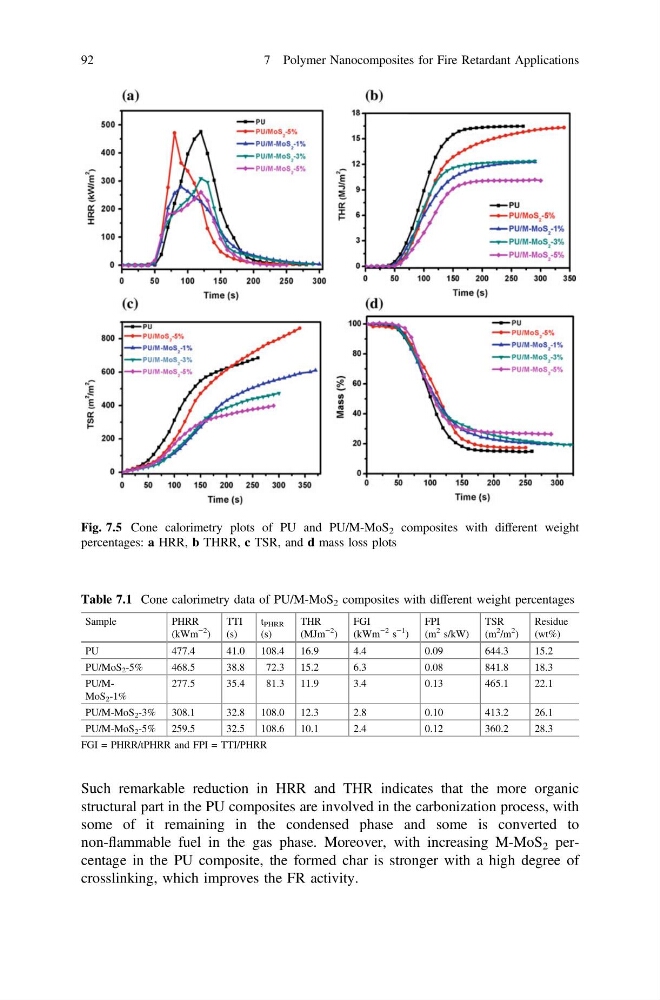
Such remarkable reduction in HRR and THR indicates that the more organic
structural part in the PU composites are involved in the carbonization process, with
some of it remaining in the condensed phase and some is converted to
non-flammable fuel in the gas phase. Moreover, with increasing M-MoS 2 percentage in the PU composite, the formed char is stronger with a high degree of
crosslinking, which improves the FR activity.
Fig. 7.5 Cone calorimetry plots of PU and PU/M-MoS 2 composites with different weight
percentages: a HRR, b THRR, c TSR, and d mass loss plots
Table 7.1 Cone calorimetry data of PU/M-MoS 2 composites with different weight percentages
Sample
PHRR
(kWm
−2
)
TTI
(s)
t PHRR
(s)
THR
(MJm
−2
)
FGI
(kWm
−2 s
−1
)
FPI
(m
2 s/kW)
TSR
(m
2
/m
2
)
Residue
(wt%)
PU
477.4
41.0
108.4
16.9
4.4
0.09
644.3
15.2
PU/MoS 2 -5%
468.5
38.8
72.3
15.2
6.3
0.08
841.8
18.3
PU/MMoS 2 -1%
277.5
35.4
81.3
11.9
3.4
0.13
465.1
22.1
PU/M-MoS 2 -3%
308.1
32.8
108.0
12.3
2.8
0.10
413.2
26.1
PU/M-MoS 2 -5%
259.5
32.5
108.6
10.1
2.4
0.12
360.2
28.3
FGI = PHRR/tPHRR and FPI = TTI/PHRR
92
7 Polymer Nanocomposites for Fire Retardant Applications
structural part in the PU composites are involved in the carbonization process, with
some of it remaining in the condensed phase and some is converted to
non-flammable fuel in the gas phase. Moreover, with increasing M-MoS 2 percentage in the PU composite, the formed char is stronger with a high degree of
crosslinking, which improves the FR activity.
Fig. 7.5 Cone calorimetry plots of PU and PU/M-MoS 2 composites with different weight
percentages: a HRR, b THRR, c TSR, and d mass loss plots
Table 7.1 Cone calorimetry data of PU/M-MoS 2 composites with different weight percentages
Sample
PHRR
(kWm
−2
)
TTI
(s)
t PHRR
(s)
THR
(MJm
−2
)
FGI
(kWm
−2 s
−1
)
FPI
(m
2 s/kW)
TSR
(m
2
/m
2
)
Residue
(wt%)
PU
477.4
41.0
108.4
16.9
4.4
0.09
644.3
15.2
PU/MoS 2 -5%
468.5
38.8
72.3
15.2
6.3
0.08
841.8
18.3
PU/MMoS 2 -1%
277.5
35.4
81.3
11.9
3.4
0.13
465.1
22.1
PU/M-MoS 2 -3%
308.1
32.8
108.0
12.3
2.8
0.10
413.2
26.1
PU/M-MoS 2 -5%
259.5
32.5
108.6
10.1
2.4
0.12
360.2
28.3
FGI = PHRR/tPHRR and FPI = TTI/PHRR
92
7 Polymer Nanocomposites for Fire Retardant Applications