

82
conventional energies and discharges CO 2 , which is the main subsidizer for
climate change. Emissions of such excessive CO 2 are a real threat to the environment which cause disastrous natural disasters for the Mother Earth.
Though conventional heating and cooling technologies have been studied
comprehensively, the natural mechanism for cooling and heating technologies is not
yet researched to resolve the global energy demand and environmental vulnerability
[4–6]. In this study therefore, an innovative mechanism of natural heating and cooling technology has been proposed by the utilization of Higgs boson (H → γγ
−
)
electro-quantum and Bose-Einstein discrete photonic distribution in the building’s
exterior curtain wall. The proposed mechanism transforms the solar irradiance into
the cooling photons and thermal photons. Hence, photon will be formed into
cooling- state photon by the nano-point breaks and waveguides of photonic bandgaps, prompted by helium of the exterior curtain wall by the induction of quantum
electrodynamics (QED) [7, 8]. Then, through the implementation of single-diode
semiconductor into the curtain wall skin, the cooling-state photon is proposed to
reform into a thermal state photon through the agitation of Higgs boson (H → γγ
−
)
electro-quantum by forming electromagnetic field to create the thermal photon in
order to heat the building naturally [9–11]. This natural mechanism for cooling and
hearing the building by controlling solar energy shall indeed be a novel approach to
console global energy demand and climate change perplexity.
Methods and Simulation
Cooling Mechanism
Solar energy is transformed into the cooling-state photons by inducing nano-point
breaks of waveguides of the helium (He)-aided curtain walls, by the formation of
point defects in the B-E photon discretion field [12–14]. Simply, the structure of
photonic bandgap (PBG) waveguide gets defected once it is integrated into the walls
of the curtain, and then the defective PBG waveguide deforms the quantum mechanics of solar photons under helium (He)-aided curtain wall to generate a cooling-state
photon [15–17]. To confirm this formation of cooling-state photon, a mathematical
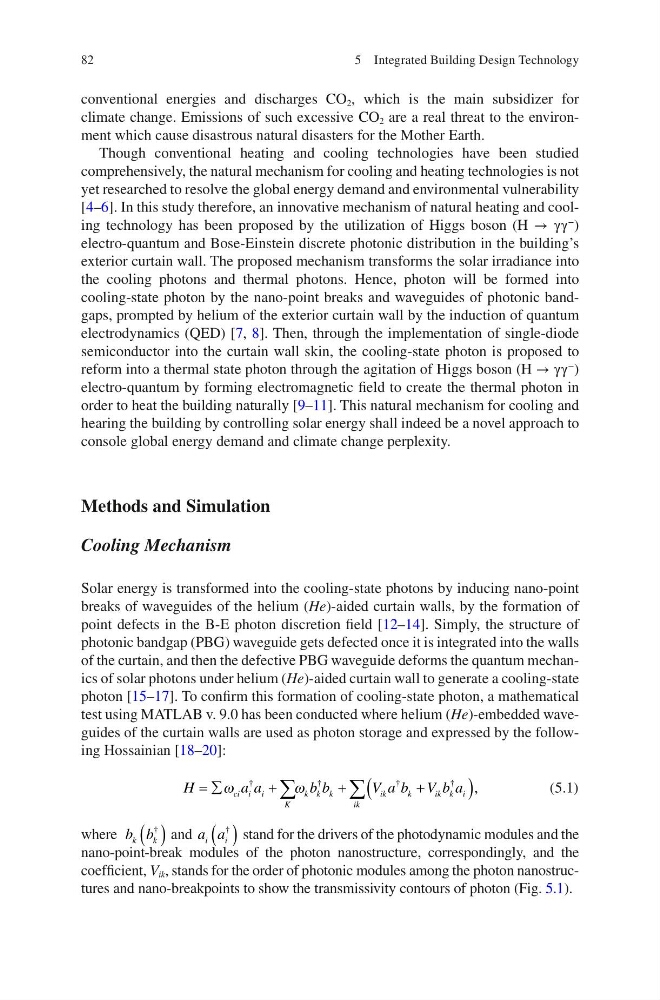
test using MATLAB v. 9.0 has been conducted where helium (He)-embedded waveguides of the curtain walls are used as photon storage and expressed by the following Hossainian [18–20]:
H
aa
bb
V a b V b a
ci i i
K
k k k
ik
ik
k
i k k i
= ∑
+
+
+
(
)
∑
∑
ω
ω
†
†
†
†
,
(5.1)
where b b
k
k
†
( ) and a a
i
i
†
( ) stand for the drivers of the photodynamic modules and the
nano-point-break modules of the photon nanostructure, correspondingly, and the
coefficient, V ik , stands for the order of photonic modules among the photon nanostructures and nano-breakpoints to show the transmissivity contours of photon (Fig. 5.1).
5 Integrated Building Design Technology
conventional energies and discharges CO 2 , which is the main subsidizer for
climate change. Emissions of such excessive CO 2 are a real threat to the environment which cause disastrous natural disasters for the Mother Earth.
Though conventional heating and cooling technologies have been studied
comprehensively, the natural mechanism for cooling and heating technologies is not
yet researched to resolve the global energy demand and environmental vulnerability
[4–6]. In this study therefore, an innovative mechanism of natural heating and cooling technology has been proposed by the utilization of Higgs boson (H → γγ
−
)
electro-quantum and Bose-Einstein discrete photonic distribution in the building’s
exterior curtain wall. The proposed mechanism transforms the solar irradiance into
the cooling photons and thermal photons. Hence, photon will be formed into
cooling- state photon by the nano-point breaks and waveguides of photonic bandgaps, prompted by helium of the exterior curtain wall by the induction of quantum
electrodynamics (QED) [7, 8]. Then, through the implementation of single-diode
semiconductor into the curtain wall skin, the cooling-state photon is proposed to
reform into a thermal state photon through the agitation of Higgs boson (H → γγ
−
)
electro-quantum by forming electromagnetic field to create the thermal photon in
order to heat the building naturally [9–11]. This natural mechanism for cooling and
hearing the building by controlling solar energy shall indeed be a novel approach to
console global energy demand and climate change perplexity.
Methods and Simulation
Cooling Mechanism
Solar energy is transformed into the cooling-state photons by inducing nano-point
breaks of waveguides of the helium (He)-aided curtain walls, by the formation of
point defects in the B-E photon discretion field [12–14]. Simply, the structure of
photonic bandgap (PBG) waveguide gets defected once it is integrated into the walls
of the curtain, and then the defective PBG waveguide deforms the quantum mechanics of solar photons under helium (He)-aided curtain wall to generate a cooling-state
photon [15–17]. To confirm this formation of cooling-state photon, a mathematical
test using MATLAB v. 9.0 has been conducted where helium (He)-embedded waveguides of the curtain walls are used as photon storage and expressed by the following Hossainian [18–20]:
H
aa
bb
V a b V b a
ci i i
K
k k k
ik
ik
k
i k k i
= ∑
+
+
+
(
)
∑
∑
ω
ω
†
†
†
†
,
(5.1)
where b b
k
k
†
( ) and a a
i
i
†
( ) stand for the drivers of the photodynamic modules and the
nano-point-break modules of the photon nanostructure, correspondingly, and the
coefficient, V ik , stands for the order of photonic modules among the photon nanostructures and nano-breakpoints to show the transmissivity contours of photon (Fig. 5.1).
5 Integrated Building Design Technology