

51
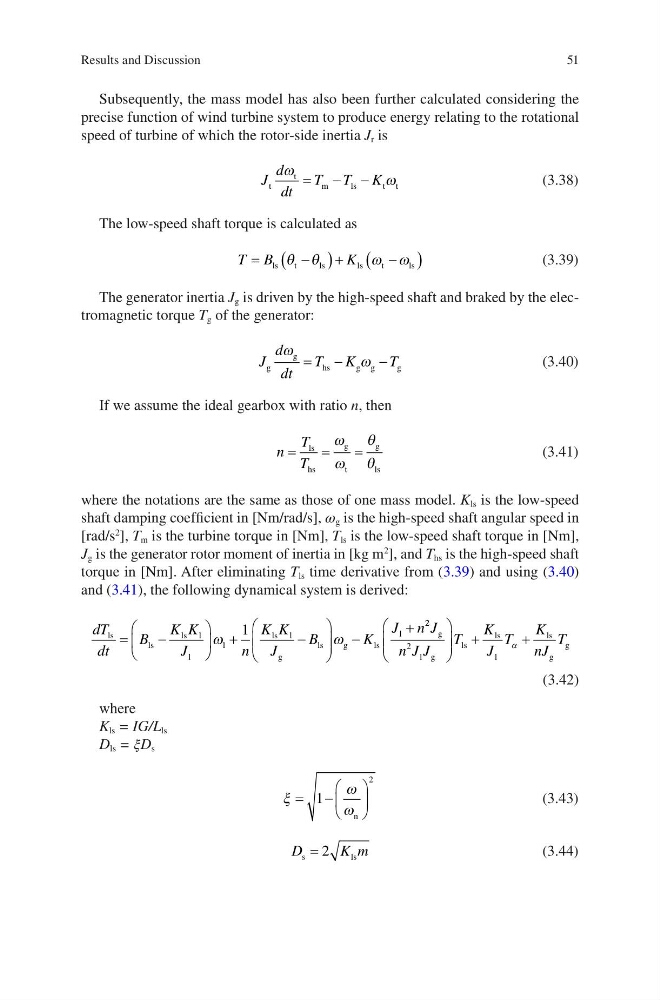
Subsequently, the mass model has also been further calculated considering the
precise function of wind turbine system to produce energy relating to the rotational
speed of turbine of which the rotor-side inertia J r is
J
d
dt
T T K
t
t
m
l s
t t
ω
ω
= − −
(3.38)
The low-speed shaft torque is calculated as
T B
K
=
−
(
)+
−
(
)
ls
t
l s
l s
t
ls
θ θ
ω ω
(3.39)
The generator inertia J g is driven by the high-speed shaft and braked by the electromagnetic torque T g of the generator:
J
d
dt
T K
T
g
g
hs
g g
g
ω
ω
= −
−
(3.40)
If we assume the ideal gearbox with ratio n, then
n
T
T
=
=
=
ls
hs
g
t
g
ls
ω
ω
θ
θ
(3.41)
where the notations are the same as those of one mass model. K ls is the low-speed
shaft damping coefficient in [Nm/rad/s], ω g is the high-speed shaft angular speed in
[rad/s
2
], T m is the turbine torque in [Nm], T ls is the low-speed shaft torque in [Nm],
J g is the generator rotor moment of inertia in [kg m
2
], and T hs is the high-speed shaft
torque in [Nm]. After eliminating T ls time derivative from (3.39) and using (3.40)
and (3.41), the following dynamical system is derived:
dT
dt
B
K K
J
n
K K
J
B
K
J n
ls
ls
ls l
l
l
ls l
g
ls
g
l s
l
=
−
+
−
−
+
ω
ω
1
2 2
2
J
n J J
T
K
J
T
K
nJ
T
g
l g
ls
ls
l
ls
g
g
+
+
α
(3.42)
where
K ls = IG/L ls
D ls = ξD s
ξ
ω
ω
= −
1
2
n
(3.43)
D
K m
s
l s
= 2
(3.44)
Results and Discussion
Subsequently, the mass model has also been further calculated considering the
precise function of wind turbine system to produce energy relating to the rotational
speed of turbine of which the rotor-side inertia J r is
J
d
dt
T T K
t
t
m
l s
t t
ω
ω
= − −
(3.38)
The low-speed shaft torque is calculated as
T B
K
=
−
(
)+
−
(
)
ls
t
l s
l s
t
ls
θ θ
ω ω
(3.39)
The generator inertia J g is driven by the high-speed shaft and braked by the electromagnetic torque T g of the generator:
J
d
dt
T K
T
g
g
hs
g g
g
ω
ω
= −
−
(3.40)
If we assume the ideal gearbox with ratio n, then
n
T
T
=
=
=
ls
hs
g
t
g
ls
ω
ω
θ
θ
(3.41)
where the notations are the same as those of one mass model. K ls is the low-speed
shaft damping coefficient in [Nm/rad/s], ω g is the high-speed shaft angular speed in
[rad/s
2
], T m is the turbine torque in [Nm], T ls is the low-speed shaft torque in [Nm],
J g is the generator rotor moment of inertia in [kg m
2
], and T hs is the high-speed shaft
torque in [Nm]. After eliminating T ls time derivative from (3.39) and using (3.40)
and (3.41), the following dynamical system is derived:
dT
dt
B
K K
J
n
K K
J
B
K
J n
ls
ls
ls l
l
l
ls l
g
ls
g
l s
l
=
−
+
−
−
+
ω
ω
1
2 2
2
J
n J J
T
K
J
T
K
nJ
T
g
l g
ls
ls
l
ls
g
g
+
+
α
(3.42)
where
K ls = IG/L ls
D ls = ξD s
ξ
ω
ω
= −
1
2
n
(3.43)
D
K m
s
l s
= 2
(3.44)
Results and Discussion