

44
T T
G
c
a
t
NOCT
= +
−
20
800
(3.5)
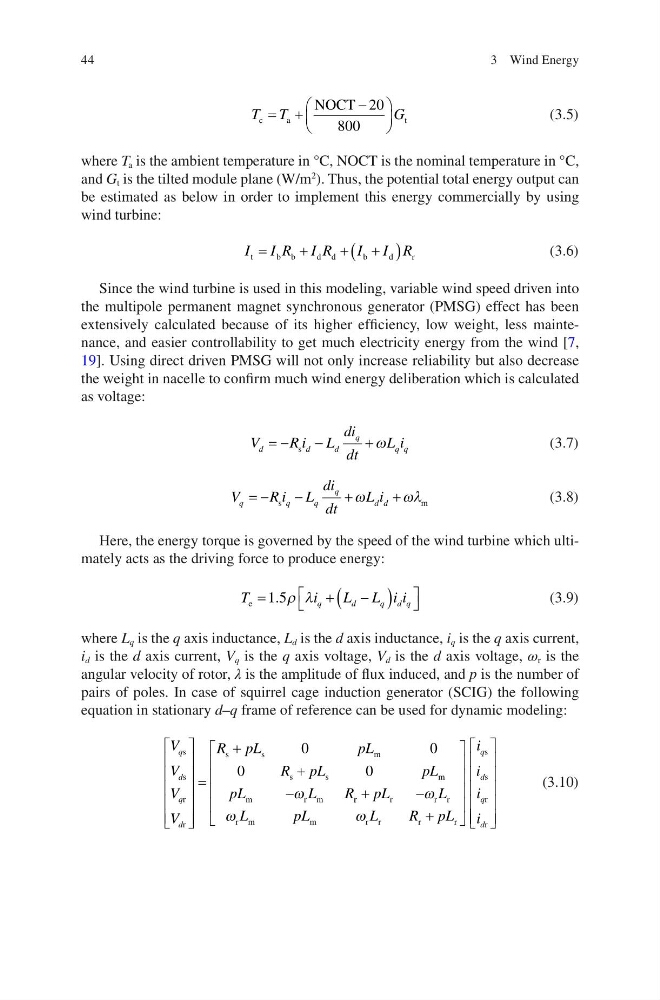
where T a is the ambient temperature in °C, NOCT is the nominal temperature in °C,
and G t is the tilted module plane (W/m
2
). Thus, the potential total energy output can
be estimated as below in order to implement this energy commercially by using
wind turbine:
I I R I R
I I R
t
b b
d d
b
d
r
=
+
+
+
(
)
(3.6)
Since the wind turbine is used in this modeling, variable wind speed driven into
the multipole permanent magnet synchronous generator (PMSG) effect has been
extensively calculated because of its higher efficiency, low weight, less maintenance, and easier controllability to get much electricity energy from the wind [7,
19]. Using direct driven PMSG will not only increase reliability but also decrease
the weight in nacelle to confirm much wind energy deliberation which is calculated
as voltage:
V
Ri L
di
dt
L i
d
d
d
q
q q
= −
−
+
s
ω
(3.7)
V
Ri L
di
dt
L i
q
q
q
q
d d
= −
−
+
+
s
m
ω
ωλ
(3.8)
Here, the energy torque is governed by the speed of the wind turbine which ultimately acts as the driving force to produce energy:
T
i
L L i i
q
d
q d q
e =
+
−
(
)
1 5
. ρ λ
(3.9)
where L q is the q axis inductance, L d is the d axis inductance, i q is the q axis current,
i d is the d axis current, V q is the q axis voltage, V d is the d axis voltage, ω r is the
angular velocity of rotor, λ is the amplitude of flux induced, and p is the number of
pairs of poles. In case of squirrel cage induction generator (SCIG) the following
equation in stationary d–q frame of reference can be used for dynamic modeling:
V
V
V
V
R pL
p L
R pL
p L
pL
L
R
q
d
q
d
s
s
r
r
s
s
m
s
s
m
m
rm
=
+
+
−
0
0
0
0
ω
r r
r
r r
r m
m
r r
r
r
s
s
r
r
+
−
+
pL
L
L
p L
L
R pL
i
i
i
i
q
d
q
d
ω
ω
ω
(3.10)
3 Wind Energy
T T
G
c
a
t
NOCT
= +
−
20
800
(3.5)
where T a is the ambient temperature in °C, NOCT is the nominal temperature in °C,
and G t is the tilted module plane (W/m
2
). Thus, the potential total energy output can
be estimated as below in order to implement this energy commercially by using
wind turbine:
I I R I R
I I R
t
b b
d d
b
d
r
=
+
+
+
(
)
(3.6)
Since the wind turbine is used in this modeling, variable wind speed driven into
the multipole permanent magnet synchronous generator (PMSG) effect has been
extensively calculated because of its higher efficiency, low weight, less maintenance, and easier controllability to get much electricity energy from the wind [7,
19]. Using direct driven PMSG will not only increase reliability but also decrease
the weight in nacelle to confirm much wind energy deliberation which is calculated
as voltage:
V
Ri L
di
dt
L i
d
d
d
q
q q
= −
−
+
s
ω
(3.7)
V
Ri L
di
dt
L i
q
q
q
q
d d
= −
−
+
+
s
m
ω
ωλ
(3.8)
Here, the energy torque is governed by the speed of the wind turbine which ultimately acts as the driving force to produce energy:
T
i
L L i i
q
d
q d q
e =
+
−
(
)
1 5
. ρ λ
(3.9)
where L q is the q axis inductance, L d is the d axis inductance, i q is the q axis current,
i d is the d axis current, V q is the q axis voltage, V d is the d axis voltage, ω r is the
angular velocity of rotor, λ is the amplitude of flux induced, and p is the number of
pairs of poles. In case of squirrel cage induction generator (SCIG) the following
equation in stationary d–q frame of reference can be used for dynamic modeling:
V
V
V
V
R pL
p L
R pL
p L
pL
L
R
q
d
q
d
s
s
r
r
s
s
m
s
s
m
m
rm
=
+
+
−
0
0
0
0
ω
r r
r
r r
r m
m
r r
r
r
s
s
r
r
+
−
+
pL
L
L
p L
L
R pL
i
i
i
i
q
d
q
d
ω
ω
ω
(3.10)
3 Wind Energy