

43
Materials and Simulation
Since wind energy is the kinetic energy of air in motion, the kinetic energy of the air
of mass m is calculated here with its velocity v which is governed by ½mv
2
. To
determine the mass of the air passing through any area A perpendicular to its velocity, it is multiplied by its volume considering the time t within the air density ρ,
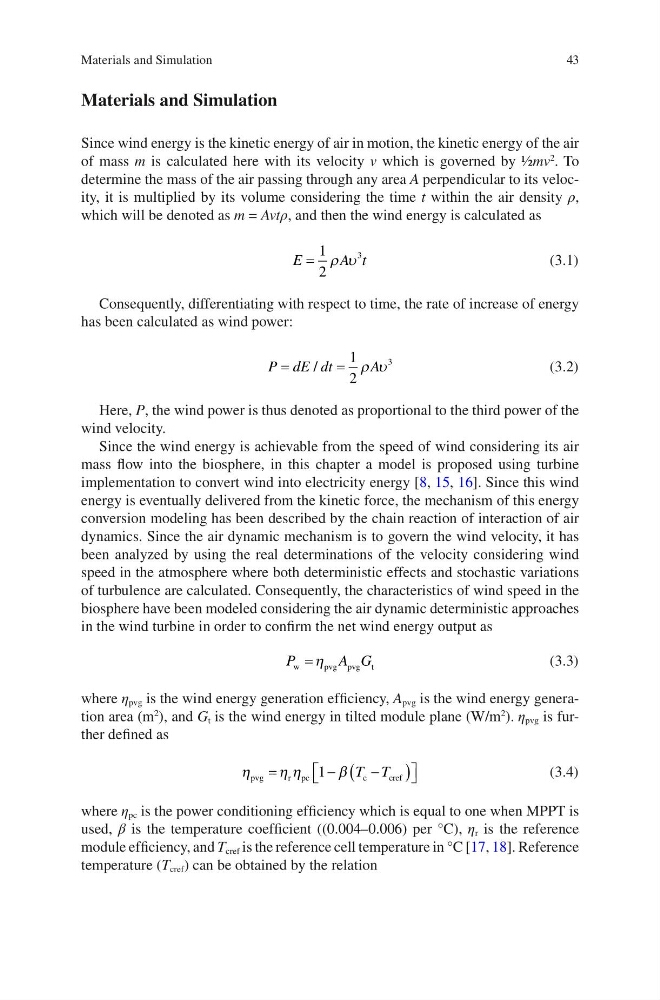
which will be denoted as m = Avtρ, and then the wind energy is calculated as
E
A t
=
1
2
3
ρ υ
(3.1)
Consequently, differentiating with respect to time, the rate of increase of energy
has been calculated as wind power:
P dE dt
A
=
=
/
1
2
3
ρ υ
(3.2)
Here, P, the wind power is thus denoted as proportional to the third power of the
wind velocity.
Since the wind energy is achievable from the speed of wind considering its air
mass flow into the biosphere, in this chapter a model is proposed using turbine
implementation to convert wind into electricity energy [8, 15, 16]. Since this wind
energy is eventually delivered from the kinetic force, the mechanism of this energy
conversion modeling has been described by the chain reaction of interaction of air
dynamics. Since the air dynamic mechanism is to govern the wind velocity, it has
been analyzed by using the real determinations of the velocity considering wind
speed in the atmosphere where both deterministic effects and stochastic variations
of turbulence are calculated. Consequently, the characteristics of wind speed in the
biosphere have been modeled considering the air dynamic deterministic approaches
in the wind turbine in order to confirm the net wind energy output as
P
A G
w
pvg pvg t
= η
(3.3)
where η pvg is the wind energy generation efficiency, A pvg is the wind energy generation area (m
2
), and G t is the wind energy in tilted module plane (W/m
2
). η pvg is further defined as
η
ηη
β
pvg
r pc
c
cref
=
−
−
(
)
1
T T
(3.4)
where η pc is the power conditioning efficiency which is equal to one when MPPT is
used, β is the temperature coefficient ((0.004–0.006) per °C), η r is the reference
module efficiency, and T cref is the reference cell temperature in °C [17, 18]. Reference
temperature (T cref ) can be obtained by the relation
Materials and Simulation
Materials and Simulation
Since wind energy is the kinetic energy of air in motion, the kinetic energy of the air
of mass m is calculated here with its velocity v which is governed by ½mv
2
. To
determine the mass of the air passing through any area A perpendicular to its velocity, it is multiplied by its volume considering the time t within the air density ρ,
which will be denoted as m = Avtρ, and then the wind energy is calculated as
E
A t
=
1
2
3
ρ υ
(3.1)
Consequently, differentiating with respect to time, the rate of increase of energy
has been calculated as wind power:
P dE dt
A
=
=
/
1
2
3
ρ υ
(3.2)
Here, P, the wind power is thus denoted as proportional to the third power of the
wind velocity.
Since the wind energy is achievable from the speed of wind considering its air
mass flow into the biosphere, in this chapter a model is proposed using turbine
implementation to convert wind into electricity energy [8, 15, 16]. Since this wind
energy is eventually delivered from the kinetic force, the mechanism of this energy
conversion modeling has been described by the chain reaction of interaction of air
dynamics. Since the air dynamic mechanism is to govern the wind velocity, it has
been analyzed by using the real determinations of the velocity considering wind
speed in the atmosphere where both deterministic effects and stochastic variations
of turbulence are calculated. Consequently, the characteristics of wind speed in the
biosphere have been modeled considering the air dynamic deterministic approaches
in the wind turbine in order to confirm the net wind energy output as
P
A G
w
pvg pvg t
= η
(3.3)
where η pvg is the wind energy generation efficiency, A pvg is the wind energy generation area (m
2
), and G t is the wind energy in tilted module plane (W/m
2
). η pvg is further defined as
η
ηη
β
pvg
r pc
c
cref
=
−
−
(
)
1
T T
(3.4)
where η pc is the power conditioning efficiency which is equal to one when MPPT is
used, β is the temperature coefficient ((0.004–0.006) per °C), η r is the reference
module efficiency, and T cref is the reference cell temperature in °C [17, 18]. Reference
temperature (T cref ) can be obtained by the relation
Materials and Simulation