

34
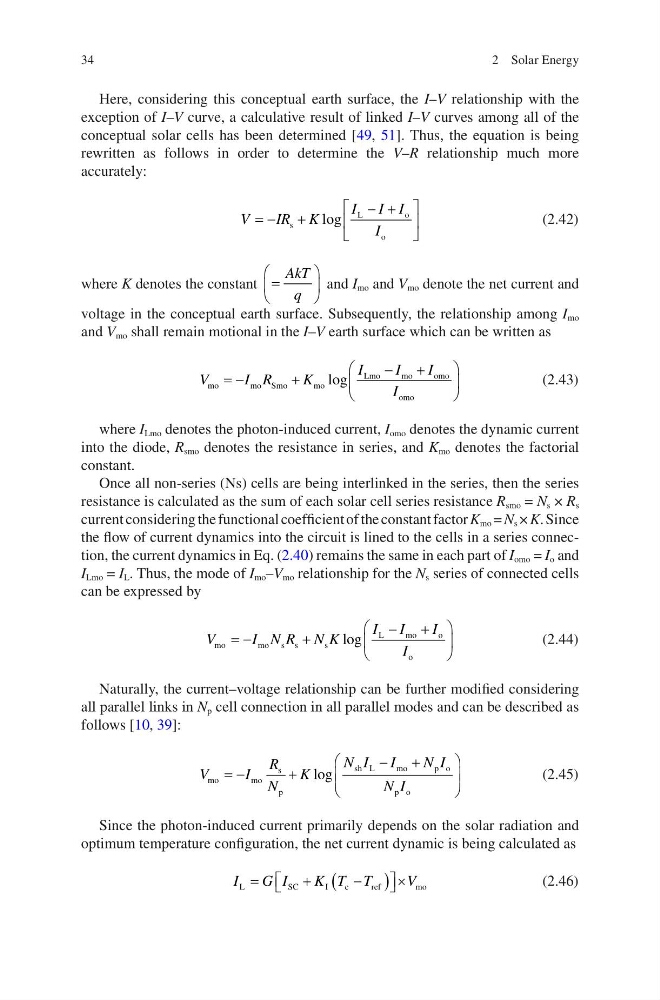
Here, considering this conceptual earth surface, the I–V relationship with the
exception of I–V curve, a calculative result of linked I–V curves among all of the
conceptual solar cells has been determined [49, 51]. Thus, the equation is being
rewritten as follows in order to determine the V–R relationship much more
accurately:
V
IR K
I I I
I
ª
¬
«
º
¼
»
s
L
o
o
log
(2.42)
where K denotes the constant
§
©
¨
·
¹
¸
AkT
q
and I mo and V mo denote the net current and
voltage in the conceptual earth surface. Subsequently, the relationship among I mo
and V mo shall remain motional in the I–V earth surface which can be written as
V
I R
K
I
I
I
I
mo
mo Smo
m o
Lmo
m o
o mo
omo
§
©
¨
·
¹
¸
log
(2.43)
where I Lmo denotes the photon-induced current, I omo denotes the dynamic current
into the diode, R smo denotes the resistance in series, and K mo denotes the factorial
constant.
Once all non-series (Ns) cells are being interlinked in the series, then the series
resistance is calculated as the sum of each solar cell series resistance R smo = N s × R s
current considering the functional coefficient of the constant factor K mo = N s × K. Since
the flow of current dynamics into the circuit is lined to the cells in a series connection, the current dynamics in Eq. (2.40) remains the same in each part of I omo = I o and
I Lmo = I L . Thus, the mode of I mo –V mo relationship for the N s series of connected cells
can be expressed by
V
I N R N K
I I
I
I
mo
mo s s
s
L
m o
o
o
§
©
¨
·
¹
¸
log
(2.44)
Naturally, the current–voltage relationship can be further modified considering
all parallel links in N p cell connection in all parallel modes and can be described as
follows [10, 39]:
V
I
R
N
K
N I I
N I
N I
mo
mo
s
p
sh L
m o
p o
p o
§
©
¨ ¨
·
¹
¸ ¸
log
(2.45)
Since the photon-induced current primarily depends on the solar radiation and
optimum temperature configuration, the net current dynamic is being calculated as
I
G I
K T T
V
L
S C
I
c
r ef
mo
ª ¬
º ¼ u
(2.46)
2 Solar Energy
Here, considering this conceptual earth surface, the I–V relationship with the
exception of I–V curve, a calculative result of linked I–V curves among all of the
conceptual solar cells has been determined [49, 51]. Thus, the equation is being
rewritten as follows in order to determine the V–R relationship much more
accurately:
V
IR K
I I I
I
ª
¬
«
º
¼
»
s
L
o
o
log
(2.42)
where K denotes the constant
§
©
¨
·
¹
¸
AkT
q
and I mo and V mo denote the net current and
voltage in the conceptual earth surface. Subsequently, the relationship among I mo
and V mo shall remain motional in the I–V earth surface which can be written as
V
I R
K
I
I
I
I
mo
mo Smo
m o
Lmo
m o
o mo
omo
§
©
¨
·
¹
¸
log
(2.43)
where I Lmo denotes the photon-induced current, I omo denotes the dynamic current
into the diode, R smo denotes the resistance in series, and K mo denotes the factorial
constant.
Once all non-series (Ns) cells are being interlinked in the series, then the series
resistance is calculated as the sum of each solar cell series resistance R smo = N s × R s
current considering the functional coefficient of the constant factor K mo = N s × K. Since
the flow of current dynamics into the circuit is lined to the cells in a series connection, the current dynamics in Eq. (2.40) remains the same in each part of I omo = I o and
I Lmo = I L . Thus, the mode of I mo –V mo relationship for the N s series of connected cells
can be expressed by
V
I N R N K
I I
I
I
mo
mo s s
s
L
m o
o
o
§
©
¨
·
¹
¸
log
(2.44)
Naturally, the current–voltage relationship can be further modified considering
all parallel links in N p cell connection in all parallel modes and can be described as
follows [10, 39]:
V
I
R
N
K
N I I
N I
N I
mo
mo
s
p
sh L
m o
p o
p o
§
©
¨ ¨
·
¹
¸ ¸
log
(2.45)
Since the photon-induced current primarily depends on the solar radiation and
optimum temperature configuration, the net current dynamic is being calculated as
I
G I
K T T
V
L
S C
I
c
r ef
mo
ª ¬
º ¼ u
(2.46)
2 Solar Energy