

33
m
t n J
t
t
v t t
t
m
n
m
||
||
e
,
U
Z
D
D
D
ª ¬
º ¼
ª ¬
º ¼
ª ¬
º ¼
:
0
2
1
n n
k
m n
k
m n
m k n k k
v t t
t
^ `
ª
¬
«
«
º
¼
»
»
¦
1
0
0
2
min
! !
!
! !
,
,
: D
(2.39)
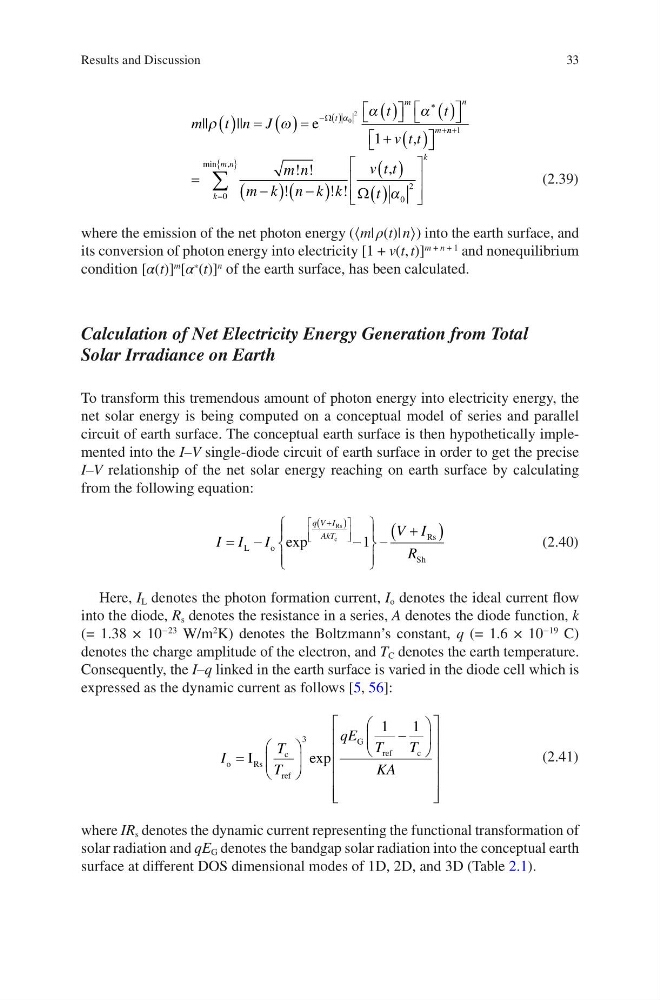
where the emission of the net photon energy (⟨m| ρ(t)| n⟩) into the earth surface, and
its conversion of photon energy into electricity [1 + v(t, t)]
m + n + 1
and nonequilibrium
condition [α(t)]
m
[α
∗
(t)]
n
of the earth surface, has been calculated.
Calculation of Net Electricity Energy Generation from Total
Solar Irradiance on Earth
To transform this tremendous amount of photon energy into electricity energy, the
net solar energy is being computed on a conceptual model of series and parallel
circuit of earth surface. The conceptual earth surface is then hypothetically implemented into the I–V single-diode circuit of earth surface in order to get the precise
I–V relationship of the net solar energy reaching on earth surface by calculating
from the following equation:
I I I
V I
R
q V I
AkT
®
°
¯ °
½
¾
°
¿ °
ª
¬
«
«
º
¼
»
»
L
o
Rs
Sh
Rs
c
exp
1
(2.40)
Here, I L denotes the photon formation current, I o denotes the ideal current flow
into the diode, R s denotes the resistance in a series, A denotes the diode function, k
(= 1.38 × 10
−23
W/m
2
K) denotes the Boltzmann’s constant, q (= 1.6 × 10
−19
C)
denotes the charge amplitude of the electron, and T C denotes the earth temperature.
Consequently, the I–q linked in the earth surface is varied in the diode cell which is
expressed as the dynamic current as follows [5, 56]:
I
T
T
qE T
T
KA
o
R s
c
ref
G
ref
c
I
§
©
¨
·
¹
¸
§
©
¨
·
¹
¸
ª
¬
«
«
«
«
«
º
¼
»
»
»
»
»
3
1
1
exp
(2.41)
where IR s denotes the dynamic current representing the functional transformation of
solar radiation and qE G denotes the bandgap solar radiation into the conceptual earth
surface at different DOS dimensional modes of 1D, 2D, and 3D (Table 2.1).
Results and Discussion
m
t n J
t
t
v t t
t
m
n
m
||
||
e
,
U
Z
D
D
D
ª ¬
º ¼
ª ¬
º ¼
ª ¬
º ¼
:
0
2
1
n n
k
m n
k
m n
m k n k k
v t t
t
^ `
ª
¬
«
«
º
¼
»
»
¦
1
0
0
2
min
! !
!
! !
,
,
: D
(2.39)
where the emission of the net photon energy (⟨m| ρ(t)| n⟩) into the earth surface, and
its conversion of photon energy into electricity [1 + v(t, t)]
m + n + 1
and nonequilibrium
condition [α(t)]
m
[α
∗
(t)]
n
of the earth surface, has been calculated.
Calculation of Net Electricity Energy Generation from Total
Solar Irradiance on Earth
To transform this tremendous amount of photon energy into electricity energy, the
net solar energy is being computed on a conceptual model of series and parallel
circuit of earth surface. The conceptual earth surface is then hypothetically implemented into the I–V single-diode circuit of earth surface in order to get the precise
I–V relationship of the net solar energy reaching on earth surface by calculating
from the following equation:
I I I
V I
R
q V I
AkT
®
°
¯ °
½
¾
°
¿ °
ª
¬
«
«
º
¼
»
»
L
o
Rs
Sh
Rs
c
exp
1
(2.40)
Here, I L denotes the photon formation current, I o denotes the ideal current flow
into the diode, R s denotes the resistance in a series, A denotes the diode function, k
(= 1.38 × 10
−23
W/m
2
K) denotes the Boltzmann’s constant, q (= 1.6 × 10
−19
C)
denotes the charge amplitude of the electron, and T C denotes the earth temperature.
Consequently, the I–q linked in the earth surface is varied in the diode cell which is
expressed as the dynamic current as follows [5, 56]:
I
T
T
qE T
T
KA
o
R s
c
ref
G
ref
c
I
§
©
¨
·
¹
¸
§
©
¨
·
¹
¸
ª
¬
«
«
«
«
«
º
¼
»
»
»
»
»
3
1
1
exp
(2.41)
where IR s denotes the dynamic current representing the functional transformation of
solar radiation and qE G denotes the bandgap solar radiation into the conceptual earth
surface at different DOS dimensional modes of 1D, 2D, and 3D (Table 2.1).
Results and Discussion