

399
fluoxetine, norfluoxetine, triclosan, ofloxacin, and ciprofloxacin have been found to
be within the particulate phase of influent wastewater at significant concentrations
(>20% of the total concentration). Consequently, particulate-phase determination is
necessary to correctly report influent concentration for some chemicals. This is also
essential for back calculations of population usage by wastewater-based epidemiology [28, 29]. Partitioning of ECs to suspended matter in final effluents is even less
studied due to the very low solid concentrations encountered (typically 10–30 mg/L
for secondary processes). Nevertheless, some researchers found that the final effluent of secondary processes had >20% of the total triclosan, ofloxacin, and ciprofloxacin concentration to be within the particulate phase, despite very low suspended
solid concentrations. Particulate-phase concentrations were equivalent to, and in the
range of, 26–296 ng/L, respectively. This provides a route for their release into the
environment which goes unmonitored and the environmental fate of these particulate-bound chemicals is unknown.
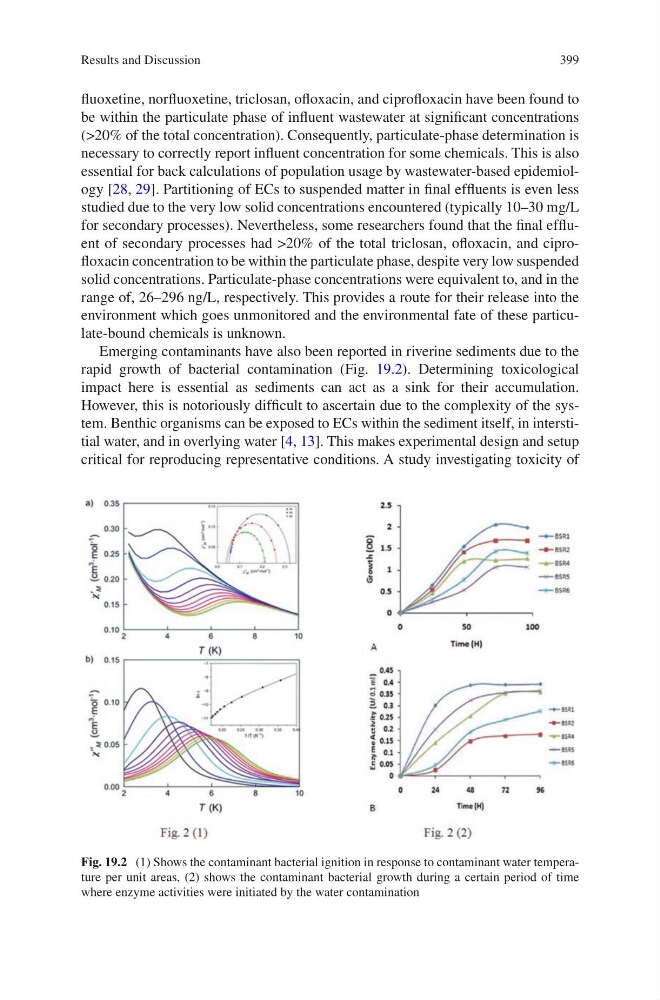
Emerging contaminants have also been reported in riverine sediments due to the
rapid growth of bacterial contamination (Fig. 19.2). Determining toxicological
impact here is essential as sediments can act as a sink for their accumulation.
However, this is notoriously difficult to ascertain due to the complexity of the system. Benthic organisms can be exposed to ECs within the sediment itself, in interstitial water, and in overlying water [4, 13]. This makes experimental design and setup
critical for reproducing representative conditions. A study investigating toxicity of
Fig. 19.2 (1) Shows the contaminant bacterial ignition in response to contaminant water temperature per unit areas, (2) shows the contaminant bacterial growth during a certain period of time
where enzyme activities were initiated by the water contamination
Results and Discussion
fluoxetine, norfluoxetine, triclosan, ofloxacin, and ciprofloxacin have been found to
be within the particulate phase of influent wastewater at significant concentrations
(>20% of the total concentration). Consequently, particulate-phase determination is
necessary to correctly report influent concentration for some chemicals. This is also
essential for back calculations of population usage by wastewater-based epidemiology [28, 29]. Partitioning of ECs to suspended matter in final effluents is even less
studied due to the very low solid concentrations encountered (typically 10–30 mg/L
for secondary processes). Nevertheless, some researchers found that the final effluent of secondary processes had >20% of the total triclosan, ofloxacin, and ciprofloxacin concentration to be within the particulate phase, despite very low suspended
solid concentrations. Particulate-phase concentrations were equivalent to, and in the
range of, 26–296 ng/L, respectively. This provides a route for their release into the
environment which goes unmonitored and the environmental fate of these particulate-bound chemicals is unknown.
Emerging contaminants have also been reported in riverine sediments due to the
rapid growth of bacterial contamination (Fig. 19.2). Determining toxicological
impact here is essential as sediments can act as a sink for their accumulation.
However, this is notoriously difficult to ascertain due to the complexity of the system. Benthic organisms can be exposed to ECs within the sediment itself, in interstitial water, and in overlying water [4, 13]. This makes experimental design and setup
critical for reproducing representative conditions. A study investigating toxicity of
Fig. 19.2 (1) Shows the contaminant bacterial ignition in response to contaminant water temperature per unit areas, (2) shows the contaminant bacterial growth during a certain period of time
where enzyme activities were initiated by the water contamination
Results and Discussion