

389
IPCC and considering the timescale for CFC penetration [14, 27]. This CO 2 sequestration value is comparable to that of 2.0 ± 0.5 GtC/year calculated for the 1990s
and 1.9–2.5 GtC/year for 1990–2009 [18, 21] with a ±0.3 to ±0.7 GtC/year range of
uncertainty. Therefore, this method can accurately calculate observation-based
ocean sequestration by implementing the sea-air pCO 2 (sea-air pCO 2 variable) × (gas
transfer coefficient), and the results are completely consistent with the observed
results [21, 34].
Ultimately, the calculation shows that residual terrestrial CO 2 sequestration
increased from 1.7 ± 0.7 GtC/year in the 1960s to 3.1 ± 0.9 GtC/year from 2006 to
2015 with an inter-annual variability of up to 2 GtC/year. It also indicates reduced
land sequestration during El Ni ˆ
n o and overaccumulation by ocean sequestration,
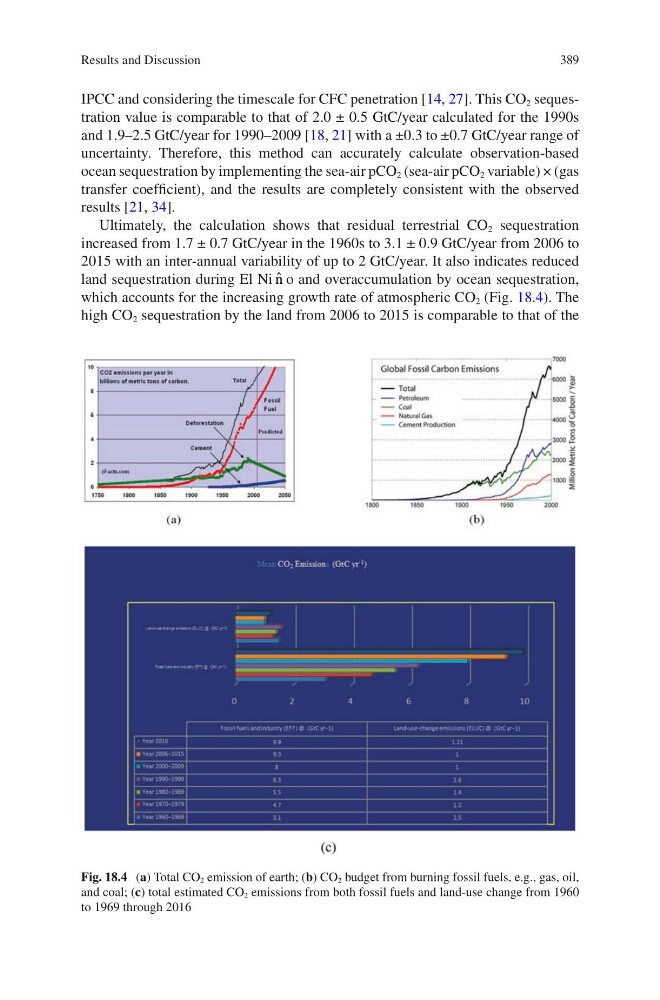
which accounts for the increasing growth rate of atmospheric CO 2 (Fig. 18.4). The
high CO 2 sequestration by the land from 2006 to 2015 is comparable to that of the
Fig. 18.4 (a) Total CO 2 emission of earth; (b) CO 2 budget from burning fossil fuels, e.g., gas, oil,
and coal; (c) total estimated CO 2 emissions from both fossil fuels and land-use change from 1960
to 1969 through 2016
Results and Discussion
IPCC and considering the timescale for CFC penetration [14, 27]. This CO 2 sequestration value is comparable to that of 2.0 ± 0.5 GtC/year calculated for the 1990s
and 1.9–2.5 GtC/year for 1990–2009 [18, 21] with a ±0.3 to ±0.7 GtC/year range of
uncertainty. Therefore, this method can accurately calculate observation-based
ocean sequestration by implementing the sea-air pCO 2 (sea-air pCO 2 variable) × (gas
transfer coefficient), and the results are completely consistent with the observed
results [21, 34].
Ultimately, the calculation shows that residual terrestrial CO 2 sequestration
increased from 1.7 ± 0.7 GtC/year in the 1960s to 3.1 ± 0.9 GtC/year from 2006 to
2015 with an inter-annual variability of up to 2 GtC/year. It also indicates reduced
land sequestration during El Ni ˆ
n o and overaccumulation by ocean sequestration,
which accounts for the increasing growth rate of atmospheric CO 2 (Fig. 18.4). The
high CO 2 sequestration by the land from 2006 to 2015 is comparable to that of the
Fig. 18.4 (a) Total CO 2 emission of earth; (b) CO 2 budget from burning fossil fuels, e.g., gas, oil,
and coal; (c) total estimated CO 2 emissions from both fossil fuels and land-use change from 1960
to 1969 through 2016
Results and Discussion