

366
concern about the massive urbanization has increased due to the limitations of urban
mobility, as well as the urban’s finite ability to absorb habitants due to the flocking
of the citizens into the urban area. The urban area covers 3% of the world’s land
surface and the vast land on earth surface remains uninhabited which is still having
less pollution in air and environment [7, 8]. Simply, if a rapid communication within
the urban and rural area is developed in order to help people work in urban area from
rural area by employing advanced connectivity technology, it will indeed keep the
urban environment physically, chemically, biologically, and environmentally balanced. The recent study suggested that the urban transportation infrastructure consumes 1% of the earth surface which is nearly 1/3 of the total urban area and made
the urban system terribly congested causing severe environmental perplexity [9–11].
To address this severe connectivity problem, the high-speed flying train technology
would be an innovative transportation technology which will conveniently transport
the people from rural to urban and urban to rural area and thus in this study a model
of computational 3D numerical simulation for a flying train has been presented considering the implementation of 3D k-omega aerodynamic impact during the takeoff,
landing, and flying stage of the train. Subsequently, the numerical aspect comprises
its Reynolds-averaged Navier–Stokes (RANS) mechanism that has been analyzed in
order to confirm that this flying train is highly safe during the takeoff, landing, and
flying stage. This study, thus, aims to introduce a 3D numerical simulation of propulsive and impulsive force, and its 3D k-omega mechanism to address the aerodynamics of takeoff, landing, and flying velocity to confirm that the performance of
the flying train is perfect enough to travel smoothly.
Methods and Materials
In order to design a high-speed flying train, initially the guideway model system
has been conducted by adopting Bernoulli-Euler equation to confirm a safe takeoff
and landing of the high-speed flying train considering the levitation and lateral force
control (Fig. 17.1).
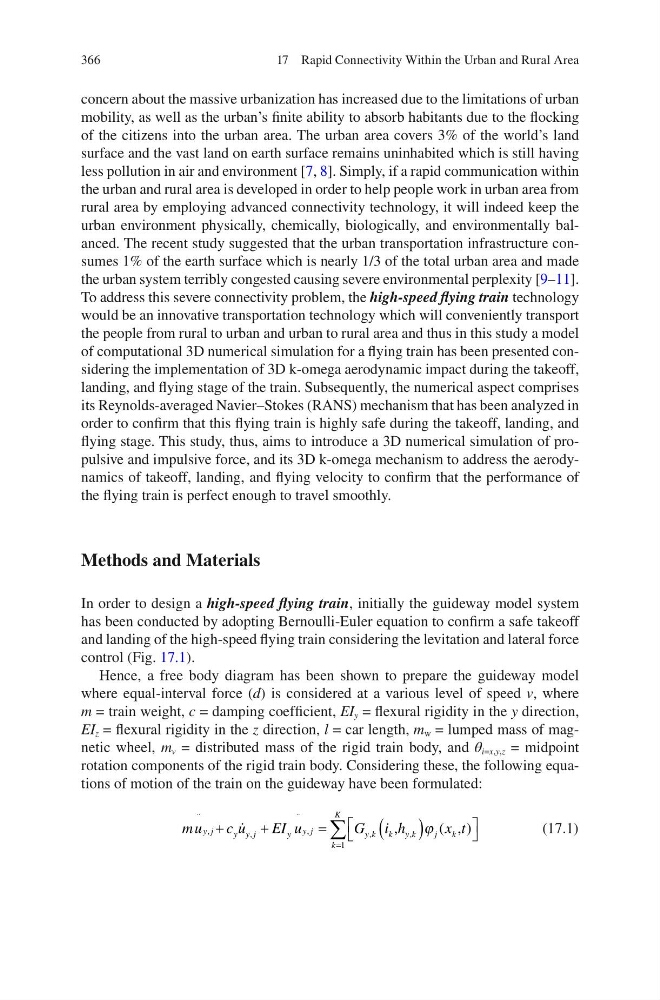
Hence, a free body diagram has been shown to prepare the guideway model
where equal-interval force (d) is considered at a various level of speed v, where
m = train weight, c = damping coefficient, EI y = flexural rigidity in the y direction,
EI z = flexural rigidity in the z direction, l = car length, m w = lumped mass of magnetic wheel, m v = distributed mass of the rigid train body, and θ i=x,y,z = midpoint
rotation components of the rigid train body. Considering these, the following equations of motion of the train on the guideway have been formulated:
mu
c u
EI u
G i h
x t
y j
y y j
y y j
k
K
y k
k yk
j
k
¨
,
,
¨
,
,
,
( )
+
+
=
( )
=
∑
1
,
,
ϕ
(17.1)
17 Rapid Connectivity Within the Urban and Rural Area
concern about the massive urbanization has increased due to the limitations of urban
mobility, as well as the urban’s finite ability to absorb habitants due to the flocking
of the citizens into the urban area. The urban area covers 3% of the world’s land
surface and the vast land on earth surface remains uninhabited which is still having
less pollution in air and environment [7, 8]. Simply, if a rapid communication within
the urban and rural area is developed in order to help people work in urban area from
rural area by employing advanced connectivity technology, it will indeed keep the
urban environment physically, chemically, biologically, and environmentally balanced. The recent study suggested that the urban transportation infrastructure consumes 1% of the earth surface which is nearly 1/3 of the total urban area and made
the urban system terribly congested causing severe environmental perplexity [9–11].
To address this severe connectivity problem, the high-speed flying train technology
would be an innovative transportation technology which will conveniently transport
the people from rural to urban and urban to rural area and thus in this study a model
of computational 3D numerical simulation for a flying train has been presented considering the implementation of 3D k-omega aerodynamic impact during the takeoff,
landing, and flying stage of the train. Subsequently, the numerical aspect comprises
its Reynolds-averaged Navier–Stokes (RANS) mechanism that has been analyzed in
order to confirm that this flying train is highly safe during the takeoff, landing, and
flying stage. This study, thus, aims to introduce a 3D numerical simulation of propulsive and impulsive force, and its 3D k-omega mechanism to address the aerodynamics of takeoff, landing, and flying velocity to confirm that the performance of
the flying train is perfect enough to travel smoothly.
Methods and Materials
In order to design a high-speed flying train, initially the guideway model system
has been conducted by adopting Bernoulli-Euler equation to confirm a safe takeoff
and landing of the high-speed flying train considering the levitation and lateral force
control (Fig. 17.1).
Hence, a free body diagram has been shown to prepare the guideway model
where equal-interval force (d) is considered at a various level of speed v, where
m = train weight, c = damping coefficient, EI y = flexural rigidity in the y direction,
EI z = flexural rigidity in the z direction, l = car length, m w = lumped mass of magnetic wheel, m v = distributed mass of the rigid train body, and θ i=x,y,z = midpoint
rotation components of the rigid train body. Considering these, the following equations of motion of the train on the guideway have been formulated:
mu
c u
EI u
G i h
x t
y j
y y j
y y j
k
K
y k
k yk
j
k
¨
,
,
¨
,
,
,
( )
+
+
=
( )
=
∑
1
,
,
ϕ
(17.1)
17 Rapid Connectivity Within the Urban and Rural Area