

355
P
N N P
array
s p M
=
(16.15)
Naturally the movement of photon flux applied to the solar panel will be
activated by the photo-physical reactions to deliver energy-level charges [39, 40].
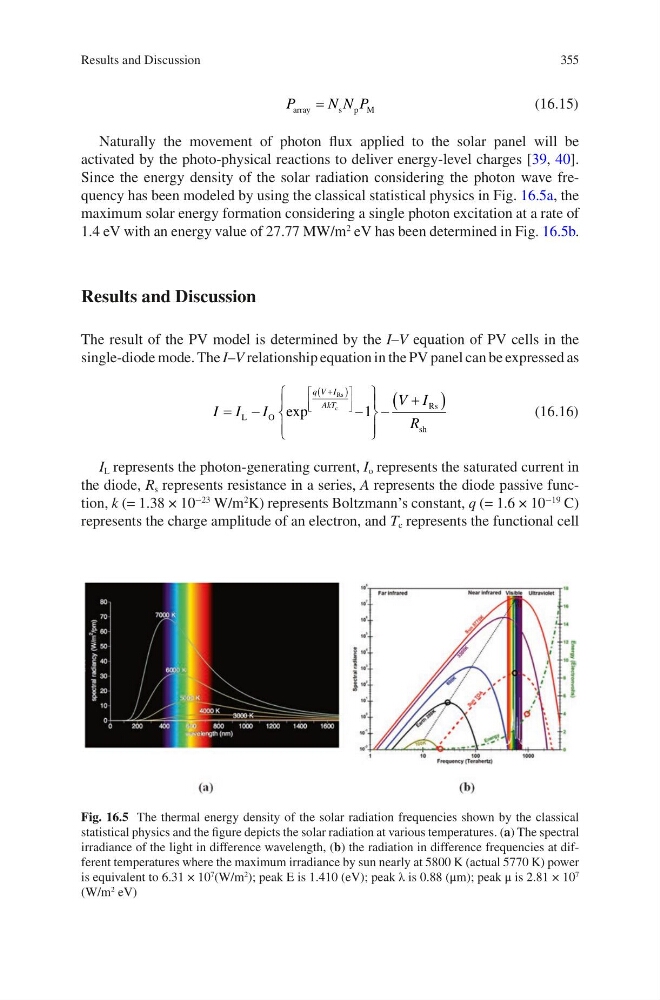
Since the energy density of the solar radiation considering the photon wave frequency has been modeled by using the classical statistical physics in Fig. 16.5a, the
maximum solar energy formation considering a single photon excitation at a rate of
1.4 eV with an energy value of 27.77 MW/m
2
eV has been determined in Fig. 16.5b.
Results and Discussion
The result of the PV model is determined by the I–V equation of PV cells in the
single-diode mode. The I–V relationship equation in the PV panel can be expressed as
I I I
V I
R
q V I
AkT
®
°
¯ °
½
¾
°
¿ °
ª
¬
«
«
º
¼
»
»
L
O
Rs
sh
Rs
c
exp
1
(16.16)
I L represents the photon-generating current, I o represents the saturated current in
the diode, R s represents resistance in a series, A represents the diode passive function, k (= 1.38 × 10
−23
W/m
2
K) represents Boltzmann’s constant, q (= 1.6 × 10
−19
C)
represents the charge amplitude of an electron, and T c represents the functional cell
Fig. 16.5 The thermal energy density of the solar radiation frequencies shown by the classical
statistical physics and the figure depicts the solar radiation at various temperatures. (a) The spectral
irradiance of the light in difference wavelength, (b) the radiation in difference frequencies at different temperatures where the maximum irradiance by sun nearly at 5800 K (actual 5770 K) power
is equivalent to 6.31 × 10
7 (W/m
2 ); peak E is 1.410 (eV); peak λ is 0.88 (μm); peak μ is 2.81 × 10
7
(W/m
2 eV)
Results and Discussion
P
N N P
array
s p M
=
(16.15)
Naturally the movement of photon flux applied to the solar panel will be
activated by the photo-physical reactions to deliver energy-level charges [39, 40].
Since the energy density of the solar radiation considering the photon wave frequency has been modeled by using the classical statistical physics in Fig. 16.5a, the
maximum solar energy formation considering a single photon excitation at a rate of
1.4 eV with an energy value of 27.77 MW/m
2
eV has been determined in Fig. 16.5b.
Results and Discussion
The result of the PV model is determined by the I–V equation of PV cells in the
single-diode mode. The I–V relationship equation in the PV panel can be expressed as
I I I
V I
R
q V I
AkT
®
°
¯ °
½
¾
°
¿ °
ª
¬
«
«
º
¼
»
»
L
O
Rs
sh
Rs
c
exp
1
(16.16)
I L represents the photon-generating current, I o represents the saturated current in
the diode, R s represents resistance in a series, A represents the diode passive function, k (= 1.38 × 10
−23
W/m
2
K) represents Boltzmann’s constant, q (= 1.6 × 10
−19
C)
represents the charge amplitude of an electron, and T c represents the functional cell
Fig. 16.5 The thermal energy density of the solar radiation frequencies shown by the classical
statistical physics and the figure depicts the solar radiation at various temperatures. (a) The spectral
irradiance of the light in difference wavelength, (b) the radiation in difference frequencies at different temperatures where the maximum irradiance by sun nearly at 5800 K (actual 5770 K) power
is equivalent to 6.31 × 10
7 (W/m
2 ); peak E is 1.410 (eV); peak λ is 0.88 (μm); peak μ is 2.81 × 10
7
(W/m
2 eV)
Results and Discussion