

350
Once the angles and Cartesian coordinates of the solar panel are determined, the
panel wiring diagram is focused on ensuring that the photovoltaic DC current can
transmit into AC current at high efficiency [25, 26]. Thus, two of the Kyocera plates
are mounted on aluminum bars to carry light from photovoltaic modules DC; then
it is multiplied into the short-circuit current by 125%; this value is used for all 80%
efficiency; and then 125% AC current ofcontinuous flow is obtained by using three
parallel circuits.
Thereafter, parameters of the current–voltage (I–V) characteristic are necessarily
explained considering two/single-diode equivalent circuit model of the PV cell
[27–29]. Subsequently, the photovoltaic array at various parameters (voltage proliferation, transformation rate, and PVVI curves) and least control strategy are being
used to confirm the active electricity production (I v+ ) from solar energy to the utilization of it by the building itself [5, 12].
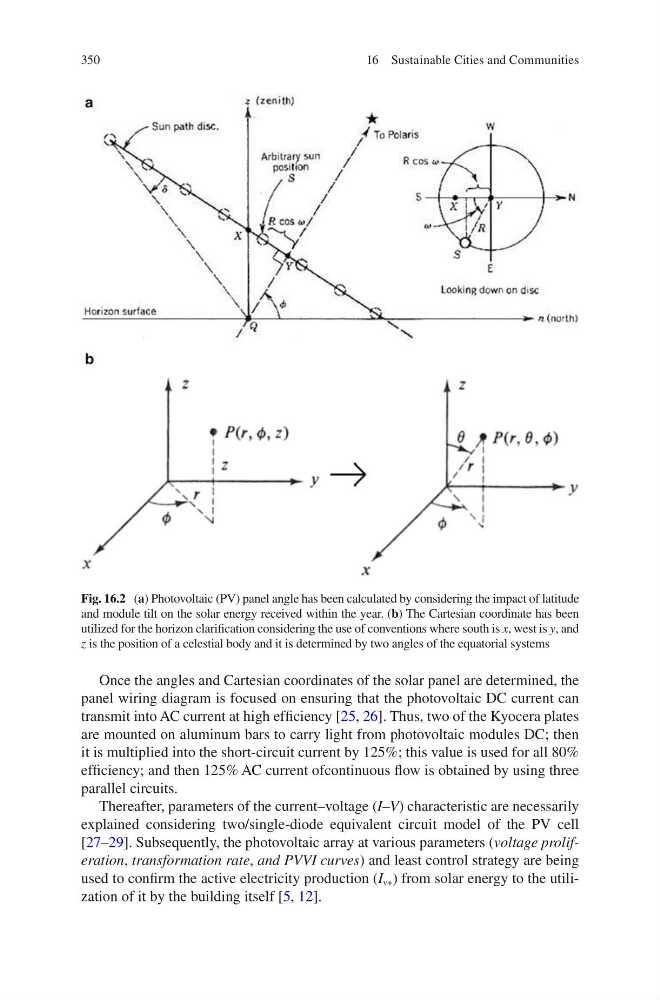
Fig. 16.2 (a) Photovoltaic (PV) panel angle has been calculated by considering the impact of latitude
and module tilt on the solar energy received within the year. (b) The Cartesian coordinate has been
utilized for the horizon clarification considering the use of conventions where south is x, west is y, and
z is the position of a celestial body and it is determined by two angles of the equatorial systems
16 Sustainable Cities and Communities
Once the angles and Cartesian coordinates of the solar panel are determined, the
panel wiring diagram is focused on ensuring that the photovoltaic DC current can
transmit into AC current at high efficiency [25, 26]. Thus, two of the Kyocera plates
are mounted on aluminum bars to carry light from photovoltaic modules DC; then
it is multiplied into the short-circuit current by 125%; this value is used for all 80%
efficiency; and then 125% AC current ofcontinuous flow is obtained by using three
parallel circuits.
Thereafter, parameters of the current–voltage (I–V) characteristic are necessarily
explained considering two/single-diode equivalent circuit model of the PV cell
[27–29]. Subsequently, the photovoltaic array at various parameters (voltage proliferation, transformation rate, and PVVI curves) and least control strategy are being
used to confirm the active electricity production (I v+ ) from solar energy to the utilization of it by the building itself [5, 12].
Fig. 16.2 (a) Photovoltaic (PV) panel angle has been calculated by considering the impact of latitude
and module tilt on the solar energy received within the year. (b) The Cartesian coordinate has been
utilized for the horizon clarification considering the use of conventions where south is x, west is y, and
z is the position of a celestial body and it is determined by two angles of the equatorial systems
16 Sustainable Cities and Communities