

343
Conclusion
The United Nations Environment Programme (UNEP) estimates that each year 2.4
million people die from air pollution and nearly 5 million people die because of
water pollution, and nearly 10 million people die due to human-caused other environmental problems in urban area. The most dangerous, particularly hazardous for
health, are emissions of black carbon, a component of particulate matter, which is a
known cause of respiratory and carcinogenic diseases and the main contributor to
global climate change due to overcongestion in the urban area. Currently the urban
atmospheric CO 2 is 400 ppm and it is increasing at a rate of 2.11% yearly which is
running to reach the toxic level of CO 2 concentration in the air of 60,000 ppm when
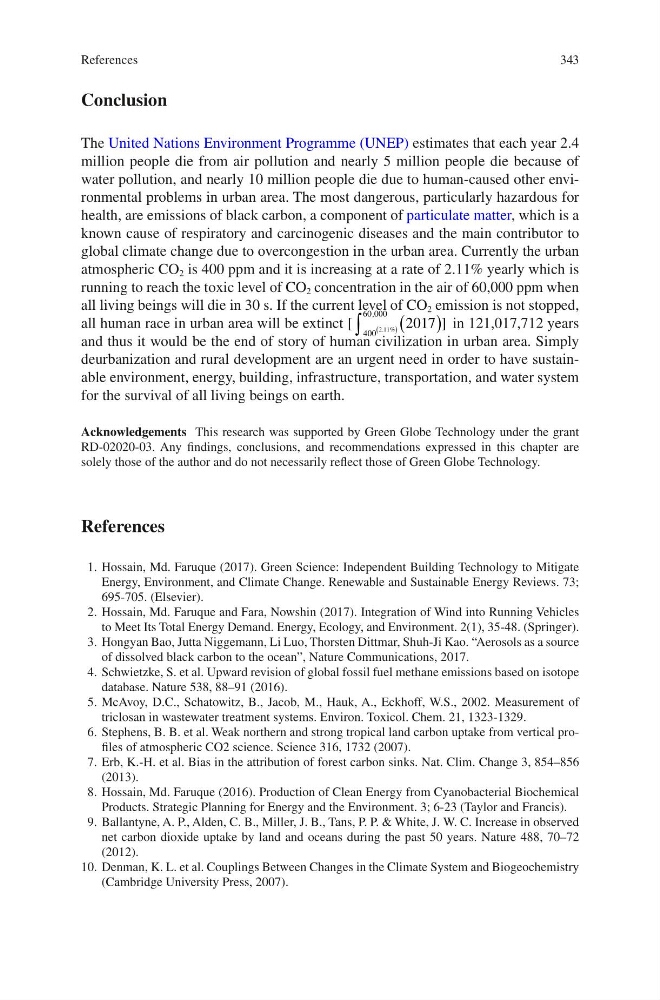
all living beings will die in 30 s. If the current level of CO 2 emission is not stopped,
all human race in urban area will be extinct [
400
60 000
2 11
2017
. %
,
]
(
)
∫
(
) in 121,017,712 years
and thus it would be the end of story of human civilization in urban area. Simply
deurbanization and rural development are an urgent need in order to have sustainable environment, energy, building, infrastructure, transportation, and water system
for the survival of all living beings on earth.
Acknowledgements This research was supported by Green Globe Technology under the grant
RD-02020-03. Any findings, conclusions, and recommendations expressed in this chapter are
solely those of the author and do not necessarily reflect those of Green Globe Technology.
References
1. Hossain, Md. Faruque (2017). Green Science: Independent Building Technology to Mitigate
Energy, Environment, and Climate Change. Renewable and Sustainable Energy Reviews. 73;
695-705. (Elsevier).
2. Hossain, Md. Faruque and Fara, Nowshin (2017). Integration of Wind into Running Vehicles
to Meet Its Total Energy Demand. Energy, Ecology, and Environment. 2(1), 35-48. (Springer).
3. Hongyan Bao, Jutta Niggemann, Li Luo, Thorsten Dittmar, Shuh-Ji Kao. “Aerosols as a source
of dissolved black carbon to the ocean”, Nature Communications, 2017.
4. Schwietzke, S. et al. Upward revision of global fossil fuel methane emissions based on isotope
database. Nature 538, 88–91 (2016).
5. McAvoy, D.C., Schatowitz, B., Jacob, M., Hauk, A., Eckhoff, W.S., 2002. Measurement of
triclosan in wastewater treatment systems. Environ. Toxicol. Chem. 21, 1323-1329.
6. Stephens, B. B. et al. Weak northern and strong tropical land carbon uptake from vertical profiles of atmospheric CO2 science. Science 316, 1732 (2007).
7. Erb, K.-H. et al. Bias in the attribution of forest carbon sinks. Nat. Clim. Change 3, 854–856
(2013).
8. Hossain, Md. Faruque (2016). Production of Clean Energy from Cyanobacterial Biochemical
Products. Strategic Planning for Energy and the Environment. 3; 6-23 (Taylor and Francis).
9. Ballantyne, A. P., Alden, C. B., Miller, J. B., Tans, P. P. & White, J. W. C. Increase in observed
net carbon dioxide uptake by land and oceans during the past 50 years. Nature 488, 70–72
(2012).
10. Denman, K. L. et al. Couplings Between Changes in the Climate System and Biogeochemistry
(Cambridge University Press, 2007).
References
Conclusion
The United Nations Environment Programme (UNEP) estimates that each year 2.4
million people die from air pollution and nearly 5 million people die because of
water pollution, and nearly 10 million people die due to human-caused other environmental problems in urban area. The most dangerous, particularly hazardous for
health, are emissions of black carbon, a component of particulate matter, which is a
known cause of respiratory and carcinogenic diseases and the main contributor to
global climate change due to overcongestion in the urban area. Currently the urban
atmospheric CO 2 is 400 ppm and it is increasing at a rate of 2.11% yearly which is
running to reach the toxic level of CO 2 concentration in the air of 60,000 ppm when
all living beings will die in 30 s. If the current level of CO 2 emission is not stopped,
all human race in urban area will be extinct [
400
60 000
2 11
2017
. %
,
]
(
)
∫
(
) in 121,017,712 years
and thus it would be the end of story of human civilization in urban area. Simply
deurbanization and rural development are an urgent need in order to have sustainable environment, energy, building, infrastructure, transportation, and water system
for the survival of all living beings on earth.
Acknowledgements This research was supported by Green Globe Technology under the grant
RD-02020-03. Any findings, conclusions, and recommendations expressed in this chapter are
solely those of the author and do not necessarily reflect those of Green Globe Technology.
References
1. Hossain, Md. Faruque (2017). Green Science: Independent Building Technology to Mitigate
Energy, Environment, and Climate Change. Renewable and Sustainable Energy Reviews. 73;
695-705. (Elsevier).
2. Hossain, Md. Faruque and Fara, Nowshin (2017). Integration of Wind into Running Vehicles
to Meet Its Total Energy Demand. Energy, Ecology, and Environment. 2(1), 35-48. (Springer).
3. Hongyan Bao, Jutta Niggemann, Li Luo, Thorsten Dittmar, Shuh-Ji Kao. “Aerosols as a source
of dissolved black carbon to the ocean”, Nature Communications, 2017.
4. Schwietzke, S. et al. Upward revision of global fossil fuel methane emissions based on isotope
database. Nature 538, 88–91 (2016).
5. McAvoy, D.C., Schatowitz, B., Jacob, M., Hauk, A., Eckhoff, W.S., 2002. Measurement of
triclosan in wastewater treatment systems. Environ. Toxicol. Chem. 21, 1323-1329.
6. Stephens, B. B. et al. Weak northern and strong tropical land carbon uptake from vertical profiles of atmospheric CO2 science. Science 316, 1732 (2007).
7. Erb, K.-H. et al. Bias in the attribution of forest carbon sinks. Nat. Clim. Change 3, 854–856
(2013).
8. Hossain, Md. Faruque (2016). Production of Clean Energy from Cyanobacterial Biochemical
Products. Strategic Planning for Energy and the Environment. 3; 6-23 (Taylor and Francis).
9. Ballantyne, A. P., Alden, C. B., Miller, J. B., Tans, P. P. & White, J. W. C. Increase in observed
net carbon dioxide uptake by land and oceans during the past 50 years. Nature 488, 70–72
(2012).
10. Denman, K. L. et al. Couplings Between Changes in the Climate System and Biogeochemistry
(Cambridge University Press, 2007).
References