

327
And
V
m
Φ Φ
Φ Φ
Φ Φ
∗
∗
∗
( ) = ( ) + ( )
λ
2
2
2
(14.3)
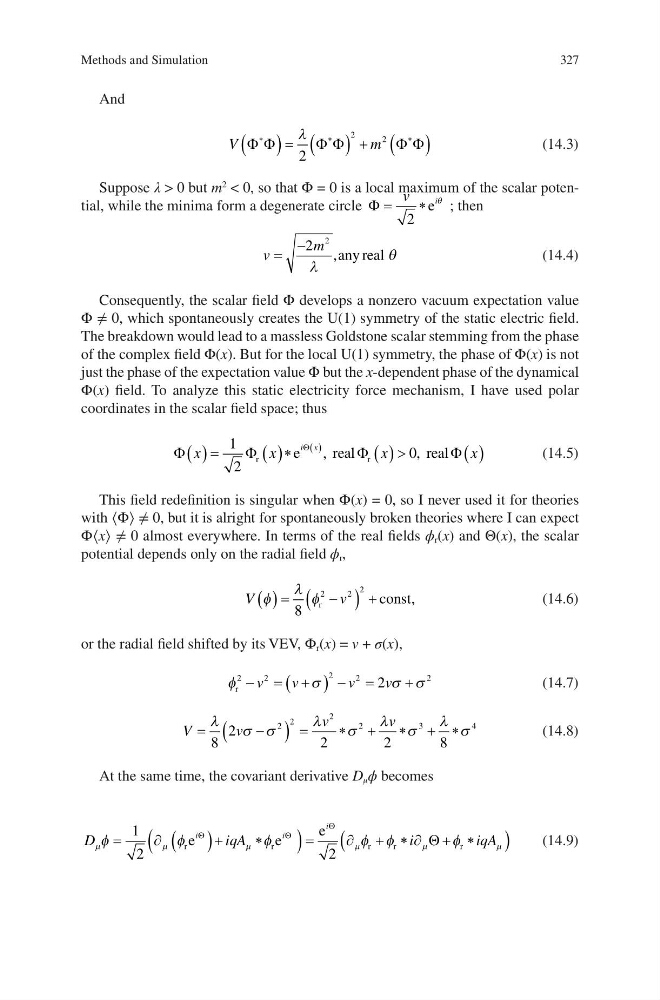
Suppose λ > 0 but m
2
< 0, so that Φ = 0 is a local maximum of the scalar potential, while the minima form a degenerate circle Φ =
∗
v
i
2
e
θ ; then
v
m
=
−2
2
λ
θ
,any real
(14.4)
Consequently, the scalar field Φ develops a nonzero vacuum expectation value
Φ ≠ 0, which spontaneously creates the U(1) symmetry of the static electric field.
The breakdown would lead to a massless Goldstone scalar stemming from the phase
of the complex field Φ(x). But for the local U(1) symmetry, the phase of Φ(x) is not
just the phase of the expectation value Φ but the x-dependent phase of the dynamical
Φ(x) field. To analyze this static electricity force mechanism, I have used polar
coordinates in the scalar field space; thus
Φ
Φ
Φ
Φ
Θ
x
x
x
x
i x
( ) =
( )∗
( ) >
( )
( )
1
2
0
r
r
e
real
real
,
,
(14.5)
This field redefinition is singular when Φ(x) = 0, so I never used it for theories
with 〈Φ〉 ≠ 0, but it is alright for spontaneously broken theories where I can expect
Φ〈x〉 ≠ 0 almost everywhere. In terms of the real fields ϕ r (x) and Θ(x), the scalar
potential depends only on the radial field ϕ r ,
V
v
φ
λ φ
( ) =
−
(
) +
8
2
2
2
r
const,
(14.6)
or the radial field shifted by its VEV, Φ r (x) = v + σ(x),
φ
σ
σ σ
r
2
2
2
2
2
2
− = +
(
) − =
+
v
v
v
v
(14.7)
V
v
v
v
=
−
(
) = ∗ + ∗ + ∗
λ
σ σ
λ
σ
λ σ
λ σ
8
2
2
2
8
2
2
2
2
3
4
(14.8)
At the same time, the covariant derivative D μ ϕ becomes
D
i qA
i
i qA
i
i
i
µ
µ
µ
µ
µ
µ
φ
φ
φ
φ φ
φ
=
∂ ( ) + ∗
(
) = ∂ + ∗ ∂ + ∗
(
)
1
2
2
r
r
r
r
r
e
e
e
Θ
Θ
Θ
Θ
(14.9)
Methods and Simulation
And
V
m
Φ Φ
Φ Φ
Φ Φ
∗
∗
∗
( ) = ( ) + ( )
λ
2
2
2
(14.3)
Suppose λ > 0 but m
2
< 0, so that Φ = 0 is a local maximum of the scalar potential, while the minima form a degenerate circle Φ =
∗
v
i
2
e
θ ; then
v
m
=
−2
2
λ
θ
,any real
(14.4)
Consequently, the scalar field Φ develops a nonzero vacuum expectation value
Φ ≠ 0, which spontaneously creates the U(1) symmetry of the static electric field.
The breakdown would lead to a massless Goldstone scalar stemming from the phase
of the complex field Φ(x). But for the local U(1) symmetry, the phase of Φ(x) is not
just the phase of the expectation value Φ but the x-dependent phase of the dynamical
Φ(x) field. To analyze this static electricity force mechanism, I have used polar
coordinates in the scalar field space; thus
Φ
Φ
Φ
Φ
Θ
x
x
x
x
i x
( ) =
( )∗
( ) >
( )
( )
1
2
0
r
r
e
real
real
,
,
(14.5)
This field redefinition is singular when Φ(x) = 0, so I never used it for theories
with 〈Φ〉 ≠ 0, but it is alright for spontaneously broken theories where I can expect
Φ〈x〉 ≠ 0 almost everywhere. In terms of the real fields ϕ r (x) and Θ(x), the scalar
potential depends only on the radial field ϕ r ,
V
v
φ
λ φ
( ) =
−
(
) +
8
2
2
2
r
const,
(14.6)
or the radial field shifted by its VEV, Φ r (x) = v + σ(x),
φ
σ
σ σ
r
2
2
2
2
2
2
− = +
(
) − =
+
v
v
v
v
(14.7)
V
v
v
v
=
−
(
) = ∗ + ∗ + ∗
λ
σ σ
λ
σ
λ σ
λ σ
8
2
2
2
8
2
2
2
2
3
4
(14.8)
At the same time, the covariant derivative D μ ϕ becomes
D
i qA
i
i qA
i
i
i
µ
µ
µ
µ
µ
µ
φ
φ
φ
φ φ
φ
=
∂ ( ) + ∗
(
) = ∂ + ∗ ∂ + ∗
(
)
1
2
2
r
r
r
r
r
e
e
e
Θ
Θ
Θ
Θ
(14.9)
Methods and Simulation