

326
proposed to eliminate this water loss by diverting this transpiration mechanism by
collecting this water vapor instead of allowing it to enter the air and transforming it
into potable water and clean energy. Simply static electricity creator plastic tank
near the plants has been proposed to install to trap all the water vapor as the water
vapor is attracted by the force of static electricity. Just because water vapor has positive and negative charges and the electrons that end up on static electrical force have
a positive charge, while water molecules have a negative charge on one side, the
positive charge of static electric force and negative charge of water vapor pull each
other closer together, and the positive side tugs the direction and forces the water to
come down so that it can be collected in a tank and treated in situ to meet the daily
water demand. Calculation revealed that only four standard oak trees can meet the
total water demand for a small family throughout the year. Since the groundwater
strata are getting lower fast to a finite level, and global water demand and global
warming are getting dangerous putting earth on a vulnerable condition, these two
vital needs must be resolved immediately. Interestingly this new finding has the
total solution to solve the global water and environmental crisis for the survival of
this planet which will indeed open new door in science.
Methods and Simulation
Static Electric Force Generation
To capture the water vapor from air which is released by stomatal cells of the plants
during the daytime, a model has been proposed to create Hossain static electric
force (HsrF = ɧ) by implementing the friction of insulator into the plastic tank to
pull down the water vapor into the plastic tank [5, 6]. To create HsrF into the plastic
tank, I have implemented albanian local symmetry calculation by using MATLAB
software considering gauge field symmetry and Goldstone scalar with respect to
longitudinal mode of the vector [7, 8]. Thus, for each spontaneously broken particle
T
α
of the local symmetry there will be a corresponding gauge field of A x
µ
α
( ) where
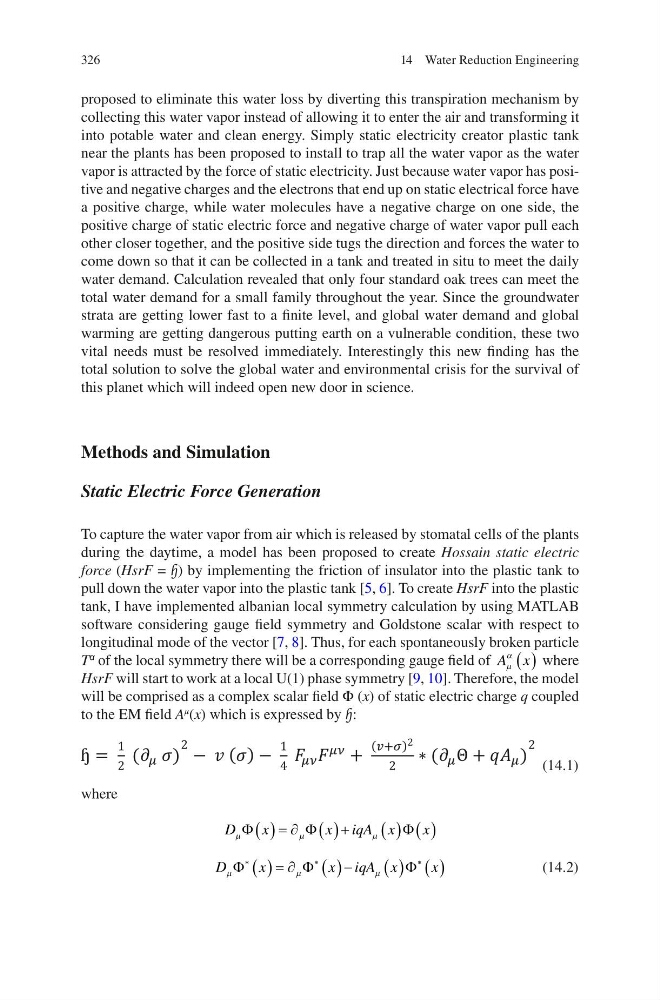
HsrF will start to work at a local U(1) phase symmetry [9, 10]. Therefore, the model
will be comprised as a complex scalar field Φ (x) of static electric charge q coupled
to the EM field A
μ
(x) which is expressed by ɧ:
(14.1)
where
D
x
x iqA x
x
µ
µ
µ
Φ
Φ
Φ
( ) = ∂ ( )+
( ) ( )
D
x
x iqA x
x
µ
µ
µ
Φ
Φ
Φ
∗
∗
∗
( ) = ∂ ( )−
( ) ( )
(14.2)
14 Water Reduction Engineering
proposed to eliminate this water loss by diverting this transpiration mechanism by
collecting this water vapor instead of allowing it to enter the air and transforming it
into potable water and clean energy. Simply static electricity creator plastic tank
near the plants has been proposed to install to trap all the water vapor as the water
vapor is attracted by the force of static electricity. Just because water vapor has positive and negative charges and the electrons that end up on static electrical force have
a positive charge, while water molecules have a negative charge on one side, the
positive charge of static electric force and negative charge of water vapor pull each
other closer together, and the positive side tugs the direction and forces the water to
come down so that it can be collected in a tank and treated in situ to meet the daily
water demand. Calculation revealed that only four standard oak trees can meet the
total water demand for a small family throughout the year. Since the groundwater
strata are getting lower fast to a finite level, and global water demand and global
warming are getting dangerous putting earth on a vulnerable condition, these two
vital needs must be resolved immediately. Interestingly this new finding has the
total solution to solve the global water and environmental crisis for the survival of
this planet which will indeed open new door in science.
Methods and Simulation
Static Electric Force Generation
To capture the water vapor from air which is released by stomatal cells of the plants
during the daytime, a model has been proposed to create Hossain static electric
force (HsrF = ɧ) by implementing the friction of insulator into the plastic tank to
pull down the water vapor into the plastic tank [5, 6]. To create HsrF into the plastic
tank, I have implemented albanian local symmetry calculation by using MATLAB
software considering gauge field symmetry and Goldstone scalar with respect to
longitudinal mode of the vector [7, 8]. Thus, for each spontaneously broken particle
T
α
of the local symmetry there will be a corresponding gauge field of A x
µ
α
( ) where
HsrF will start to work at a local U(1) phase symmetry [9, 10]. Therefore, the model
will be comprised as a complex scalar field Φ (x) of static electric charge q coupled
to the EM field A
μ
(x) which is expressed by ɧ:
(14.1)
where
D
x
x iqA x
x
µ
µ
µ
Φ
Φ
Φ
( ) = ∂ ( )+
( ) ( )
D
x
x iqA x
x
µ
µ
µ
Φ
Φ
Φ
∗
∗
∗
( ) = ∂ ( )−
( ) ( )
(14.2)
14 Water Reduction Engineering