

303
Mn H O
M
H
O
TiO
o
+
( )
+
+
→
+
+
2
2
2
4
hv
n
n
(13.49)
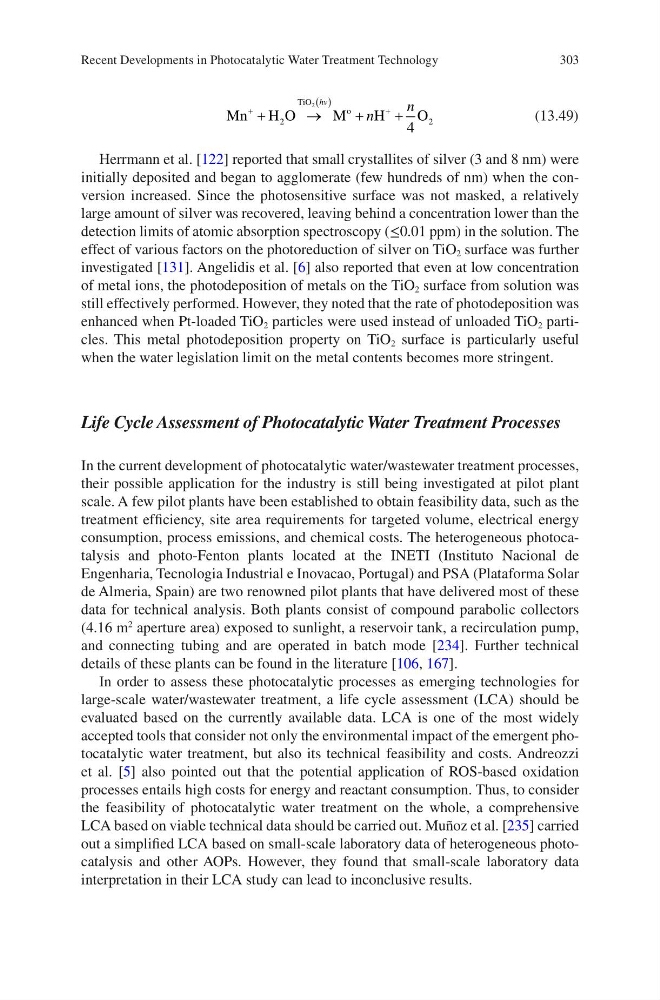
Herrmann et al. [122] reported that small crystallites of silver (3 and 8 nm) were
initially deposited and began to agglomerate (few hundreds of nm) when the conversion increased. Since the photosensitive surface was not masked, a relatively
large amount of silver was recovered, leaving behind a concentration lower than the
detection limits of atomic absorption spectroscopy (≤0.01 ppm) in the solution. The
effect of various factors on the photoreduction of silver on TiO 2 surface was further
investigated [131]. Angelidis et al. [6] also reported that even at low concentration
of metal ions, the photodeposition of metals on the TiO 2 surface from solution was
still effectively performed. However, they noted that the rate of photodeposition was
enhanced when Pt-loaded TiO 2 particles were used instead of unloaded TiO 2 particles. This metal photodeposition property on TiO 2 surface is particularly useful
when the water legislation limit on the metal contents becomes more stringent.
Life Cycle Assessment of Photocatalytic Water Treatment Processes
In the current development of photocatalytic water/wastewater treatment processes,
their possible application for the industry is still being investigated at pilot plant
scale. A few pilot plants have been established to obtain feasibility data, such as the
treatment efficiency, site area requirements for targeted volume, electrical energy
consumption, process emissions, and chemical costs. The heterogeneous photocatalysis and photo-Fenton plants located at the INETI (Instituto Nacional de
Engenharia, Tecnologia Industrial e Inovacao, Portugal) and PSA (Plataforma Solar
de Almeria, Spain) are two renowned pilot plants that have delivered most of these
data for technical analysis. Both plants consist of compound parabolic collectors
(4.16 m
2
aperture area) exposed to sunlight, a reservoir tank, a recirculation pump,
and connecting tubing and are operated in batch mode [234]. Further technical
details of these plants can be found in the literature [106, 167].
In order to assess these photocatalytic processes as emerging technologies for
large-scale water/wastewater treatment, a life cycle assessment (LCA) should be
evaluated based on the currently available data. LCA is one of the most widely
accepted tools that consider not only the environmental impact of the emergent photocatalytic water treatment, but also its technical feasibility and costs. Andreozzi
et al. [5] also pointed out that the potential application of ROS-based oxidation
processes entails high costs for energy and reactant consumption. Thus, to consider
the feasibility of photocatalytic water treatment on the whole, a comprehensive
LCA based on viable technical data should be carried out. Muñoz et al. [235] carried
out a simplified LCA based on small-scale laboratory data of heterogeneous photocatalysis and other AOPs. However, they found that small-scale laboratory data
interpretation in their LCA study can lead to inconclusive results.
Recent Developments in Photocatalytic Water Treatment Technology
Mn H O
M
H
O
TiO
o
+
( )
+
+
→
+
+
2
2
2
4
hv
n
n
(13.49)
Herrmann et al. [122] reported that small crystallites of silver (3 and 8 nm) were
initially deposited and began to agglomerate (few hundreds of nm) when the conversion increased. Since the photosensitive surface was not masked, a relatively
large amount of silver was recovered, leaving behind a concentration lower than the
detection limits of atomic absorption spectroscopy (≤0.01 ppm) in the solution. The
effect of various factors on the photoreduction of silver on TiO 2 surface was further
investigated [131]. Angelidis et al. [6] also reported that even at low concentration
of metal ions, the photodeposition of metals on the TiO 2 surface from solution was
still effectively performed. However, they noted that the rate of photodeposition was
enhanced when Pt-loaded TiO 2 particles were used instead of unloaded TiO 2 particles. This metal photodeposition property on TiO 2 surface is particularly useful
when the water legislation limit on the metal contents becomes more stringent.
Life Cycle Assessment of Photocatalytic Water Treatment Processes
In the current development of photocatalytic water/wastewater treatment processes,
their possible application for the industry is still being investigated at pilot plant
scale. A few pilot plants have been established to obtain feasibility data, such as the
treatment efficiency, site area requirements for targeted volume, electrical energy
consumption, process emissions, and chemical costs. The heterogeneous photocatalysis and photo-Fenton plants located at the INETI (Instituto Nacional de
Engenharia, Tecnologia Industrial e Inovacao, Portugal) and PSA (Plataforma Solar
de Almeria, Spain) are two renowned pilot plants that have delivered most of these
data for technical analysis. Both plants consist of compound parabolic collectors
(4.16 m
2
aperture area) exposed to sunlight, a reservoir tank, a recirculation pump,
and connecting tubing and are operated in batch mode [234]. Further technical
details of these plants can be found in the literature [106, 167].
In order to assess these photocatalytic processes as emerging technologies for
large-scale water/wastewater treatment, a life cycle assessment (LCA) should be
evaluated based on the currently available data. LCA is one of the most widely
accepted tools that consider not only the environmental impact of the emergent photocatalytic water treatment, but also its technical feasibility and costs. Andreozzi
et al. [5] also pointed out that the potential application of ROS-based oxidation
processes entails high costs for energy and reactant consumption. Thus, to consider
the feasibility of photocatalytic water treatment on the whole, a comprehensive
LCA based on viable technical data should be carried out. Muñoz et al. [235] carried
out a simplified LCA based on small-scale laboratory data of heterogeneous photocatalysis and other AOPs. However, they found that small-scale laboratory data
interpretation in their LCA study can lead to inconclusive results.
Recent Developments in Photocatalytic Water Treatment Technology