

291
seen where the oxidation rate increases with irradiation time until the rate
becomes zero [70, 223]. The appearance of such kinetics regime usually fits the
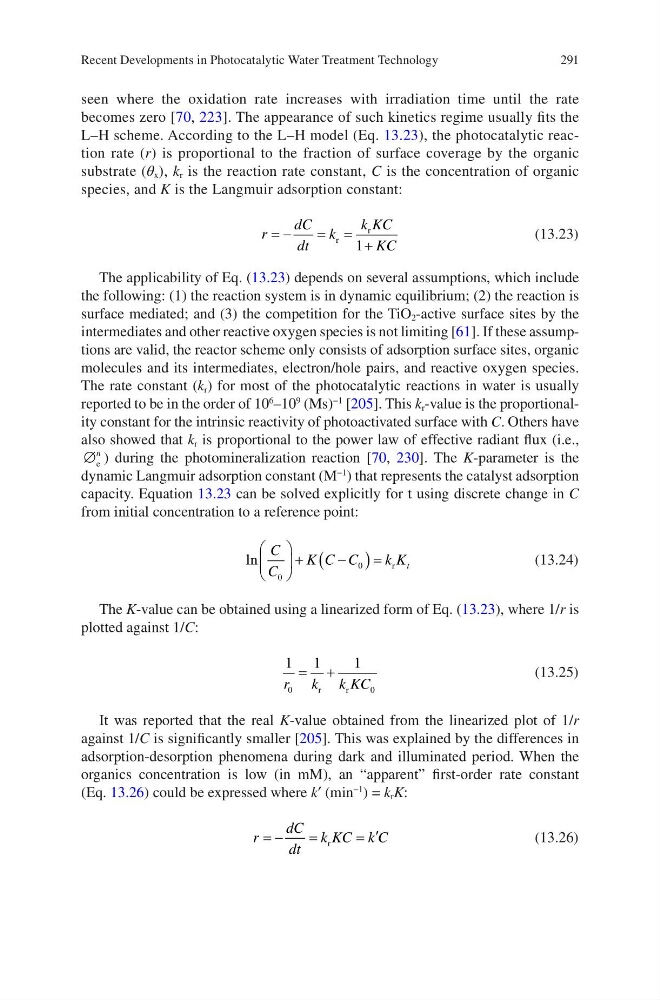
L–H scheme. According to the L–H model (Eq. 13.23), the photocatalytic reaction rate (r) is proportional to the fraction of surface coverage by the organic
substrate (θ x ), k r is the reaction rate constant, C is the concentration of organic
species, and K is the Langmuir adsorption constant:
r
dC
dt
k
k KC
KC
= −
= = +
r
r
1
(13.23)
The applicability of Eq. (13.23) depends on several assumptions, which include
the following: (1) the reaction system is in dynamic equilibrium; (2) the reaction is
surface mediated; and (3) the competition for the TiO 2 -active surface sites by the
intermediates and other reactive oxygen species is not limiting [61]. If these assumptions are valid, the reactor scheme only consists of adsorption surface sites, organic
molecules and its intermediates, electron/hole pairs, and reactive oxygen species.
The rate constant (k r ) for most of the photocatalytic reactions in water is usually
reported to be in the order of 10
6
–10
9
(Ms)
−1
[205]. This k r -value is the proportionality constant for the intrinsic reactivity of photoactivated surface with C. Others have
also showed that k r is proportional to the power law of effective radiant flux (i.e.,
∅ e
n ) during the photomineralization reaction [70, 230]. The K-parameter is the
dynamic Langmuir adsorption constant (M
−1
) that represents the catalyst adsorption
capacity. Equation 13.23 can be solved explicitly for t using discrete change in C
from initial concentration to a reference point:
ln
C
C
K C C
k K t
0
0
+
−
(
)= r
(13.24)
The K-value can be obtained using a linearized form of Eq. (13.23), where 1/r is
plotted against 1/C:
1 1
1
0
0
r k k KC
= +
r
r
(13.25)
It was reported that the real K-value obtained from the linearized plot of 1/r
against 1/C is significantly smaller [205]. This was explained by the differences in
adsorption-desorption phenomena during dark and illuminated period. When the
organics concentration is low (in mM), an “apparent” first-order rate constant
(Eq. 13.26) could be expressed where k′ (min
−1
) = k r K:
r
dC
dt
k KC k C
= −
=
= ′
r
(13.26)
Recent Developments in Photocatalytic Water Treatment Technology
seen where the oxidation rate increases with irradiation time until the rate
becomes zero [70, 223]. The appearance of such kinetics regime usually fits the
L–H scheme. According to the L–H model (Eq. 13.23), the photocatalytic reaction rate (r) is proportional to the fraction of surface coverage by the organic
substrate (θ x ), k r is the reaction rate constant, C is the concentration of organic
species, and K is the Langmuir adsorption constant:
r
dC
dt
k
k KC
KC
= −
= = +
r
r
1
(13.23)
The applicability of Eq. (13.23) depends on several assumptions, which include
the following: (1) the reaction system is in dynamic equilibrium; (2) the reaction is
surface mediated; and (3) the competition for the TiO 2 -active surface sites by the
intermediates and other reactive oxygen species is not limiting [61]. If these assumptions are valid, the reactor scheme only consists of adsorption surface sites, organic
molecules and its intermediates, electron/hole pairs, and reactive oxygen species.
The rate constant (k r ) for most of the photocatalytic reactions in water is usually
reported to be in the order of 10
6
–10
9
(Ms)
−1
[205]. This k r -value is the proportionality constant for the intrinsic reactivity of photoactivated surface with C. Others have
also showed that k r is proportional to the power law of effective radiant flux (i.e.,
∅ e
n ) during the photomineralization reaction [70, 230]. The K-parameter is the
dynamic Langmuir adsorption constant (M
−1
) that represents the catalyst adsorption
capacity. Equation 13.23 can be solved explicitly for t using discrete change in C
from initial concentration to a reference point:
ln
C
C
K C C
k K t
0
0
+
−
(
)= r
(13.24)
The K-value can be obtained using a linearized form of Eq. (13.23), where 1/r is
plotted against 1/C:
1 1
1
0
0
r k k KC
= +
r
r
(13.25)
It was reported that the real K-value obtained from the linearized plot of 1/r
against 1/C is significantly smaller [205]. This was explained by the differences in
adsorption-desorption phenomena during dark and illuminated period. When the
organics concentration is low (in mM), an “apparent” first-order rate constant
(Eq. 13.26) could be expressed where k′ (min
−1
) = k r K:
r
dC
dt
k KC k C
= −
=
= ′
r
(13.26)
Recent Developments in Photocatalytic Water Treatment Technology