

279
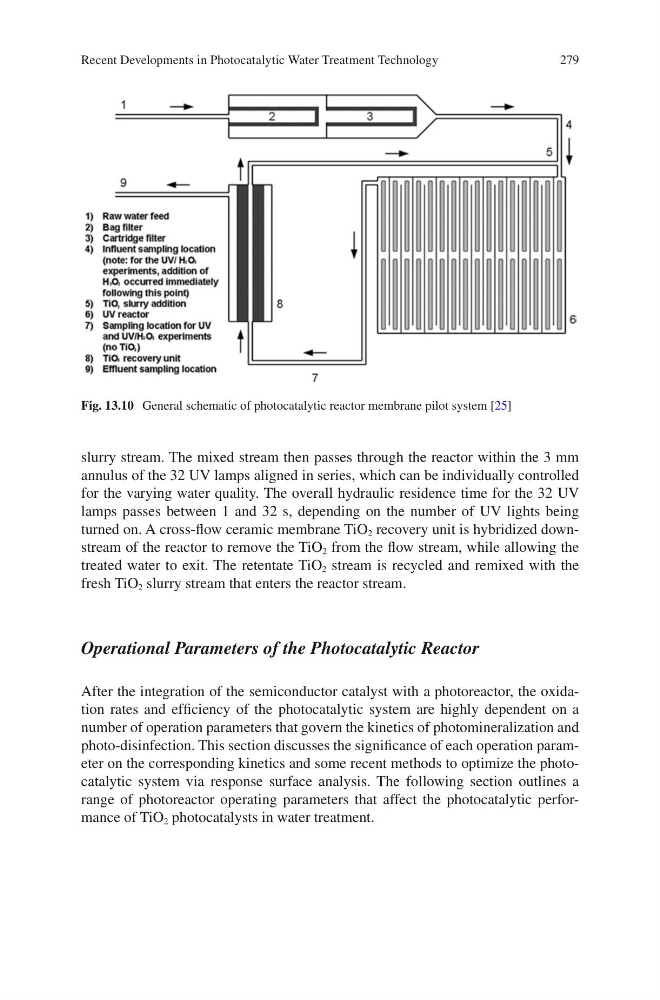
slurry stream. The mixed stream then passes through the reactor within the 3 mm
annulus of the 32 UV lamps aligned in series, which can be individually controlled
for the varying water quality. The overall hydraulic residence time for the 32 UV
lamps passes between 1 and 32 s, depending on the number of UV lights being
turned on. A cross-flow ceramic membrane TiO 2 recovery unit is hybridized downstream of the reactor to remove the TiO 2 from the flow stream, while allowing the
treated water to exit. The retentate TiO 2 stream is recycled and remixed with the
fresh TiO 2 slurry stream that enters the reactor stream.
Operational Parameters of the Photocatalytic Reactor
After the integration of the semiconductor catalyst with a photoreactor, the oxidation rates and efficiency of the photocatalytic system are highly dependent on a
number of operation parameters that govern the kinetics of photomineralization and
photo-disinfection. This section discusses the significance of each operation parameter on the corresponding kinetics and some recent methods to optimize the photocatalytic system via response surface analysis. The following section outlines a
range of photoreactor operating parameters that affect the photocatalytic performance of TiO 2 photocatalysts in water treatment.
Fig. 13.10 General schematic of photocatalytic reactor membrane pilot system [25]
Recent Developments in Photocatalytic Water Treatment Technology
slurry stream. The mixed stream then passes through the reactor within the 3 mm
annulus of the 32 UV lamps aligned in series, which can be individually controlled
for the varying water quality. The overall hydraulic residence time for the 32 UV
lamps passes between 1 and 32 s, depending on the number of UV lights being
turned on. A cross-flow ceramic membrane TiO 2 recovery unit is hybridized downstream of the reactor to remove the TiO 2 from the flow stream, while allowing the
treated water to exit. The retentate TiO 2 stream is recycled and remixed with the
fresh TiO 2 slurry stream that enters the reactor stream.
Operational Parameters of the Photocatalytic Reactor
After the integration of the semiconductor catalyst with a photoreactor, the oxidation rates and efficiency of the photocatalytic system are highly dependent on a
number of operation parameters that govern the kinetics of photomineralization and
photo-disinfection. This section discusses the significance of each operation parameter on the corresponding kinetics and some recent methods to optimize the photocatalytic system via response surface analysis. The following section outlines a
range of photoreactor operating parameters that affect the photocatalytic performance of TiO 2 photocatalysts in water treatment.
Fig. 13.10 General schematic of photocatalytic reactor membrane pilot system [25]
Recent Developments in Photocatalytic Water Treatment Technology