

278
The MD is a process where the feed volatile components in water are evaporated
through a porous hydrophobic membrane to produce high-quality distillate products
[232]. Its main advantage is that there is no membrane fouling when TiO 2 is present.
During the process, the volatile stream is maintained inside the membrane pores.
The difference in vapor pressure on both sides of the porous membrane remains as
a driving force for the process. This force, however, largely depends on the temperatures and solution composition in the layer adjacent to the membrane [113, 305]. It
was reported that the feeding temperature in MD can range from 303 to 363 K. Similar
scaling-up operational constraints of low permeate flux and high energy demand
have been redundant in its current full-scale development. However, some efforts to
utilize alternative energy source such as solar energy to enable MD application are
found in the literature [31, 169].
Among all the hybrid PMR systems, the pilot Photo-Cat™ system (Fig. 13.10)
(manufactured by Purifics Inc., Ontario, London) has shown the potential application. Benotti et al. [25] have evaluated its ability in the removal of 32 pharmaceuticals, endocrine-disrupting compounds, and estrogenic activity from water. They
found that 29 targeted compounds and estrogenic activity of greater than 70% were
removed while only 3 compounds were less than 50% removed at the highest number of UV passes. In the Photo-Cat™ system, the water stream passes through a
pre-filter bag and a cartridge filter before being mixed with a nanoparticle TiO 2
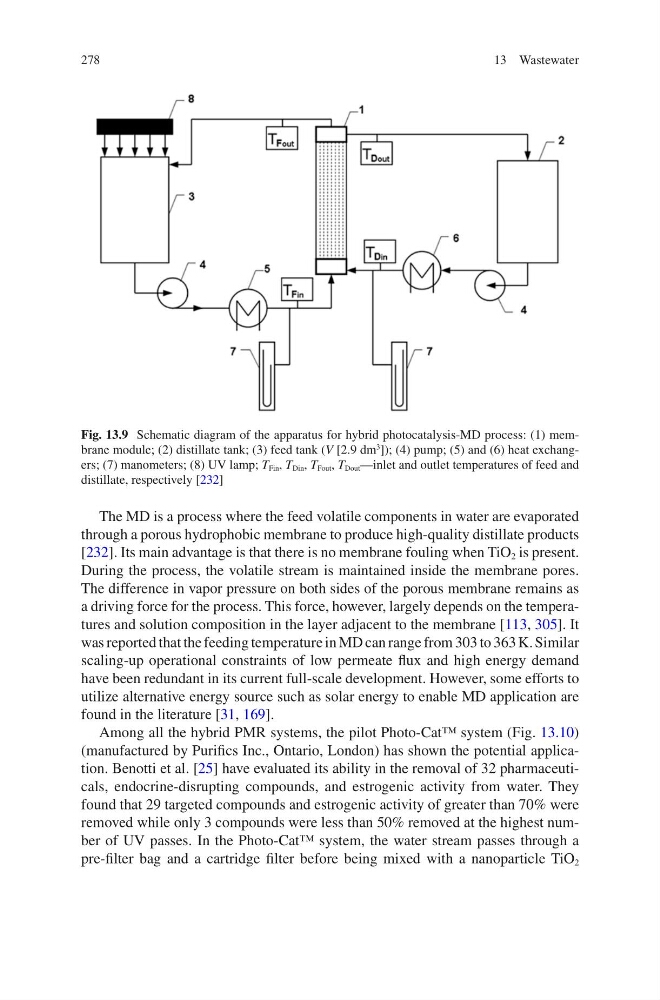
Fig. 13.9 Schematic diagram of the apparatus for hybrid photocatalysis-MD process: (1) membrane module; (2) distillate tank; (3) feed tank (V [2.9 dm
3 ]); (4) pump; (5) and (6) heat exchangers; (7) manometers; (8) UV lamp; T Fin , T Din , T Fout , T Dout —inlet and outlet temperatures of feed and
distillate, respectively [232]
13 Wastewater
The MD is a process where the feed volatile components in water are evaporated
through a porous hydrophobic membrane to produce high-quality distillate products
[232]. Its main advantage is that there is no membrane fouling when TiO 2 is present.
During the process, the volatile stream is maintained inside the membrane pores.
The difference in vapor pressure on both sides of the porous membrane remains as
a driving force for the process. This force, however, largely depends on the temperatures and solution composition in the layer adjacent to the membrane [113, 305]. It
was reported that the feeding temperature in MD can range from 303 to 363 K. Similar
scaling-up operational constraints of low permeate flux and high energy demand
have been redundant in its current full-scale development. However, some efforts to
utilize alternative energy source such as solar energy to enable MD application are
found in the literature [31, 169].
Among all the hybrid PMR systems, the pilot Photo-Cat™ system (Fig. 13.10)
(manufactured by Purifics Inc., Ontario, London) has shown the potential application. Benotti et al. [25] have evaluated its ability in the removal of 32 pharmaceuticals, endocrine-disrupting compounds, and estrogenic activity from water. They
found that 29 targeted compounds and estrogenic activity of greater than 70% were
removed while only 3 compounds were less than 50% removed at the highest number of UV passes. In the Photo-Cat™ system, the water stream passes through a
pre-filter bag and a cartridge filter before being mixed with a nanoparticle TiO 2
Fig. 13.9 Schematic diagram of the apparatus for hybrid photocatalysis-MD process: (1) membrane module; (2) distillate tank; (3) feed tank (V [2.9 dm
3 ]); (4) pump; (5) and (6) heat exchangers; (7) manometers; (8) UV lamp; T Fin , T Din , T Fout , T Dout —inlet and outlet temperatures of feed and
distillate, respectively [232]
13 Wastewater