

216
e
n
n
e
n
n
n
n
Ω
Ω
Ω
Ω
Ω
Ω
g
g
g
g
g
g
( )
∗
( )
∗
=
( )− ( )
=
( )−
−
( )
∆
1
(11.26)
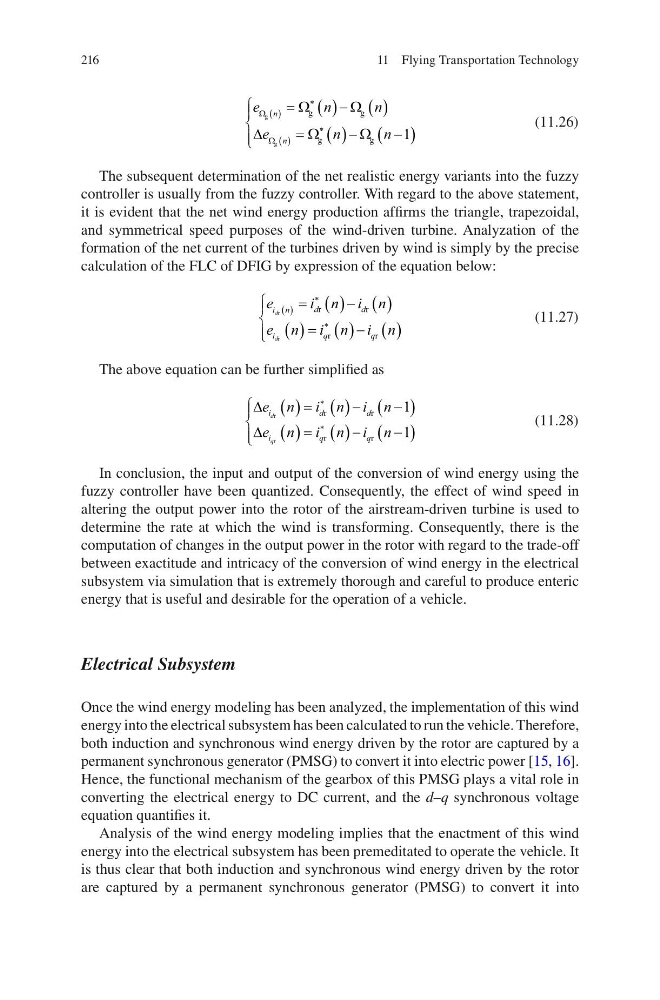
The subsequent determination of the net realistic energy variants into the fuzzy
controller is usually from the fuzzy controller. With regard to the above statement,
it is evident that the net wind energy production affirms the triangle, trapezoidal,
and symmetrical speed purposes of the wind-driven turbine. Analyzation of the
formation of the net current of the turbines driven by wind is simply by the precise
calculation of the FLC of DFIG by expression of the equation below:
e
i n i n
e n i n i n
i n
d
d
i
q
q
d
d
r
r
r
r
r
r
( )
∗
∗
= ( )− ( )
( ) = ( )− ( )
(11.27)
The above equation can be further simplified as
∆
∆
e n i n i n
e n i n i n
i
d
d
i
q
q
d
q
r
r
r
r
r
r
( ) = ( )−
−
( )
( ) = ( )−
−
( )
∗
∗
1
1
(11.28)
In conclusion, the input and output of the conversion of wind energy using the
fuzzy controller have been quantized. Consequently, the effect of wind speed in
altering the output power into the rotor of the airstream-driven turbine is used to
determine the rate at which the wind is transforming. Consequently, there is the
computation of changes in the output power in the rotor with regard to the trade-off
between exactitude and intricacy of the conversion of wind energy in the electrical
subsystem via simulation that is extremely thorough and careful to produce enteric
energy that is useful and desirable for the operation of a vehicle.
Electrical Subsystem
Once the wind energy modeling has been analyzed, the implementation of this wind
energy into the electrical subsystem has been calculated to run the vehicle. Therefore,
both induction and synchronous wind energy driven by the rotor are captured by a
permanent synchronous generator (PMSG) to convert it into electric power [15, 16].
Hence, the functional mechanism of the gearbox of this PMSG plays a vital role in
converting the electrical energy to DC current, and the d–q synchronous voltage
equation quantifies it.
Analysis of the wind energy modeling implies that the enactment of this wind
energy into the electrical subsystem has been premeditated to operate the vehicle. It
is thus clear that both induction and synchronous wind energy driven by the rotor
are captured by a permanent synchronous generator (PMSG) to convert it into
11 Flying Transportation Technology
e
n
n
e
n
n
n
n
Ω
Ω
Ω
Ω
Ω
Ω
g
g
g
g
g
g
( )
∗
( )
∗
=
( )− ( )
=
( )−
−
( )
∆
1
(11.26)
The subsequent determination of the net realistic energy variants into the fuzzy
controller is usually from the fuzzy controller. With regard to the above statement,
it is evident that the net wind energy production affirms the triangle, trapezoidal,
and symmetrical speed purposes of the wind-driven turbine. Analyzation of the
formation of the net current of the turbines driven by wind is simply by the precise
calculation of the FLC of DFIG by expression of the equation below:
e
i n i n
e n i n i n
i n
d
d
i
q
q
d
d
r
r
r
r
r
r
( )
∗
∗
= ( )− ( )
( ) = ( )− ( )
(11.27)
The above equation can be further simplified as
∆
∆
e n i n i n
e n i n i n
i
d
d
i
q
q
d
q
r
r
r
r
r
r
( ) = ( )−
−
( )
( ) = ( )−
−
( )
∗
∗
1
1
(11.28)
In conclusion, the input and output of the conversion of wind energy using the
fuzzy controller have been quantized. Consequently, the effect of wind speed in
altering the output power into the rotor of the airstream-driven turbine is used to
determine the rate at which the wind is transforming. Consequently, there is the
computation of changes in the output power in the rotor with regard to the trade-off
between exactitude and intricacy of the conversion of wind energy in the electrical
subsystem via simulation that is extremely thorough and careful to produce enteric
energy that is useful and desirable for the operation of a vehicle.
Electrical Subsystem
Once the wind energy modeling has been analyzed, the implementation of this wind
energy into the electrical subsystem has been calculated to run the vehicle. Therefore,
both induction and synchronous wind energy driven by the rotor are captured by a
permanent synchronous generator (PMSG) to convert it into electric power [15, 16].
Hence, the functional mechanism of the gearbox of this PMSG plays a vital role in
converting the electrical energy to DC current, and the d–q synchronous voltage
equation quantifies it.
Analysis of the wind energy modeling implies that the enactment of this wind
energy into the electrical subsystem has been premeditated to operate the vehicle. It
is thus clear that both induction and synchronous wind energy driven by the rotor
are captured by a permanent synchronous generator (PMSG) to convert it into
11 Flying Transportation Technology