

209
Battery Modeling
In situations where the car is nonfunctional or where the engine power is exceeded
by the power produced, battery modeling is adopted in order to conserve the extra
power [7, 8]. This process can be calculated by using the formula below:
t
H
C
IH
k
discharge =
(11.18)
In the formula, the discharge time of the battery is represented by t. C shows the
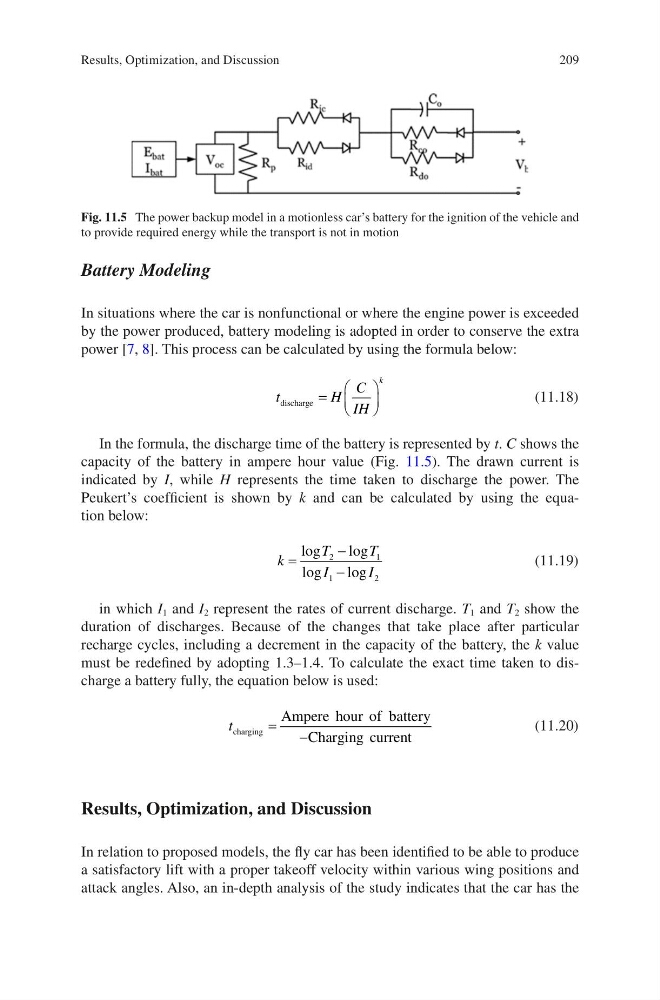
capacity of the battery in ampere hour value (Fig. 11.5). The drawn current is
indicated by I, while H represents the time taken to discharge the power. The
Peukert’s coefficient is shown by k and can be calculated by using the equation below:
k
T
T
I
I
=
−
−
log
log
log
log
2
1
1
2
(11.19)
in which I 1 and I 2 represent the rates of current discharge. T 1 and T 2 show the
duration of discharges. Because of the changes that take place after particular
recharge cycles, including a decrement in the capacity of the battery, the k value
must be redefined by adopting 1.3–1.4. To calculate the exact time taken to discharge a battery fully, the equation below is used:
t charging
Ampere hour of battery
Charging current
=
−
(11.20)
Results, Optimization, and Discussion
In relation to proposed models, the fly car has been identified to be able to produce
a satisfactory lift with a proper takeoff velocity within various wing positions and
attack angles. Also, an in-depth analysis of the study indicates that the car has the
Fig. 11.5 The power backup model in a motionless car’s battery for the ignition of the vehicle and
to provide required energy while the transport is not in motion
Results, Optimization, and Discussion
Battery Modeling
In situations where the car is nonfunctional or where the engine power is exceeded
by the power produced, battery modeling is adopted in order to conserve the extra
power [7, 8]. This process can be calculated by using the formula below:
t
H
C
IH
k
discharge =
(11.18)
In the formula, the discharge time of the battery is represented by t. C shows the
capacity of the battery in ampere hour value (Fig. 11.5). The drawn current is
indicated by I, while H represents the time taken to discharge the power. The
Peukert’s coefficient is shown by k and can be calculated by using the equation below:
k
T
T
I
I
=
−
−
log
log
log
log
2
1
1
2
(11.19)
in which I 1 and I 2 represent the rates of current discharge. T 1 and T 2 show the
duration of discharges. Because of the changes that take place after particular
recharge cycles, including a decrement in the capacity of the battery, the k value
must be redefined by adopting 1.3–1.4. To calculate the exact time taken to discharge a battery fully, the equation below is used:
t charging
Ampere hour of battery
Charging current
=
−
(11.20)
Results, Optimization, and Discussion
In relation to proposed models, the fly car has been identified to be able to produce
a satisfactory lift with a proper takeoff velocity within various wing positions and
attack angles. Also, an in-depth analysis of the study indicates that the car has the
Fig. 11.5 The power backup model in a motionless car’s battery for the ignition of the vehicle and
to provide required energy while the transport is not in motion
Results, Optimization, and Discussion