

187
between 4 and 4.5 s, around 25% between 6 and 6.5 s, and 50% between 8 and 8.5 s
[35, 36]. Since the wind turbine is considered as working over ideal conditions to
guarantee a unique wind intake factor into the rotor, the stator active and reactive
winds are calculated in accordance to MPPT and fuzzy logic controller. This is
because this condition permits to control the DFIG mechanism which plays an
active role in wind transformation in order to clarify the maximum angular speed of
the generator shaft [37, 38].
Since the generator shaft velocity reaches the maximum angular velocity, the
wind regulation is increased at peak rated wind speed in order to control the maximum power point. Therefore, it is a very good decoupling mechanism between the
bidirectional components of rotor’s active and reactive speed to determine wind
energy intake rate. With the functional wind transfer into the rotor, the nominal stator force will confirm the unit wind intake power into the wind turbine. Hence, the
bidirectional control involves cross coupling between the two axes (Eq. (10.14)) in
order to determine the precise wind energy balance as P s + P r = P m , where P s = T em ω s
and P m = T q ω. To confirm this stator active power, the calculation of MPPT control
by analyzing the electromagnetic torque suggested that a predefined turbine powerspeed plays a vital role in tracking the maximum power point in the rotor [39, 40].
The turbine shaft speed is then determined to achieve the maximum power cofactor which shows that P s = T em ω s where T em
∗ is the referenced electromagnetic torque
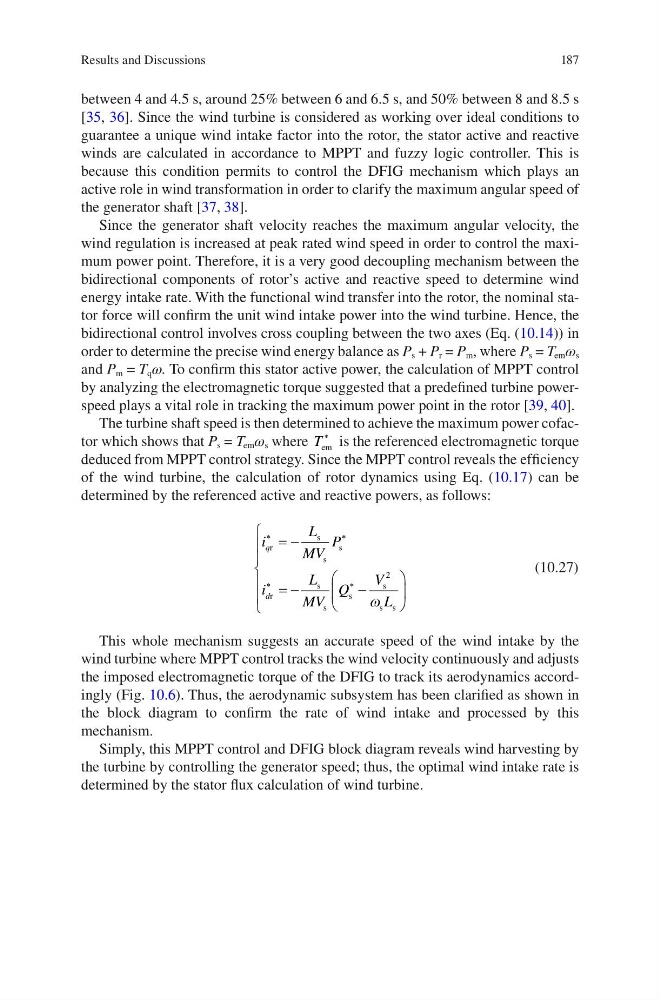
deduced from MPPT control strategy. Since the MPPT control reveals the efficiency
of the wind turbine, the calculation of rotor dynamics using Eq. (10.17) can be
determined by the referenced active and reactive powers, as follows:
i
L
MV
P
i
L
MV
Q
V
L
q
d
r
s
s
s
r
s
s
s
s
s s
∗
∗
∗
∗
= −
= −
−
2
ω
(10.27)
This whole mechanism suggests an accurate speed of the wind intake by the
wind turbine where MPPT control tracks the wind velocity continuously and adjusts
the imposed electromagnetic torque of the DFIG to track its aerodynamics accordingly (Fig. 10.6). Thus, the aerodynamic subsystem has been clarified as shown in
the block diagram to confirm the rate of wind intake and processed by this
mechanism.
Simply, this MPPT control and DFIG block diagram reveals wind harvesting by
the turbine by controlling the generator speed; thus, the optimal wind intake rate is
determined by the stator flux calculation of wind turbine.
Results and Discussions
between 4 and 4.5 s, around 25% between 6 and 6.5 s, and 50% between 8 and 8.5 s
[35, 36]. Since the wind turbine is considered as working over ideal conditions to
guarantee a unique wind intake factor into the rotor, the stator active and reactive
winds are calculated in accordance to MPPT and fuzzy logic controller. This is
because this condition permits to control the DFIG mechanism which plays an
active role in wind transformation in order to clarify the maximum angular speed of
the generator shaft [37, 38].
Since the generator shaft velocity reaches the maximum angular velocity, the
wind regulation is increased at peak rated wind speed in order to control the maximum power point. Therefore, it is a very good decoupling mechanism between the
bidirectional components of rotor’s active and reactive speed to determine wind
energy intake rate. With the functional wind transfer into the rotor, the nominal stator force will confirm the unit wind intake power into the wind turbine. Hence, the
bidirectional control involves cross coupling between the two axes (Eq. (10.14)) in
order to determine the precise wind energy balance as P s + P r = P m , where P s = T em ω s
and P m = T q ω. To confirm this stator active power, the calculation of MPPT control
by analyzing the electromagnetic torque suggested that a predefined turbine powerspeed plays a vital role in tracking the maximum power point in the rotor [39, 40].
The turbine shaft speed is then determined to achieve the maximum power cofactor which shows that P s = T em ω s where T em
∗ is the referenced electromagnetic torque
deduced from MPPT control strategy. Since the MPPT control reveals the efficiency
of the wind turbine, the calculation of rotor dynamics using Eq. (10.17) can be
determined by the referenced active and reactive powers, as follows:
i
L
MV
P
i
L
MV
Q
V
L
q
d
r
s
s
s
r
s
s
s
s
s s
∗
∗
∗
∗
= −
= −
−
2
ω
(10.27)
This whole mechanism suggests an accurate speed of the wind intake by the
wind turbine where MPPT control tracks the wind velocity continuously and adjusts
the imposed electromagnetic torque of the DFIG to track its aerodynamics accordingly (Fig. 10.6). Thus, the aerodynamic subsystem has been clarified as shown in
the block diagram to confirm the rate of wind intake and processed by this
mechanism.
Simply, this MPPT control and DFIG block diagram reveals wind harvesting by
the turbine by controlling the generator speed; thus, the optimal wind intake rate is
determined by the stator flux calculation of wind turbine.
Results and Discussions