

142
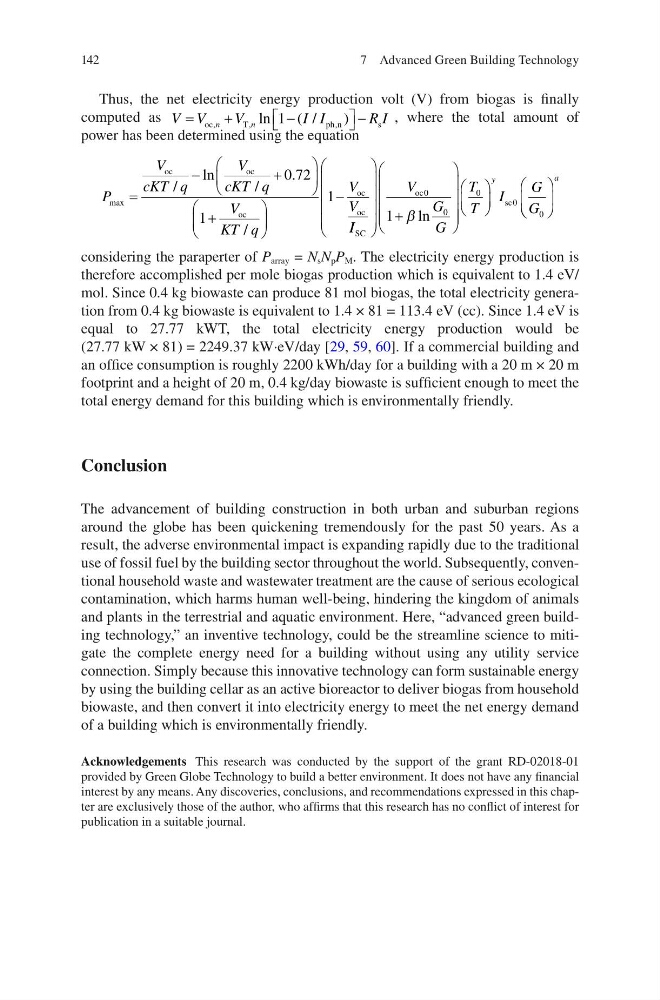
Thus, the net electricity energy production volt (V) from biogas is finally
computed as V V
V
I I
RI
n
n
=
+
−
−
oc
T
p h n
s
,
,
,
ln
( /
)
1
, where the total amount of
power has been determined using the equation
P
V
cKT q
V
cKT q
V
KT q
V
V
max
/
ln
/
.
/
=
−
+
+
−
oc
oc
oc
oc
oc
0 72
1
1
I I
V
G
G
T
T
I
G
G
y
SC
oc
sc
+
0
0
0
0
0
1 β ln
a
considering the paraperter of P array = N s N p P M . The electricity energy production is
therefore accomplished per mole biogas production which is equivalent to 1.4 eV/
mol. Since 0.4 kg biowaste can produce 81 mol biogas, the total electricity generation from 0.4 kg biowaste is equivalent to 1.4 × 81 = 113.4 eV (cc). Since 1.4 eV is
equal to 27.77 kWT, the total electricity energy production would be
(27.77 kW × 81) = 2249.37 kW·eV/day [29, 59, 60]. If a commercial building and
an office consumption is roughly 2200 kWh/day for a building with a 20 m × 20 m
footprint and a height of 20 m, 0.4 kg/day biowaste is sufficient enough to meet the
total energy demand for this building which is environmentally friendly.
Conclusion
The advancement of building construction in both urban and suburban regions
around the globe has been quickening tremendously for the past 50 years. As a
result, the adverse environmental impact is expanding rapidly due to the traditional
use of fossil fuel by the building sector throughout the world. Subsequently, conventional household waste and wastewater treatment are the cause of serious ecological
contamination, which harms human well-being, hindering the kingdom of animals
and plants in the terrestrial and aquatic environment. Here, “advanced green building technology,” an inventive technology, could be the streamline science to mitigate the complete energy need for a building without using any utility service
connection. Simply because this innovative technology can form sustainable energy
by using the building cellar as an active bioreactor to deliver biogas from household
biowaste, and then convert it into electricity energy to meet the net energy demand
of a building which is environmentally friendly.
Acknowledgements This research was conducted by the support of the grant RD-02018-01
provided by Green Globe Technology to build a better environment. It does not have any financial
interest by any means. Any discoveries, conclusions, and recommendations expressed in this chapter are exclusively those of the author, who affirms that this research has no conflict of interest for
publication in a suitable journal.
7 Advanced Green Building Technology
Thus, the net electricity energy production volt (V) from biogas is finally
computed as V V
V
I I
RI
n
n
=
+
−
−
oc
T
p h n
s
,
,
,
ln
( /
)
1
, where the total amount of
power has been determined using the equation
P
V
cKT q
V
cKT q
V
KT q
V
V
max
/
ln
/
.
/
=
−
+
+
−
oc
oc
oc
oc
oc
0 72
1
1
I I
V
G
G
T
T
I
G
G
y
SC
oc
sc
+
0
0
0
0
0
1 β ln
a
considering the paraperter of P array = N s N p P M . The electricity energy production is
therefore accomplished per mole biogas production which is equivalent to 1.4 eV/
mol. Since 0.4 kg biowaste can produce 81 mol biogas, the total electricity generation from 0.4 kg biowaste is equivalent to 1.4 × 81 = 113.4 eV (cc). Since 1.4 eV is
equal to 27.77 kWT, the total electricity energy production would be
(27.77 kW × 81) = 2249.37 kW·eV/day [29, 59, 60]. If a commercial building and
an office consumption is roughly 2200 kWh/day for a building with a 20 m × 20 m
footprint and a height of 20 m, 0.4 kg/day biowaste is sufficient enough to meet the
total energy demand for this building which is environmentally friendly.
Conclusion
The advancement of building construction in both urban and suburban regions
around the globe has been quickening tremendously for the past 50 years. As a
result, the adverse environmental impact is expanding rapidly due to the traditional
use of fossil fuel by the building sector throughout the world. Subsequently, conventional household waste and wastewater treatment are the cause of serious ecological
contamination, which harms human well-being, hindering the kingdom of animals
and plants in the terrestrial and aquatic environment. Here, “advanced green building technology,” an inventive technology, could be the streamline science to mitigate the complete energy need for a building without using any utility service
connection. Simply because this innovative technology can form sustainable energy
by using the building cellar as an active bioreactor to deliver biogas from household
biowaste, and then convert it into electricity energy to meet the net energy demand
of a building which is environmentally friendly.
Acknowledgements This research was conducted by the support of the grant RD-02018-01
provided by Green Globe Technology to build a better environment. It does not have any financial
interest by any means. Any discoveries, conclusions, and recommendations expressed in this chapter are exclusively those of the author, who affirms that this research has no conflict of interest for
publication in a suitable journal.
7 Advanced Green Building Technology