

2.3 Cantilever Bending Method for Measurement of Changes in Surface …
59
relative to the surface charge density represents the sign of
∂g
∂q
. Therefore, the value
of
∂g
∂q
obtained as a function of potential by DSA [35, 36] is comparable with that of
∂g
∂q
obtained from the q-estance method [2]. The DSA method is useful to evaluate
the electro-chemo-mechanical properties of solid electrode surfaces. The details and
typical application results of DSA are described and discussed in the Sect. 3.4.2 of
Chap. 3.
2.4 Elastic Deformation of Metal Electrode Associated
with Surface Stress
An extensometer is capable of measuring the changes in surface stress from the
relative changes in length of a very thin metal ribbon or wire (as a working electrode)
as a function of electrode potential in electrolyte solution. The principle and details
of the extensometer method have been described elsewhere [1, 13, 37]. In addition,
the stress effect on open circuit potential [38, 39] has been investigated by applying
a force to a very thin metal wire in electrolyte solution which is quite similar to the
extensometer method.
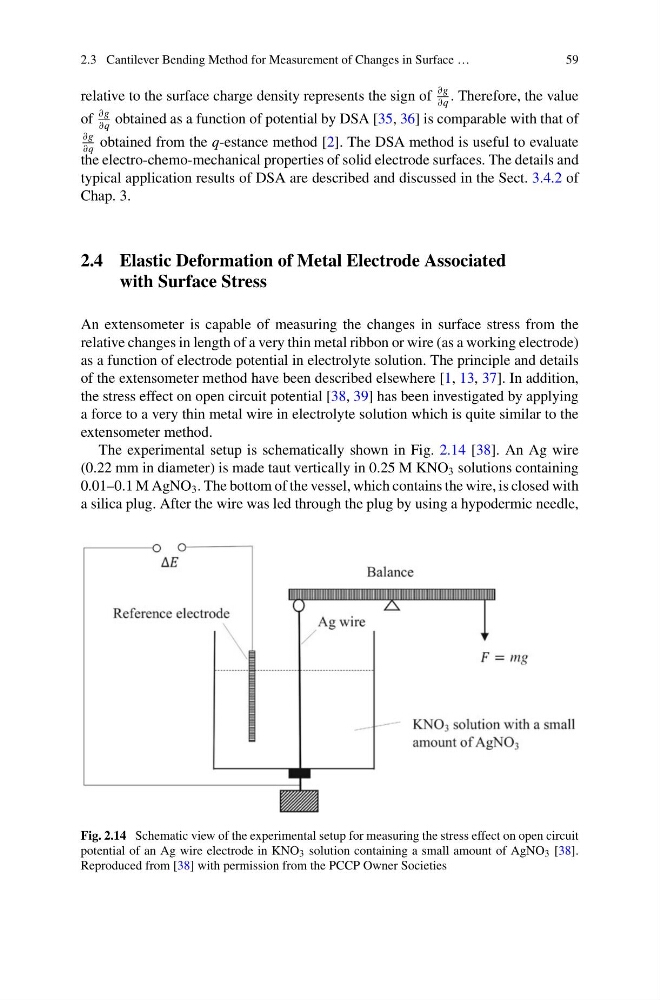
The experimental setup is schematically shown in Fig. 2.14 [38]. An Ag wire
(0.22 mm in diameter) is made taut vertically in 0.25 M KNO 3 solutions containing
0.01–0.1 M AgNO 3 . The bottom of the vessel, which contains the wire, is closed with
a silica plug. After the wire was led through the plug by using a hypodermic needle,
Fig. 2.14 Schematic view of the experimental setup for measuring the stress effect on open circuit
potential of an Ag wire electrode in KNO 3 solution containing a small amount of AgNO 3 [38].
Reproduced from [38] with permission from the PCCP Owner Societies
59
relative to the surface charge density represents the sign of
∂g
∂q
. Therefore, the value
of
∂g
∂q
obtained as a function of potential by DSA [35, 36] is comparable with that of
∂g
∂q
obtained from the q-estance method [2]. The DSA method is useful to evaluate
the electro-chemo-mechanical properties of solid electrode surfaces. The details and
typical application results of DSA are described and discussed in the Sect. 3.4.2 of
Chap. 3.
2.4 Elastic Deformation of Metal Electrode Associated
with Surface Stress
An extensometer is capable of measuring the changes in surface stress from the
relative changes in length of a very thin metal ribbon or wire (as a working electrode)
as a function of electrode potential in electrolyte solution. The principle and details
of the extensometer method have been described elsewhere [1, 13, 37]. In addition,
the stress effect on open circuit potential [38, 39] has been investigated by applying
a force to a very thin metal wire in electrolyte solution which is quite similar to the
extensometer method.
The experimental setup is schematically shown in Fig. 2.14 [38]. An Ag wire
(0.22 mm in diameter) is made taut vertically in 0.25 M KNO 3 solutions containing
0.01–0.1 M AgNO 3 . The bottom of the vessel, which contains the wire, is closed with
a silica plug. After the wire was led through the plug by using a hypodermic needle,
Fig. 2.14 Schematic view of the experimental setup for measuring the stress effect on open circuit
potential of an Ag wire electrode in KNO 3 solution containing a small amount of AgNO 3 [38].
Reproduced from [38] with permission from the PCCP Owner Societies