

56
2 Methods for Investigating Electro-Chemo-Mechanical …
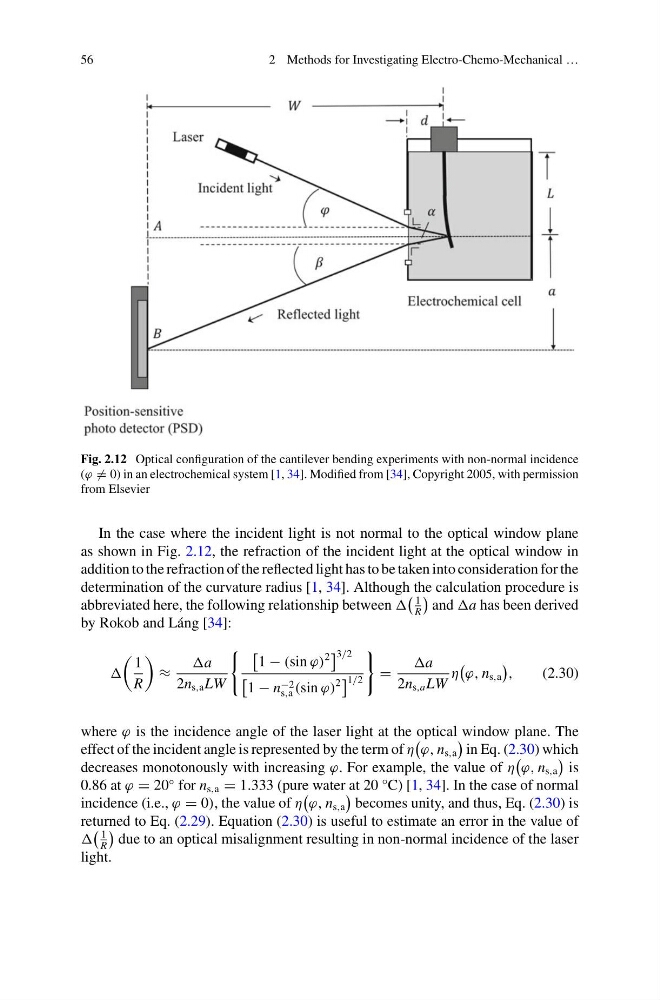
Fig. 2.12 Optical configuration of the cantilever bending experiments with non-normal incidence
(ϕ = 0) in an electrochemical system [1, 34]. Modified from [34], Copyright 2005, with permission
from Elsevier
In the case where the incident light is not normal to the optical window plane
as shown in Fig. 2.12, the refraction of the incident light at the optical window in
addition to the refraction of the reflected light has to be taken into consideration for the
determination of the curvature radius [1, 34]. Although the calculation procedure is
abbreviated here, the following relationship between
1
R
and a has been derived
by Rokob and Láng [34]:
1
R
≈
a
2n s,a LW
1 − (sin ϕ)
2
3/2
1 − n −2
s,a (sin ϕ)
2
1/2
=
a
2n s,a LW
η
ϕ, n s,a
,
(2.30)
where ϕ is the incidence angle of the laser light at the optical window plane. The
effect of the incident angle is represented by the term of η
ϕ, n s,a
in Eq. (2.30) which
decreases monotonously with increasing ϕ. For example, the value of η
ϕ, n s,a
is
0.86 at ϕ = 20
◦ for n s,a = 1.333 (pure water at 20 °C) [1, 34]. In the case of normal
incidence (i.e., ϕ = 0), the value of η
ϕ, n s,a
becomes unity, and thus, Eq. (2.30) is
returned to Eq. (2.29). Equation (2.30) is useful to estimate an error in the value of
1
R
due to an optical misalignment resulting in non-normal incidence of the laser
light.
2 Methods for Investigating Electro-Chemo-Mechanical …
Fig. 2.12 Optical configuration of the cantilever bending experiments with non-normal incidence
(ϕ = 0) in an electrochemical system [1, 34]. Modified from [34], Copyright 2005, with permission
from Elsevier
In the case where the incident light is not normal to the optical window plane
as shown in Fig. 2.12, the refraction of the incident light at the optical window in
addition to the refraction of the reflected light has to be taken into consideration for the
determination of the curvature radius [1, 34]. Although the calculation procedure is
abbreviated here, the following relationship between
1
R
and a has been derived
by Rokob and Láng [34]:
1
R
≈
a
2n s,a LW
1 − (sin ϕ)
2
3/2
1 − n −2
s,a (sin ϕ)
2
1/2
=
a
2n s,a LW
η
ϕ, n s,a
,
(2.30)
where ϕ is the incidence angle of the laser light at the optical window plane. The
effect of the incident angle is represented by the term of η
ϕ, n s,a
in Eq. (2.30) which
decreases monotonously with increasing ϕ. For example, the value of η
ϕ, n s,a
is
0.86 at ϕ = 20
◦ for n s,a = 1.333 (pure water at 20 °C) [1, 34]. In the case of normal
incidence (i.e., ϕ = 0), the value of η
ϕ, n s,a
becomes unity, and thus, Eq. (2.30) is
returned to Eq. (2.29). Equation (2.30) is useful to estimate an error in the value of
1
R
due to an optical misalignment resulting in non-normal incidence of the laser
light.