

36
1 Surface Thermodynamics of Solid Electrode
and for an isotropic substance or for a crystal surface with a threefold or greater axis
of symmetry,
g = g
1 0
0 1
,
(1.147)
in which g xy and g yx vanish, and the normal components of the tensor is equal to the
tensor itself (see Eq. (1.69) or Eq. (1.80)).
Appendix 2: Calculation of the Magnitude of Surface Elastic
Strain from the Curvature Change of Cantilever Bending
The following relationship between curvature radius of the cantilever bending R and
surface stress g holds [21, 39] (see Eq. (2.14) in Sect. 2.3.1 of Chap. 2):
1
R
=
6(1 − ν s )
E s d 2
s
g,
where E s , ν s , and d s are Young’s modulus, Poisson’s ratio, and thickness of the
cantilever substrate, respectively. The surface strain ε is given by
ε =
d s
2R
,
(1.148)
and a linear relationship between ε and g for small deformations is
ε =
3(1 − ν s )g
E s d s
.
(1.149)
Furthermore, the term
∂ε
∂E
T ,μ i
can be derived from Eq. (1.149):
∂ε
∂E
T ,μ i
=
3(1 − ν s )
E s d s
∂g
∂E
T ,μ i
.
(1.150)
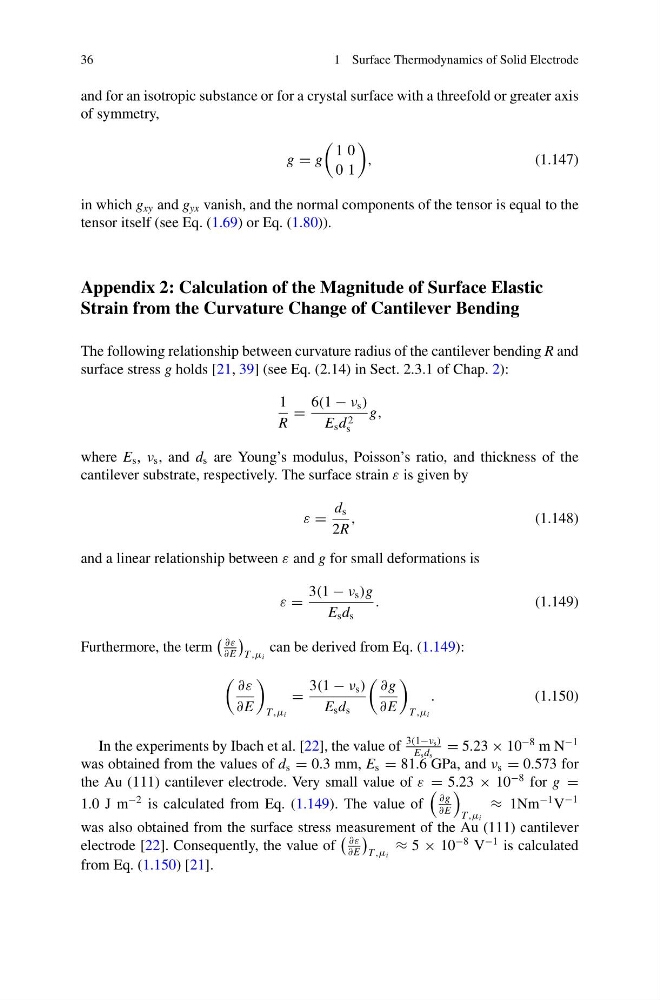
In the experiments by Ibach et al. [22], the value of
3(1−ν s )
E s d s
= 5.23 × 10
−8 m N
−1
was obtained from the values of d s = 0.3 mm, E s = 81.6 GPa, and ν s = 0.573 for
the Au (111) cantilever electrode. Very small value of ε = 5.23 × 10
−8 for g =
1.0 J m
−2 is calculated from Eq. (1.149). The value of
∂g
∂E
T ,μ i
≈ 1Nm
−1 V
−1
was also obtained from the surface stress measurement of the Au (111) cantilever
electrode [22]. Consequently, the value of
∂ε
∂E
T ,μ i
≈ 5 × 10
−8 V
−1 is calculated
from Eq. (1.150) [21].
1 Surface Thermodynamics of Solid Electrode
and for an isotropic substance or for a crystal surface with a threefold or greater axis
of symmetry,
g = g
1 0
0 1
,
(1.147)
in which g xy and g yx vanish, and the normal components of the tensor is equal to the
tensor itself (see Eq. (1.69) or Eq. (1.80)).
Appendix 2: Calculation of the Magnitude of Surface Elastic
Strain from the Curvature Change of Cantilever Bending
The following relationship between curvature radius of the cantilever bending R and
surface stress g holds [21, 39] (see Eq. (2.14) in Sect. 2.3.1 of Chap. 2):
1
R
=
6(1 − ν s )
E s d 2
s
g,
where E s , ν s , and d s are Young’s modulus, Poisson’s ratio, and thickness of the
cantilever substrate, respectively. The surface strain ε is given by
ε =
d s
2R
,
(1.148)
and a linear relationship between ε and g for small deformations is
ε =
3(1 − ν s )g
E s d s
.
(1.149)
Furthermore, the term
∂ε
∂E
T ,μ i
can be derived from Eq. (1.149):
∂ε
∂E
T ,μ i
=
3(1 − ν s )
E s d s
∂g
∂E
T ,μ i
.
(1.150)
In the experiments by Ibach et al. [22], the value of
3(1−ν s )
E s d s
= 5.23 × 10
−8 m N
−1
was obtained from the values of d s = 0.3 mm, E s = 81.6 GPa, and ν s = 0.573 for
the Au (111) cantilever electrode. Very small value of ε = 5.23 × 10
−8 for g =
1.0 J m
−2 is calculated from Eq. (1.149). The value of
∂g
∂E
T ,μ i
≈ 1Nm
−1 V
−1
was also obtained from the surface stress measurement of the Au (111) cantilever
electrode [22]. Consequently, the value of
∂ε
∂E
T ,μ i
≈ 5 × 10
−8 V
−1 is calculated
from Eq. (1.150) [21].