

Appendix 1: Derivation of the Tensor Equivalent of the Shuttleworth Equation
35
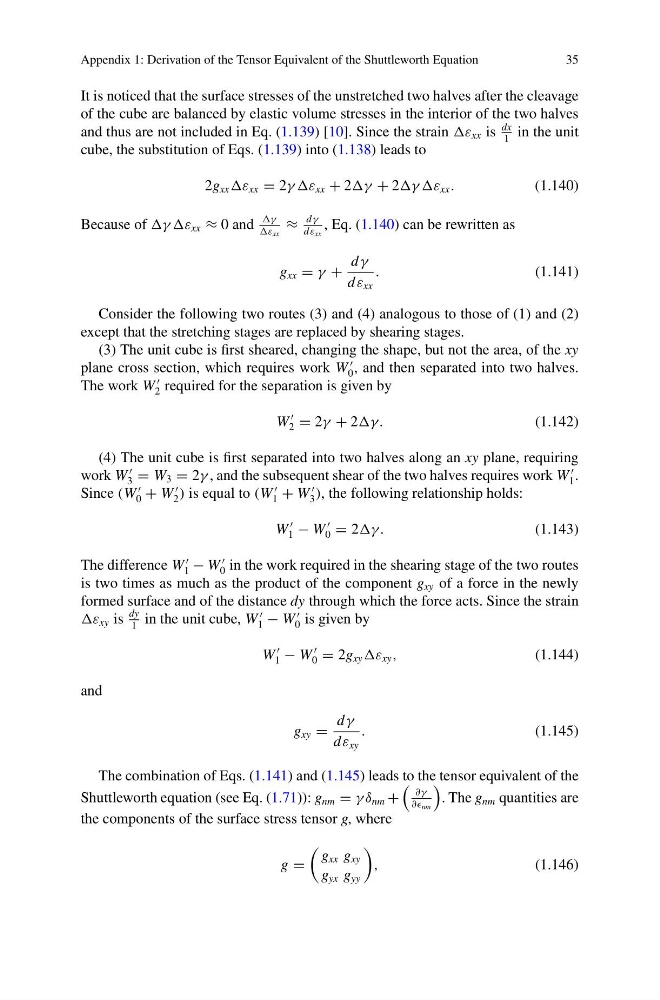
It is noticed that the surface stresses of the unstretched two halves after the cleavage
of the cube are balanced by elastic volume stresses in the interior of the two halves
and thus are not included in Eq. (1.139) [10]. Since the strain ε xx is
dx
1
in the unit
cube, the substitution of Eqs. (1.139) into (1.138) leads to
2g xx ε xx = 2γ γε xx + 2γ + 2γ γε xx .
(1.140)
Because of γ γε xx ≈ 0 and
γ
ε xx
≈
d γ
d ε xx
, Eq. (1.140) can be rewritten as
g xx = γ +
d γ
d ε xx
.
(1.141)
Consider the following two routes (3) and (4) analogous to those of (1) and (2)
except that the stretching stages are replaced by shearing stages.
(3) The unit cube is first sheared, changing the shape, but not the area, of the xy
plane cross section, which requires work W
0 , and then separated into two halves.
The work W
2 required for the separation is given by
W
2 = 2γ + 2 .
(1.142)
(4) The unit cube is first separated into two halves along an xy plane, requiring
work W
3 = W 3 = 2γ , and the subsequent shear of the two halves requires work W
1 .
Since (W
0 + W
2 ) is equal to (W
1 + W
3 ), the following relationship holds:
W
1 − W
0 = 2 .
(1.143)
The difference W
1 − W
0 in the work required in the shearing stage of the two routes
is two times as much as the product of the component g xy of a force in the newly
formed surface and of the distance dy through which the force acts. Since the strain
ε xy is
dy
1
in the unit cube, W
1 − W
0 is given by
W
1 − W
0 = 2g xy ε xy ,
(1.144)
and
g xy =
d γ
d ε xy
.
(1.145)
The combination of Eqs. (1.141) and (1.145) leads to the tensor equivalent of the
Shuttleworth equation (see Eq. (1.71)): g nm = γ δ nm +
∂γ
∂∂ nm
. The g nm quantities are
the components of the surface stress tensor g, where
g =
g xx g xy
g yx g yy
,
(1.146)
35
It is noticed that the surface stresses of the unstretched two halves after the cleavage
of the cube are balanced by elastic volume stresses in the interior of the two halves
and thus are not included in Eq. (1.139) [10]. Since the strain ε xx is
dx
1
in the unit
cube, the substitution of Eqs. (1.139) into (1.138) leads to
2g xx ε xx = 2γ γε xx + 2γ + 2γ γε xx .
(1.140)
Because of γ γε xx ≈ 0 and
γ
ε xx
≈
d γ
d ε xx
, Eq. (1.140) can be rewritten as
g xx = γ +
d γ
d ε xx
.
(1.141)
Consider the following two routes (3) and (4) analogous to those of (1) and (2)
except that the stretching stages are replaced by shearing stages.
(3) The unit cube is first sheared, changing the shape, but not the area, of the xy
plane cross section, which requires work W
0 , and then separated into two halves.
The work W
2 required for the separation is given by
W
2 = 2γ + 2 .
(1.142)
(4) The unit cube is first separated into two halves along an xy plane, requiring
work W
3 = W 3 = 2γ , and the subsequent shear of the two halves requires work W
1 .
Since (W
0 + W
2 ) is equal to (W
1 + W
3 ), the following relationship holds:
W
1 − W
0 = 2 .
(1.143)
The difference W
1 − W
0 in the work required in the shearing stage of the two routes
is two times as much as the product of the component g xy of a force in the newly
formed surface and of the distance dy through which the force acts. Since the strain
ε xy is
dy
1
in the unit cube, W
1 − W
0 is given by
W
1 − W
0 = 2g xy ε xy ,
(1.144)
and
g xy =
d γ
d ε xy
.
(1.145)
The combination of Eqs. (1.141) and (1.145) leads to the tensor equivalent of the
Shuttleworth equation (see Eq. (1.71)): g nm = γ δ nm +
∂γ
∂∂ nm
. The g nm quantities are
the components of the surface stress tensor g, where
g =
g xx g xy
g yx g yy
,
(1.146)