

1.6 Surface Tension and Surface Stress
15
In Eq. (1.69), ∂ε =
∂a
a
is the elastic strain and corresponds to the second term in
the right-hand side of Eq. (1.22). Equation (1.69) is named “Shuttleworth equation”
since Shuttleworth [7] derived first this equation for an isotropic solid surface.
In the case where the surface is subjected to partly plastic and elastic deformation,
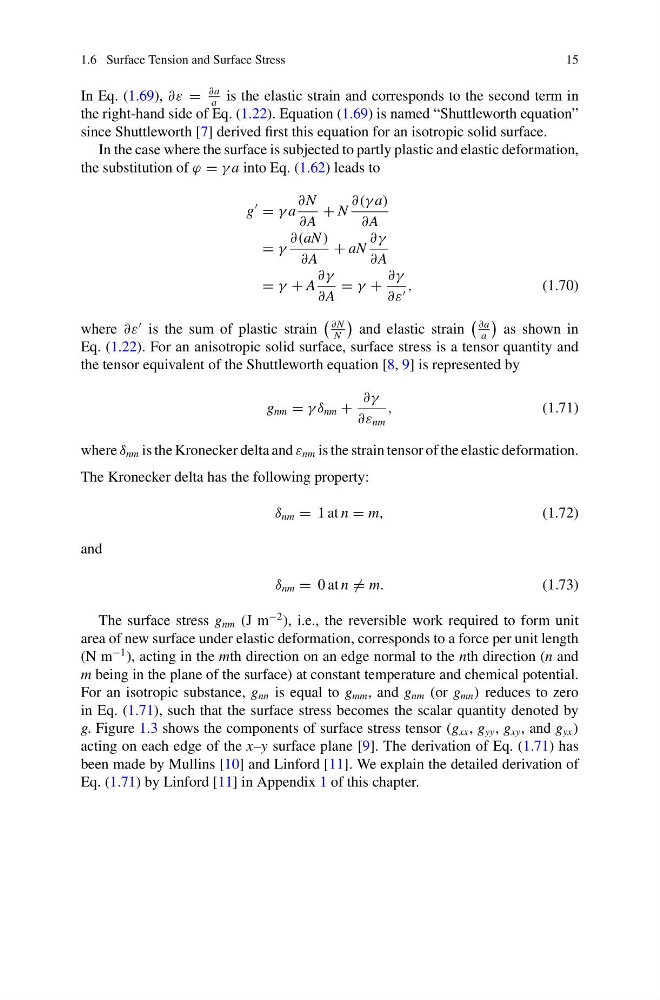
the substitution of ϕ = γ a into Eq. (1.62) leads to
g
= γ a
∂N
∂A
+ N
∂(γ a)
∂A
= γ
∂(aN )
∂A
+ aN
∂γ
∂A
= γ + A
∂γ
∂A
= γ +
∂γ
∂ε ,
(1.70)
where ∂ε
is the sum of plastic strain
∂N
N
and elastic strain
∂a
a
as shown in
Eq. (1.22). For an anisotropic solid surface, surface stress is a tensor quantity and
the tensor equivalent of the Shuttleworth equation [8, 9] is represented by
g nm = γ δ nm +
∂γ
∂ε nm
,
(1.71)
where δ nm is the Kronecker delta and ε nm is the strain tensor of the elastic deformation.
The Kronecker delta has the following property:
δ nm = 1 at n = m,
(1.72)
and
δ nm = 0 at n = m.
(1.73)
The surface stress g nm (J m
−2 ), i.e., the reversible work required to form unit
area of new surface under elastic deformation, corresponds to a force per unit length
(N m
−1 ), acting in the mth direction on an edge normal to the nth direction (n and
m being in the plane of the surface) at constant temperature and chemical potential.
For an isotropic substance, g nn is equal to g mm , and g nm (or g mn ) reduces to zero
in Eq. (1.71), such that the surface stress becomes the scalar quantity denoted by
g. Figure 1.3 shows the components of surface stress tensor (g xx , g yy , g xy , and g yx )
acting on each edge of the x–y surface plane [9]. The derivation of Eq. (1.71) has
been made by Mullins [10] and Linford [11]. We explain the detailed derivation of
Eq. (1.71) by Linford [11] in Appendix 1 of this chapter.
15
In Eq. (1.69), ∂ε =
∂a
a
is the elastic strain and corresponds to the second term in
the right-hand side of Eq. (1.22). Equation (1.69) is named “Shuttleworth equation”
since Shuttleworth [7] derived first this equation for an isotropic solid surface.
In the case where the surface is subjected to partly plastic and elastic deformation,
the substitution of ϕ = γ a into Eq. (1.62) leads to
g
= γ a
∂N
∂A
+ N
∂(γ a)
∂A
= γ
∂(aN )
∂A
+ aN
∂γ
∂A
= γ + A
∂γ
∂A
= γ +
∂γ
∂ε ,
(1.70)
where ∂ε
is the sum of plastic strain
∂N
N
and elastic strain
∂a
a
as shown in
Eq. (1.22). For an anisotropic solid surface, surface stress is a tensor quantity and
the tensor equivalent of the Shuttleworth equation [8, 9] is represented by
g nm = γ δ nm +
∂γ
∂ε nm
,
(1.71)
where δ nm is the Kronecker delta and ε nm is the strain tensor of the elastic deformation.
The Kronecker delta has the following property:
δ nm = 1 at n = m,
(1.72)
and
δ nm = 0 at n = m.
(1.73)
The surface stress g nm (J m
−2 ), i.e., the reversible work required to form unit
area of new surface under elastic deformation, corresponds to a force per unit length
(N m
−1 ), acting in the mth direction on an edge normal to the nth direction (n and
m being in the plane of the surface) at constant temperature and chemical potential.
For an isotropic substance, g nn is equal to g mm , and g nm (or g mn ) reduces to zero
in Eq. (1.71), such that the surface stress becomes the scalar quantity denoted by
g. Figure 1.3 shows the components of surface stress tensor (g xx , g yy , g xy , and g yx )
acting on each edge of the x–y surface plane [9]. The derivation of Eq. (1.71) has
been made by Mullins [10] and Linford [11]. We explain the detailed derivation of
Eq. (1.71) by Linford [11] in Appendix 1 of this chapter.