

14
1 Surface Thermodynamics of Solid Electrode
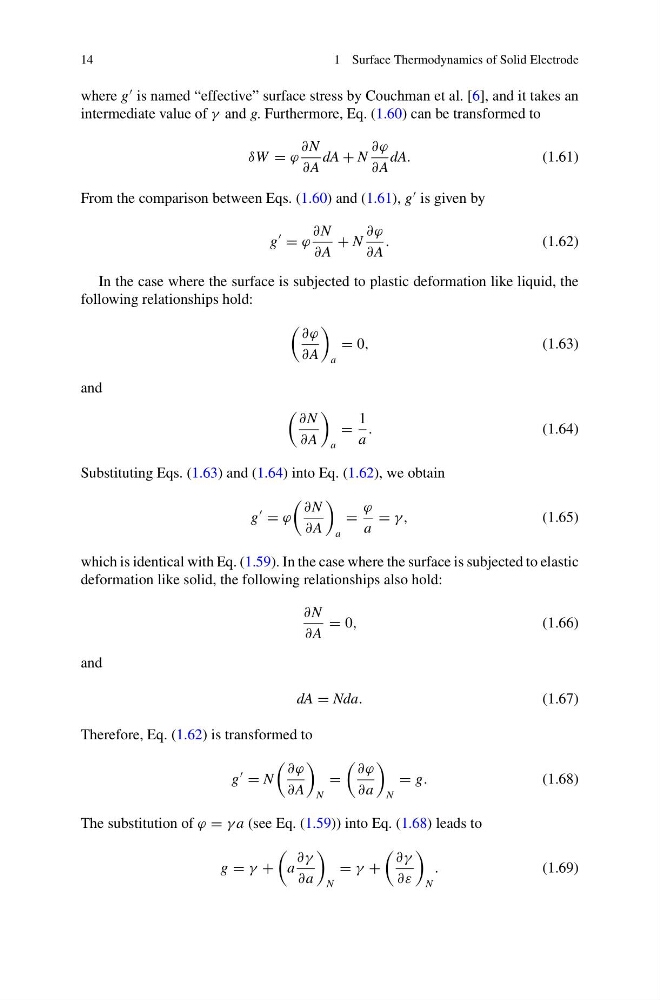
where g
is named “effective” surface stress by Couchman et al. [6], and it takes an
intermediate value of γ and g. Furthermore, Eq. (1.60) can be transformed to
δW = ϕ
∂N
∂A
dA + N
∂ϕ
∂A
dA.
(1.61)
From the comparison between Eqs. (1.60) and (1.61), g
is given by
g
= ϕ
∂N
∂A
+ N
∂ϕ
∂A
.
(1.62)
In the case where the surface is subjected to plastic deformation like liquid, the
following relationships hold:
∂ϕ
∂A
a
= 0,
(1.63)
and
∂N
∂A
a
=
1
a
.
(1.64)
Substituting Eqs. (1.63) and (1.64) into Eq. (1.62), we obtain
g
= ϕ
∂N
∂A
a
=
ϕ
a
= γ,
(1.65)
which is identical with Eq. (1.59). In the case where the surface is subjected to elastic
deformation like solid, the following relationships also hold:
∂N
∂A
= 0,
(1.66)
and
dA = Nda.
(1.67)
Therefore, Eq. (1.62) is transformed to
g
= N
∂ϕ
∂A
N
=
∂ϕ
∂a
N
= g.
(1.68)
The substitution of ϕ = γ a (see Eq. (1.59)) into Eq. (1.68) leads to
g = γ +
a
∂γ
∂a
N
= γ +
∂γ
∂ε
N
.
(1.69)
1 Surface Thermodynamics of Solid Electrode
where g
is named “effective” surface stress by Couchman et al. [6], and it takes an
intermediate value of γ and g. Furthermore, Eq. (1.60) can be transformed to
δW = ϕ
∂N
∂A
dA + N
∂ϕ
∂A
dA.
(1.61)
From the comparison between Eqs. (1.60) and (1.61), g
is given by
g
= ϕ
∂N
∂A
+ N
∂ϕ
∂A
.
(1.62)
In the case where the surface is subjected to plastic deformation like liquid, the
following relationships hold:
∂ϕ
∂A
a
= 0,
(1.63)
and
∂N
∂A
a
=
1
a
.
(1.64)
Substituting Eqs. (1.63) and (1.64) into Eq. (1.62), we obtain
g
= ϕ
∂N
∂A
a
=
ϕ
a
= γ,
(1.65)
which is identical with Eq. (1.59). In the case where the surface is subjected to elastic
deformation like solid, the following relationships also hold:
∂N
∂A
= 0,
(1.66)
and
dA = Nda.
(1.67)
Therefore, Eq. (1.62) is transformed to
g
= N
∂ϕ
∂A
N
=
∂ϕ
∂a
N
= g.
(1.68)
The substitution of ϕ = γ a (see Eq. (1.59)) into Eq. (1.68) leads to
g = γ +
a
∂γ
∂a
N
= γ +
∂γ
∂ε
N
.
(1.69)