

6.9 Plastic Flow of Porous Anodic Oxide Film
175
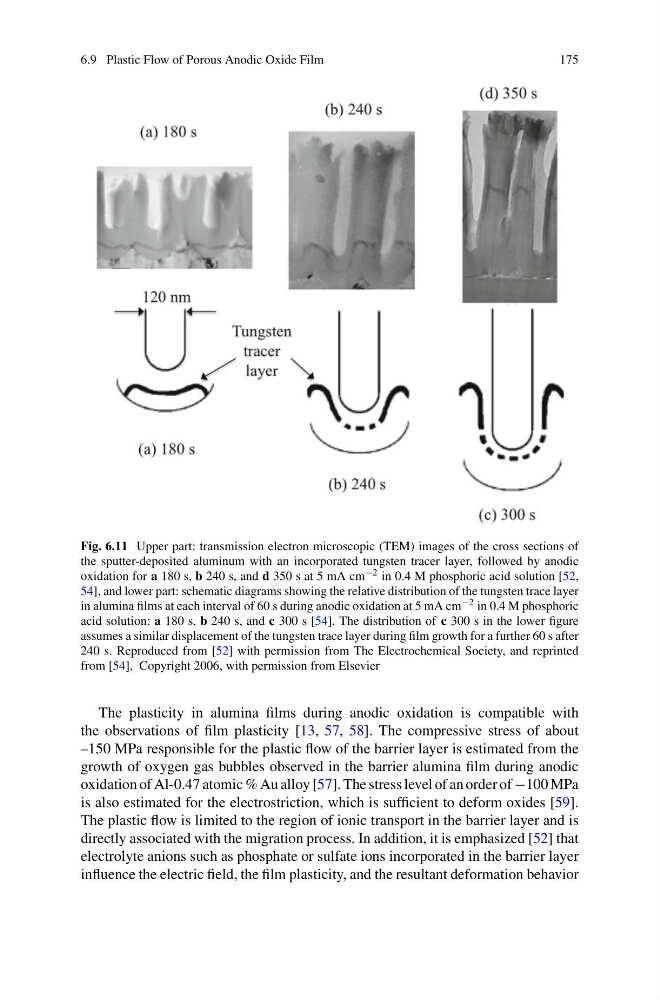
Fig. 6.11 Upper part: transmission electron microscopic (TEM) images of the cross sections of
the sputter-deposited aluminum with an incorporated tungsten tracer layer, followed by anodic
oxidation for a 180 s, b 240 s, and d 350 s at 5 mA cm −2 in 0.4 M phosphoric acid solution [52,
54], and lower part: schematic diagrams showing the relative distribution of the tungsten trace layer
in alumina films at each interval of 60 s during anodic oxidation at 5 mA cm −2 in 0.4 M phosphoric
acid solution: a 180 s, b 240 s, and c 300 s [54]. The distribution of c 300 s in the lower figure
assumes a similar displacement of the tungsten trace layer during film growth for a further 60 s after
240 s. Reproduced from [52] with permission from The Electrochemical Society, and reprinted
from [54], Copyright 2006, with permission from Elsevier
The plasticity in alumina films during anodic oxidation is compatible with
the observations of film plasticity [13, 57, 58]. The compressive stress of about
–150 MPa responsible for the plastic flow of the barrier layer is estimated from the
growth of oxygen gas bubbles observed in the barrier alumina film during anodic
oxidation of Al-0.47 atomic % Au alloy [57]. The stress level of an order of −100 MPa
is also estimated for the electrostriction, which is sufficient to deform oxides [59].
The plastic flow is limited to the region of ionic transport in the barrier layer and is
directly associated with the migration process. In addition, it is emphasized [52] that
electrolyte anions such as phosphate or sulfate ions incorporated in the barrier layer
influence the electric field, the film plasticity, and the resultant deformation behavior
175
Fig. 6.11 Upper part: transmission electron microscopic (TEM) images of the cross sections of
the sputter-deposited aluminum with an incorporated tungsten tracer layer, followed by anodic
oxidation for a 180 s, b 240 s, and d 350 s at 5 mA cm −2 in 0.4 M phosphoric acid solution [52,
54], and lower part: schematic diagrams showing the relative distribution of the tungsten trace layer
in alumina films at each interval of 60 s during anodic oxidation at 5 mA cm −2 in 0.4 M phosphoric
acid solution: a 180 s, b 240 s, and c 300 s [54]. The distribution of c 300 s in the lower figure
assumes a similar displacement of the tungsten trace layer during film growth for a further 60 s after
240 s. Reproduced from [52] with permission from The Electrochemical Society, and reprinted
from [54], Copyright 2006, with permission from Elsevier
The plasticity in alumina films during anodic oxidation is compatible with
the observations of film plasticity [13, 57, 58]. The compressive stress of about
–150 MPa responsible for the plastic flow of the barrier layer is estimated from the
growth of oxygen gas bubbles observed in the barrier alumina film during anodic
oxidation of Al-0.47 atomic % Au alloy [57]. The stress level of an order of −100 MPa
is also estimated for the electrostriction, which is sufficient to deform oxides [59].
The plastic flow is limited to the region of ionic transport in the barrier layer and is
directly associated with the migration process. In addition, it is emphasized [52] that
electrolyte anions such as phosphate or sulfate ions incorporated in the barrier layer
influence the electric field, the film plasticity, and the resultant deformation behavior