

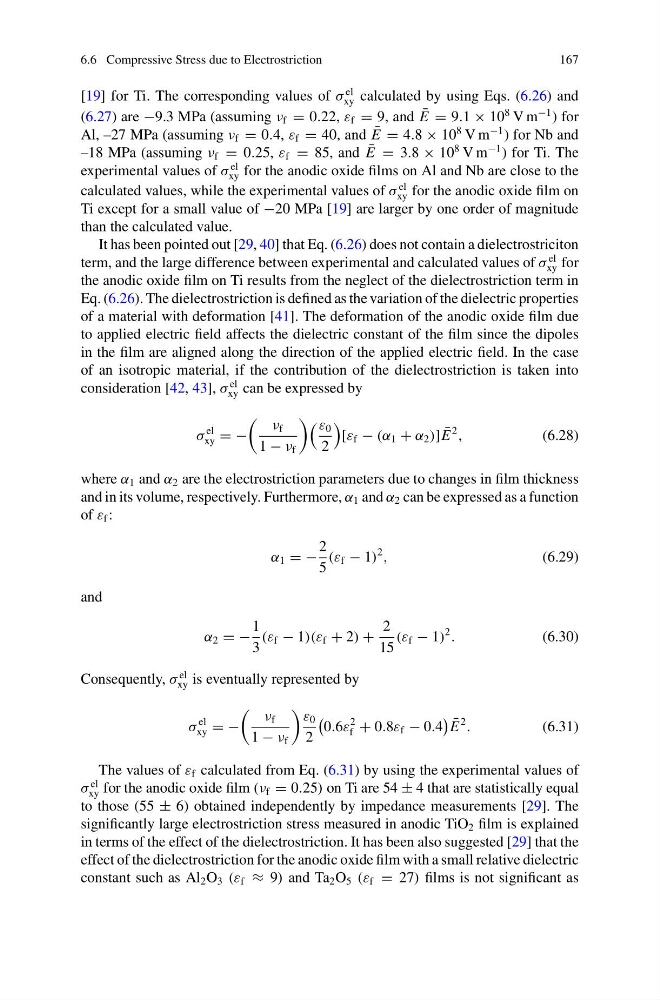
6.6 Compressive Stress due to Electrostriction
167
[19] for Ti. The corresponding values of σ
el
xy calculated by using Eqs. (6.26) and
(6.27) are −9.3 MPa (assuming ν f = 0.22, ε f = 9, and ¯
E = 9.1 × 10
8 V m
−1 ) for
Al, –27 MPa (assuming ν f = 0.4, ε f = 40, and ¯
E = 4.8 × 10
8 V m
−1 ) for Nb and
–18 MPa (assuming ν f = 0.25, ε f = 85, and ¯
E = 3.8 × 10
8 V m
−1 ) for Ti. The
experimental values of σ
el
xy for the anodic oxide films on Al and Nb are close to the
calculated values, while the experimental values of σ
el
xy for the anodic oxide film on
Ti except for a small value of −20 MPa [19] are larger by one order of magnitude
than the calculated value.
It has been pointed out [29, 40] that Eq. (6.26) does not contain a dielectrostriciton
term, and the large difference between experimental and calculated values of σ
el
xy for
the anodic oxide film on Ti results from the neglect of the dielectrostriction term in
Eq. (6.26). The dielectrostriction is defined as the variation of the dielectric properties
of a material with deformation [41]. The deformation of the anodic oxide film due
to applied electric field affects the dielectric constant of the film since the dipoles
in the film are aligned along the direction of the applied electric field. In the case
of an isotropic material, if the contribution of the dielectrostriction is taken into
consideration [42, 43], σ
el
xy can be expressed by
σ
el
xy = −
ν f
1 − ν f
ε 0
2
[ε f − (α 1 + α 2 )] ¯
E
2
,
(6.28)
where α 1 and α 2 are the electrostriction parameters due to changes in film thickness
and in its volume, respectively. Furthermore, α 1 and α 2 can be expressed as a function
of ε f :
α 1 = −
2
5
(ε f − 1)
2
,
(6.29)
and
α 2 = −
1
3
(ε f − 1)(ε f + 2) +
2
15
(ε f − 1)
2
.
(6.30)
Consequently, σ
el
xy is eventually represented by
σ
el
xy = −
ν f
1 − ν f
ε 0
2
0.6ε
2
f + 0.8ε f − 0.4
¯
E
2
.
(6.31)
The values of ε f calculated from Eq. (6.31) by using the experimental values of
σ
el
xy for the anodic oxide film (ν f = 0.25) on Ti are 54 ± 4 that are statistically equal
to those (55 ± 6) obtained independently by impedance measurements [29]. The
significantly large electrostriction stress measured in anodic TiO 2 film is explained
in terms of the effect of the dielectrostriction. It has been also suggested [29] that the
effect of the dielectrostriction for the anodic oxide film with a small relative dielectric
constant such as Al 2 O 3 (ε f ≈ 9) and Ta 2 O 5 (ε f = 27) films is not significant as
167
[19] for Ti. The corresponding values of σ
el
xy calculated by using Eqs. (6.26) and
(6.27) are −9.3 MPa (assuming ν f = 0.22, ε f = 9, and ¯
E = 9.1 × 10
8 V m
−1 ) for
Al, –27 MPa (assuming ν f = 0.4, ε f = 40, and ¯
E = 4.8 × 10
8 V m
−1 ) for Nb and
–18 MPa (assuming ν f = 0.25, ε f = 85, and ¯
E = 3.8 × 10
8 V m
−1 ) for Ti. The
experimental values of σ
el
xy for the anodic oxide films on Al and Nb are close to the
calculated values, while the experimental values of σ
el
xy for the anodic oxide film on
Ti except for a small value of −20 MPa [19] are larger by one order of magnitude
than the calculated value.
It has been pointed out [29, 40] that Eq. (6.26) does not contain a dielectrostriciton
term, and the large difference between experimental and calculated values of σ
el
xy for
the anodic oxide film on Ti results from the neglect of the dielectrostriction term in
Eq. (6.26). The dielectrostriction is defined as the variation of the dielectric properties
of a material with deformation [41]. The deformation of the anodic oxide film due
to applied electric field affects the dielectric constant of the film since the dipoles
in the film are aligned along the direction of the applied electric field. In the case
of an isotropic material, if the contribution of the dielectrostriction is taken into
consideration [42, 43], σ
el
xy can be expressed by
σ
el
xy = −
ν f
1 − ν f
ε 0
2
[ε f − (α 1 + α 2 )] ¯
E
2
,
(6.28)
where α 1 and α 2 are the electrostriction parameters due to changes in film thickness
and in its volume, respectively. Furthermore, α 1 and α 2 can be expressed as a function
of ε f :
α 1 = −
2
5
(ε f − 1)
2
,
(6.29)
and
α 2 = −
1
3
(ε f − 1)(ε f + 2) +
2
15
(ε f − 1)
2
.
(6.30)
Consequently, σ
el
xy is eventually represented by
σ
el
xy = −
ν f
1 − ν f
ε 0
2
0.6ε
2
f + 0.8ε f − 0.4
¯
E
2
.
(6.31)
The values of ε f calculated from Eq. (6.31) by using the experimental values of
σ
el
xy for the anodic oxide film (ν f = 0.25) on Ti are 54 ± 4 that are statistically equal
to those (55 ± 6) obtained independently by impedance measurements [29]. The
significantly large electrostriction stress measured in anodic TiO 2 film is explained
in terms of the effect of the dielectrostriction. It has been also suggested [29] that the
effect of the dielectrostriction for the anodic oxide film with a small relative dielectric
constant such as Al 2 O 3 (ε f ≈ 9) and Ta 2 O 5 (ε f = 27) films is not significant as