

166
6 Stresses of Anodic Oxide Films Grown on Metal Electrode
diffuse media during oxide growth [34, 35]. For example, in the case where interstitial
cation diffuses (or migrate) in the oxide film toward the oxide film/solution interface,
the lattice constant of the oxide film expands in the direction parallel to the interstitial
cation current, leading to the contraction of the lattice constant in the directions
perpendicular to the cation current, by which the tensile stress is generated in parallel
to the film plane. Unfortunately, there have been no experimental reports of the
stress generation associated with the defective structure of the anodic oxide film.
As described above, Nelson–Oriani’s criterion [17] does not account for the stress
factors associated with the annihilation or generation and diffusion (migration) of
the defects in the oxide film in addition to the crystallization and oxygen evolution.
Nevertheless, it is still worthy at the first diagnosis of the film stress to compare the
sign of the measured stress with that predicted from Nelson–Oriani’s criterion [17].
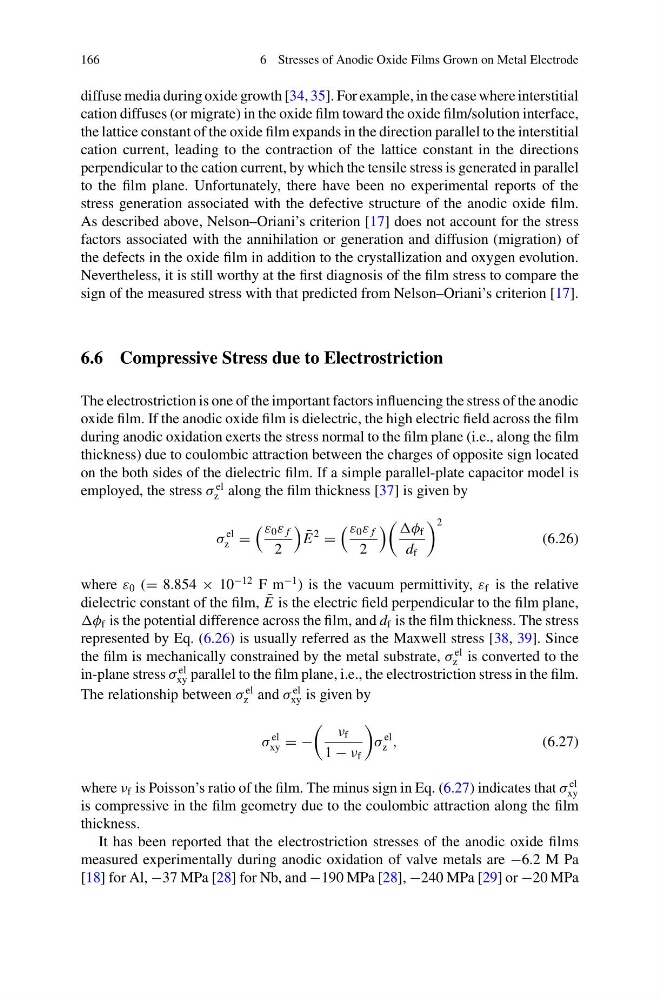
6.6 Compressive Stress due to Electrostriction
The electrostriction is one of the important factors influencing the stress of the anodic
oxide film. If the anodic oxide film is dielectric, the high electric field across the film
during anodic oxidation exerts the stress normal to the film plane (i.e., along the film
thickness) due to coulombic attraction between the charges of opposite sign located
on the both sides of the dielectric film. If a simple parallel-plate capacitor model is
employed, the stress σ
el
z along the film thickness [37] is given by
σ
el
z =
ε 0 ε f
2
¯
E
2
=
ε 0 ε f
2
φ f
d f
2
(6.26)
where ε 0 (= 8.854 × 10
−12 F m
−1 ) is the vacuum permittivity, ε f is the relative
dielectric constant of the film, ¯
E is the electric field perpendicular to the film plane,
φ f is the potential difference across the film, and d f is the film thickness. The stress
represented by Eq. (6.26) is usually referred as the Maxwell stress [38, 39]. Since
the film is mechanically constrained by the metal substrate, σ
el
z is converted to the
in-plane stress σ
el
xy parallel to the film plane, i.e., the electrostriction stress in the film.
The relationship between σ
el
z and σ
el
xy is given by
σ
el
xy = −
ν f
1 − ν f
σ
el
z ,
(6.27)
where ν f is Poisson’s ratio of the film. The minus sign in Eq. (6.27) indicates that σ
el
xy
is compressive in the film geometry due to the coulombic attraction along the film
thickness.
It has been reported that the electrostriction stresses of the anodic oxide films
measured experimentally during anodic oxidation of valve metals are −6.2 M Pa
[18] for Al, −37 MPa [28] for Nb, and −190 MPa [28], −240 MPa [29] or −20 MPa
6 Stresses of Anodic Oxide Films Grown on Metal Electrode
diffuse media during oxide growth [34, 35]. For example, in the case where interstitial
cation diffuses (or migrate) in the oxide film toward the oxide film/solution interface,
the lattice constant of the oxide film expands in the direction parallel to the interstitial
cation current, leading to the contraction of the lattice constant in the directions
perpendicular to the cation current, by which the tensile stress is generated in parallel
to the film plane. Unfortunately, there have been no experimental reports of the
stress generation associated with the defective structure of the anodic oxide film.
As described above, Nelson–Oriani’s criterion [17] does not account for the stress
factors associated with the annihilation or generation and diffusion (migration) of
the defects in the oxide film in addition to the crystallization and oxygen evolution.
Nevertheless, it is still worthy at the first diagnosis of the film stress to compare the
sign of the measured stress with that predicted from Nelson–Oriani’s criterion [17].
6.6 Compressive Stress due to Electrostriction
The electrostriction is one of the important factors influencing the stress of the anodic
oxide film. If the anodic oxide film is dielectric, the high electric field across the film
during anodic oxidation exerts the stress normal to the film plane (i.e., along the film
thickness) due to coulombic attraction between the charges of opposite sign located
on the both sides of the dielectric film. If a simple parallel-plate capacitor model is
employed, the stress σ
el
z along the film thickness [37] is given by
σ
el
z =
ε 0 ε f
2
¯
E
2
=
ε 0 ε f
2
φ f
d f
2
(6.26)
where ε 0 (= 8.854 × 10
−12 F m
−1 ) is the vacuum permittivity, ε f is the relative
dielectric constant of the film, ¯
E is the electric field perpendicular to the film plane,
φ f is the potential difference across the film, and d f is the film thickness. The stress
represented by Eq. (6.26) is usually referred as the Maxwell stress [38, 39]. Since
the film is mechanically constrained by the metal substrate, σ
el
z is converted to the
in-plane stress σ
el
xy parallel to the film plane, i.e., the electrostriction stress in the film.
The relationship between σ
el
z and σ
el
xy is given by
σ
el
xy = −
ν f
1 − ν f
σ
el
z ,
(6.27)
where ν f is Poisson’s ratio of the film. The minus sign in Eq. (6.27) indicates that σ
el
xy
is compressive in the film geometry due to the coulombic attraction along the film
thickness.
It has been reported that the electrostriction stresses of the anodic oxide films
measured experimentally during anodic oxidation of valve metals are −6.2 M Pa
[18] for Al, −37 MPa [28] for Nb, and −190 MPa [28], −240 MPa [29] or −20 MPa