

4.2 Underpotential Deposition (UPD)
105
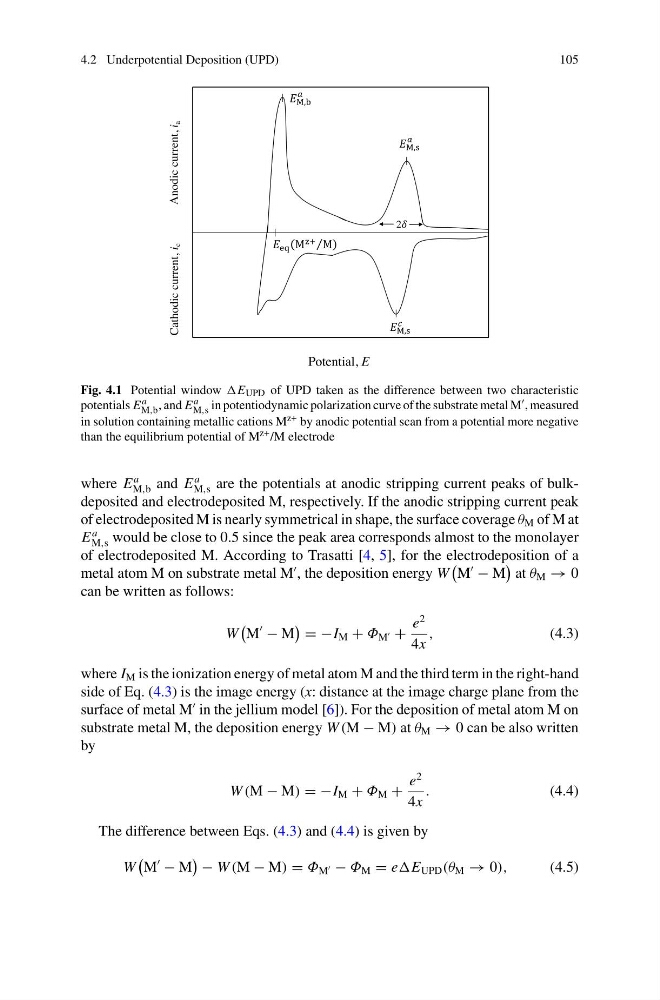
Fig. 4.1 Potential window UPD of UPD taken as the difference between two characteristic
potentials E a
M,b , and E a
M,s in potentiodynamic polarization curve of the substrate metal M , measured
in solution containing metallic cations M z+ by anodic potential scan from a potential more negative
than the equilibrium potential of M z+ /M electrode
where E
a
M,b and E
a
M,s are the potentials at anodic stripping current peaks of bulkdeposited and electrodeposited M, respectively. If the anodic stripping current peak
of electrodeposited M is nearly symmetrical in shape, the surface coverage θ M of M at
E
a
M,s would be close to 0.5 since the peak area corresponds almost to the monolayer
of electrodeposited M. According to Trasatti [4, 5], for the electrodeposition of a
metal atom M on substrate metal M
, the deposition energy W
M
− M
at θ M → 0
can be written as follows:
W
M
− M
= −I M + Φ M
+
e
2
4x
,
(4.3)
where I M is the ionization energy of metal atom M and the third term in the right-hand
side of Eq. (4.3) is the image energy (x: distance at the image charge plane from the
surface of metal M
in the jellium model [6]). For the deposition of metal atom M on
substrate metal M, the deposition energy W (M − M) at θ M → 0 can be also written
by
W (M − M) = −I M + Φ M +
e
2
4x
.
(4.4)
The difference between Eqs. (4.3) and (4.4) is given by
W
M
− M
− W (M − M) = Φ M
− Φ M = e UPD (θ M → 0),
(4.5)
105
Fig. 4.1 Potential window UPD of UPD taken as the difference between two characteristic
potentials E a
M,b , and E a
M,s in potentiodynamic polarization curve of the substrate metal M , measured
in solution containing metallic cations M z+ by anodic potential scan from a potential more negative
than the equilibrium potential of M z+ /M electrode
where E
a
M,b and E
a
M,s are the potentials at anodic stripping current peaks of bulkdeposited and electrodeposited M, respectively. If the anodic stripping current peak
of electrodeposited M is nearly symmetrical in shape, the surface coverage θ M of M at
E
a
M,s would be close to 0.5 since the peak area corresponds almost to the monolayer
of electrodeposited M. According to Trasatti [4, 5], for the electrodeposition of a
metal atom M on substrate metal M
, the deposition energy W
M
− M
at θ M → 0
can be written as follows:
W
M
− M
= −I M + Φ M
+
e
2
4x
,
(4.3)
where I M is the ionization energy of metal atom M and the third term in the right-hand
side of Eq. (4.3) is the image energy (x: distance at the image charge plane from the
surface of metal M
in the jellium model [6]). For the deposition of metal atom M on
substrate metal M, the deposition energy W (M − M) at θ M → 0 can be also written
by
W (M − M) = −I M + Φ M +
e
2
4x
.
(4.4)
The difference between Eqs. (4.3) and (4.4) is given by
W
M
− M
− W (M − M) = Φ M
− Φ M = e UPD (θ M → 0),
(4.5)