

1.8 Electrified Interface and Electrocapillarity
23
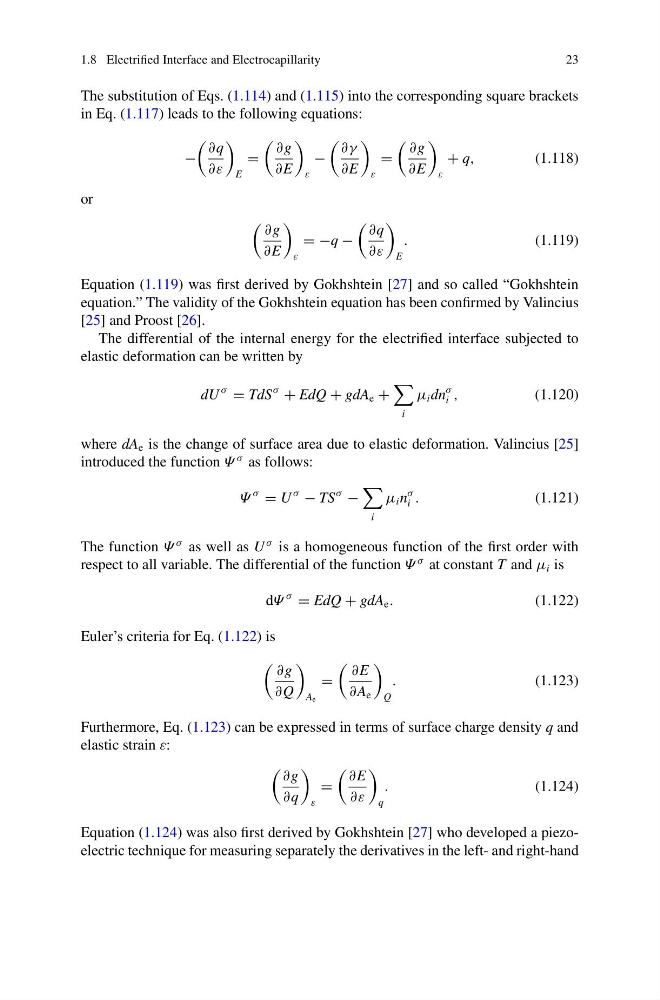
The substitution of Eqs. (1.114) and (1.115) into the corresponding square brackets
in Eq. (1.117) leads to the following equations:
−
∂q
∂ε
E
=
∂g
∂E
ε
−
∂γ
∂E
ε
=
∂g
∂E
ε
+ q,
(1.118)
or
∂g
∂E
ε
= −q −
∂q
∂ε
E
.
(1.119)
Equation (1.119) was first derived by Gokhshtein [27] and so called “Gokhshtein
equation.” The validity of the Gokhshtein equation has been confirmed by Valincius
[25] and Proost [26].
The differential of the internal energy for the electrified interface subjected to
elastic deformation can be written by
dU
σ
= TdS
σ
+ EdQ + gdA e +
i
μ i dn
σ
i ,
(1.120)
where dA e is the change of surface area due to elastic deformation. Valincius [25]
introduced the function Ψ
σ as follows:
Ψ
σ
= U
σ
− TS
σ
−
i
μ i n
σ
i .
(1.121)
The function Ψ
σ as well as U
σ is a homogeneous function of the first order with
respect to all variable. The differential of the function Ψ
σ at constant T and μ i is
dΨ
σ
= EdQ + gdA e .
(1.122)
Euler’s criteria for Eq. (1.122) is
∂g
∂Q
A e
=
∂E
∂A e
Q
.
(1.123)
Furthermore, Eq. (1.123) can be expressed in terms of surface charge density q and
elastic strain ε:
∂g
∂q
ε
=
∂E
∂ε
q
.
(1.124)
Equation (1.124) was also first derived by Gokhshtein [27] who developed a piezoelectric technique for measuring separately the derivatives in the left- and right-hand
23
The substitution of Eqs. (1.114) and (1.115) into the corresponding square brackets
in Eq. (1.117) leads to the following equations:
−
∂q
∂ε
E
=
∂g
∂E
ε
−
∂γ
∂E
ε
=
∂g
∂E
ε
+ q,
(1.118)
or
∂g
∂E
ε
= −q −
∂q
∂ε
E
.
(1.119)
Equation (1.119) was first derived by Gokhshtein [27] and so called “Gokhshtein
equation.” The validity of the Gokhshtein equation has been confirmed by Valincius
[25] and Proost [26].
The differential of the internal energy for the electrified interface subjected to
elastic deformation can be written by
dU
σ
= TdS
σ
+ EdQ + gdA e +
i
μ i dn
σ
i ,
(1.120)
where dA e is the change of surface area due to elastic deformation. Valincius [25]
introduced the function Ψ
σ as follows:
Ψ
σ
= U
σ
− TS
σ
−
i
μ i n
σ
i .
(1.121)
The function Ψ
σ as well as U
σ is a homogeneous function of the first order with
respect to all variable. The differential of the function Ψ
σ at constant T and μ i is
dΨ
σ
= EdQ + gdA e .
(1.122)
Euler’s criteria for Eq. (1.122) is
∂g
∂Q
A e
=
∂E
∂A e
Q
.
(1.123)
Furthermore, Eq. (1.123) can be expressed in terms of surface charge density q and
elastic strain ε:
∂g
∂q
ε
=
∂E
∂ε
q
.
(1.124)
Equation (1.124) was also first derived by Gokhshtein [27] who developed a piezoelectric technique for measuring separately the derivatives in the left- and right-hand