

22
1 Surface Thermodynamics of Solid Electrode
which is typical of an isotropic solid. Needs and Mansfield [19], and Payne et al. [20]
calculated the values of g = 2.77 J m
−2 and γ = 1.25 J m
−2 for the unreconstructed
Au (111) surface by using pseudopotential total energy method. Consequently, the
magnitude of (g − γ ) is estimated to be about 1.5 J m
−2 . Lipkowski et al. [21]
calculated the magnitude of surface elastic strain from the curvature change of a
cantilever bending used for the surface stress measurement of the unreconstructed Au
(111) electrode in HClO 4 solution [22]. The procedure of the calculation is described
in Appendix 2 of this chapter. As a result, the magnitude of
∂ε
∂E
T ,P,μ i
≈ 5 × 10
−8
V
−1 is calculated for the unreconstructed Au (111) electrode [21]. The magnitude of
the last term in the right-hand side of Eq. (1.112) is eventually estimated to be [21]:
(g − γ )
∂ε
∂E
T ,μ i
≈ 7.5 x 10
−8 C m
−2
.
(1.113)
The absolute value of q is around 0.4 C m
−2 for the Au (111) electrode in the potential
region of electric double layer [23, 24] where no significant charge transfer occurs
across the interface. Therefore, the last term in the right-hand side of Eq. (1.112) is
negligibly small compared to the first term. This means that the Lippmann equation
expressed by Eq. (1.109) for a liquid electrode is also valid for a solid electrode.
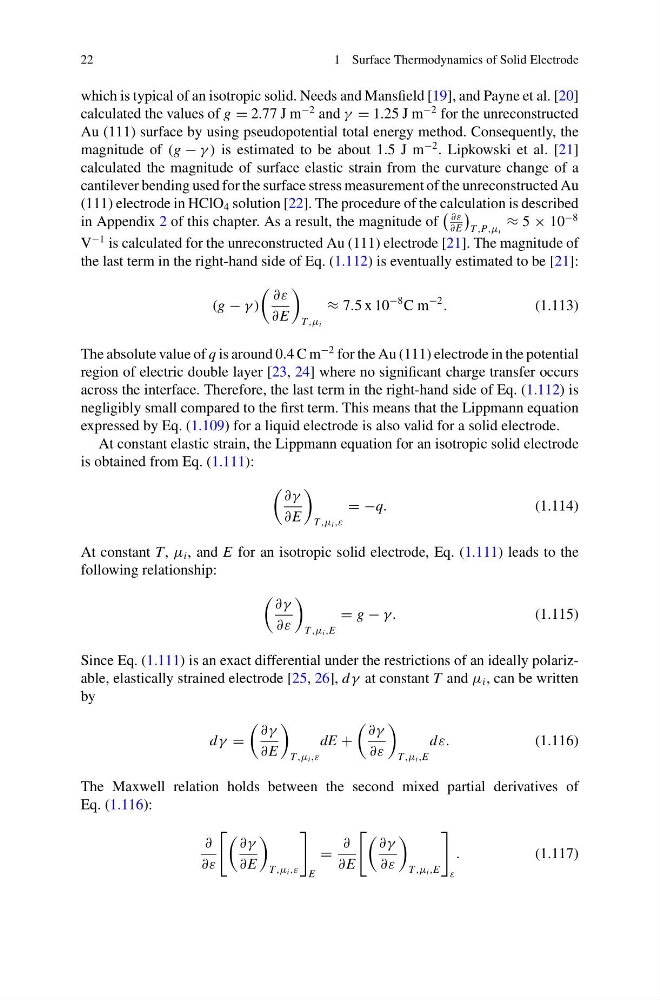
At constant elastic strain, the Lippmann equation for an isotropic solid electrode
is obtained from Eq. (1.111):
∂γ
∂E
T ,μ i ,ε
= −q.
(1.114)
At constant T, μ i , and E for an isotropic solid electrode, Eq. (1.111) leads to the
following relationship:
∂γ
∂ε
T ,μ i ,E
= g − γ.
(1.115)
Since Eq. (1.111) is an exact differential under the restrictions of an ideally polarizable, elastically strained electrode [25, 26], d γ at constant T and μ i , can be written
by
d γ =
∂γ
∂E
T ,μ i ,ε
dE +
∂γ
∂ε
T ,μ i ,E
d ε.
(1.116)
The Maxwell relation holds between the second mixed partial derivatives of
Eq. (1.116):
∂
∂ε
∂γ
∂E
T ,μ i ,ε
E
=
∂
∂E
∂γ
∂ε
T ,μ i ,E
ε
.
(1.117)
1 Surface Thermodynamics of Solid Electrode
which is typical of an isotropic solid. Needs and Mansfield [19], and Payne et al. [20]
calculated the values of g = 2.77 J m
−2 and γ = 1.25 J m
−2 for the unreconstructed
Au (111) surface by using pseudopotential total energy method. Consequently, the
magnitude of (g − γ ) is estimated to be about 1.5 J m
−2 . Lipkowski et al. [21]
calculated the magnitude of surface elastic strain from the curvature change of a
cantilever bending used for the surface stress measurement of the unreconstructed Au
(111) electrode in HClO 4 solution [22]. The procedure of the calculation is described
in Appendix 2 of this chapter. As a result, the magnitude of
∂ε
∂E
T ,P,μ i
≈ 5 × 10
−8
V
−1 is calculated for the unreconstructed Au (111) electrode [21]. The magnitude of
the last term in the right-hand side of Eq. (1.112) is eventually estimated to be [21]:
(g − γ )
∂ε
∂E
T ,μ i
≈ 7.5 x 10
−8 C m
−2
.
(1.113)
The absolute value of q is around 0.4 C m
−2 for the Au (111) electrode in the potential
region of electric double layer [23, 24] where no significant charge transfer occurs
across the interface. Therefore, the last term in the right-hand side of Eq. (1.112) is
negligibly small compared to the first term. This means that the Lippmann equation
expressed by Eq. (1.109) for a liquid electrode is also valid for a solid electrode.
At constant elastic strain, the Lippmann equation for an isotropic solid electrode
is obtained from Eq. (1.111):
∂γ
∂E
T ,μ i ,ε
= −q.
(1.114)
At constant T, μ i , and E for an isotropic solid electrode, Eq. (1.111) leads to the
following relationship:
∂γ
∂ε
T ,μ i ,E
= g − γ.
(1.115)
Since Eq. (1.111) is an exact differential under the restrictions of an ideally polarizable, elastically strained electrode [25, 26], d γ at constant T and μ i , can be written
by
d γ =
∂γ
∂E
T ,μ i ,ε
dE +
∂γ
∂ε
T ,μ i ,E
d ε.
(1.116)
The Maxwell relation holds between the second mixed partial derivatives of
Eq. (1.116):
∂
∂ε
∂γ
∂E
T ,μ i ,ε
E
=
∂
∂E
∂γ
∂ε
T ,μ i ,E
ε
.
(1.117)