

64
4.2 Sample Preparation
The method by which an analyte is obtained and processed for analysis is crucial.
Several considerations must be made for both targeted and untargeted extraction
approaches.
For targeted metabolomics, the extraction method is dependent upon the sample
matrix and class of analytes to be measured. The sample preparation process could
be as simple as dilution of the sample with solvent prior to analysis [12], or as complicated as a multistep extraction involving sample preparation columns and buffer
exchanges followed by a multistep derivatization. The goal of sample preparation is
to mitigate any interference in the measurement of the analytes of interest that may
arise from the complex biological matrix with minimal sample manipulation. Before
choosing an extraction method, it is important to consider necessary down-stream
manipulations. To continue with the above example, amino acids may need to be
extracted from a complex matrix such as cell culture and may require derivatization
for effective reverse phase chromatography. In this case, the extraction can be
accomplished effectively with a mix of methanol, water and formic acid [13], which
are ideal for downstream reverse phase chromatography. Regardless of the extraction method, one major consideration is loss of analyte during sample processing
[14]. To address this problem, a known internal standard is introduced at or near the
beginning of sample preparation to account for loss of analyte as well as any inconsistency such as pipetting error, retention time drifts in chromatography, or instrumental drift [15]. Internal standards can be utilized for normalization of analytes,
where abundances are often reported as ‘response ratios’ to their respective internal
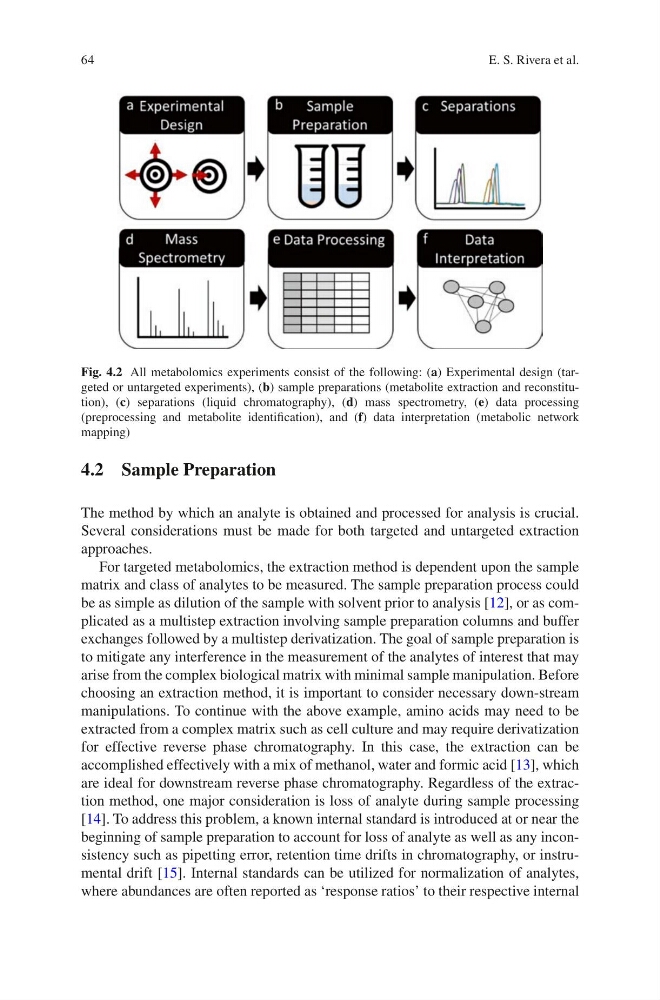
Fig. 4.2 All metabolomics experiments consist of the following: (a) Experimental design (targeted or untargeted experiments), (b) sample preparations (metabolite extraction and reconstitution), (c) separations (liquid chromatography), (d) mass spectrometry, (e) data processing
(preprocessing and metabolite identification), and (f) data interpretation (metabolic network
mapping)
E. S. Rivera et al.
4.2 Sample Preparation
The method by which an analyte is obtained and processed for analysis is crucial.
Several considerations must be made for both targeted and untargeted extraction
approaches.
For targeted metabolomics, the extraction method is dependent upon the sample
matrix and class of analytes to be measured. The sample preparation process could
be as simple as dilution of the sample with solvent prior to analysis [12], or as complicated as a multistep extraction involving sample preparation columns and buffer
exchanges followed by a multistep derivatization. The goal of sample preparation is
to mitigate any interference in the measurement of the analytes of interest that may
arise from the complex biological matrix with minimal sample manipulation. Before
choosing an extraction method, it is important to consider necessary down-stream
manipulations. To continue with the above example, amino acids may need to be
extracted from a complex matrix such as cell culture and may require derivatization
for effective reverse phase chromatography. In this case, the extraction can be
accomplished effectively with a mix of methanol, water and formic acid [13], which
are ideal for downstream reverse phase chromatography. Regardless of the extraction method, one major consideration is loss of analyte during sample processing
[14]. To address this problem, a known internal standard is introduced at or near the
beginning of sample preparation to account for loss of analyte as well as any inconsistency such as pipetting error, retention time drifts in chromatography, or instrumental drift [15]. Internal standards can be utilized for normalization of analytes,
where abundances are often reported as ‘response ratios’ to their respective internal
Fig. 4.2 All metabolomics experiments consist of the following: (a) Experimental design (targeted or untargeted experiments), (b) sample preparations (metabolite extraction and reconstitution), (c) separations (liquid chromatography), (d) mass spectrometry, (e) data processing
(preprocessing and metabolite identification), and (f) data interpretation (metabolic network
mapping)
E. S. Rivera et al.