

63
The targeted approach to metabolomics requires many considerations in order to
produce an assay that is suitable for the biological question under consideration.
The type of quantitation (i.e., absolute or relative), sample preparation, separation
strategy, mass spectrometer parameters, and data analysis approach all must be
implemented to satisfy the ultimate experimental goal. One major advantage of targeted metabolomics is that it allows for absolute quantitation. With known analytes
of interest being investigated, the necessary steps to obtain absolute quantitation are
limited, only requiring the creation of a calibration curve for each analyte to be run
in parallel with samples [9]. Relative quantitation is even easier to obtain experimentally as it entails comparing intensities among samples.
In targeted metabolomics, characteristics of analytes such as solubility, polarity,
and pH can be used to determine the optimal assay parameters. Analytes that can be
grouped together such as amino acids, or short chain fatty acids, can be processed
together for all downstream steps such as extraction, derivatization, and chromatography. For example, amino acids can be extracted in aqueous solvent, as they all
contain a primary amine, which allows for derivatization by dansyl chloride to aid
in chromatography [10]. In addition, these derivatized products can all be separated
by C18 reverse phase chromatography and require similar instrument parameters.
When taking the untargeted approach to a metabolomics experiment, the objective is to broaden the effectiveness of the workflow for simultaneous analysis of a
wide variety of metabolites [11]. As the goal of an untargeted experiment is to
develop an overall metabolic profile of a biological system, it is critical that methods of extraction and separation chosen be broadly inclusive of a diverse range of
metabolites. To achieve these goals, metabolite experiments are comprised of an
experimental design, sample preparation, separation method, mass spectrometric
analysis, data processing and data interpretation (Fig. 4.2).
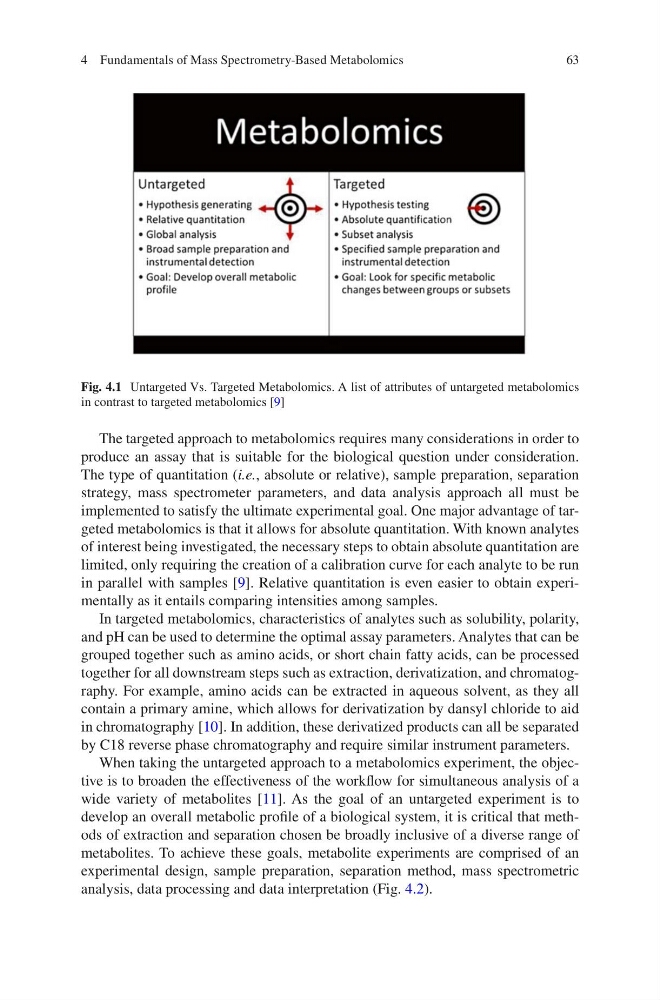
Fig. 4.1 Untargeted Vs. Targeted Metabolomics. A list of attributes of untargeted metabolomics
in contrast to targeted metabolomics [9]
4 Fundamentals of Mass Spectrometry-Based Metabolomics
The targeted approach to metabolomics requires many considerations in order to
produce an assay that is suitable for the biological question under consideration.
The type of quantitation (i.e., absolute or relative), sample preparation, separation
strategy, mass spectrometer parameters, and data analysis approach all must be
implemented to satisfy the ultimate experimental goal. One major advantage of targeted metabolomics is that it allows for absolute quantitation. With known analytes
of interest being investigated, the necessary steps to obtain absolute quantitation are
limited, only requiring the creation of a calibration curve for each analyte to be run
in parallel with samples [9]. Relative quantitation is even easier to obtain experimentally as it entails comparing intensities among samples.
In targeted metabolomics, characteristics of analytes such as solubility, polarity,
and pH can be used to determine the optimal assay parameters. Analytes that can be
grouped together such as amino acids, or short chain fatty acids, can be processed
together for all downstream steps such as extraction, derivatization, and chromatography. For example, amino acids can be extracted in aqueous solvent, as they all
contain a primary amine, which allows for derivatization by dansyl chloride to aid
in chromatography [10]. In addition, these derivatized products can all be separated
by C18 reverse phase chromatography and require similar instrument parameters.
When taking the untargeted approach to a metabolomics experiment, the objective is to broaden the effectiveness of the workflow for simultaneous analysis of a
wide variety of metabolites [11]. As the goal of an untargeted experiment is to
develop an overall metabolic profile of a biological system, it is critical that methods of extraction and separation chosen be broadly inclusive of a diverse range of
metabolites. To achieve these goals, metabolite experiments are comprised of an
experimental design, sample preparation, separation method, mass spectrometric
analysis, data processing and data interpretation (Fig. 4.2).
Fig. 4.1 Untargeted Vs. Targeted Metabolomics. A list of attributes of untargeted metabolomics
in contrast to targeted metabolomics [9]
4 Fundamentals of Mass Spectrometry-Based Metabolomics