

280
CCl COOH KNO
KCCl COO HNO
3
2
3
2
+
→
+
(31.1)
HNO C H OH C H ONO H O
2
2 5
2 5
2
2
+
→
+
(31.2)
All these reactions should be performed in a tightly capped vessel to keep the
just- formed alkyl nitrites inside. The ethers are highly volatile, they evaporate
actively and a probe taken from the gas section of the vessel will contain a mixture
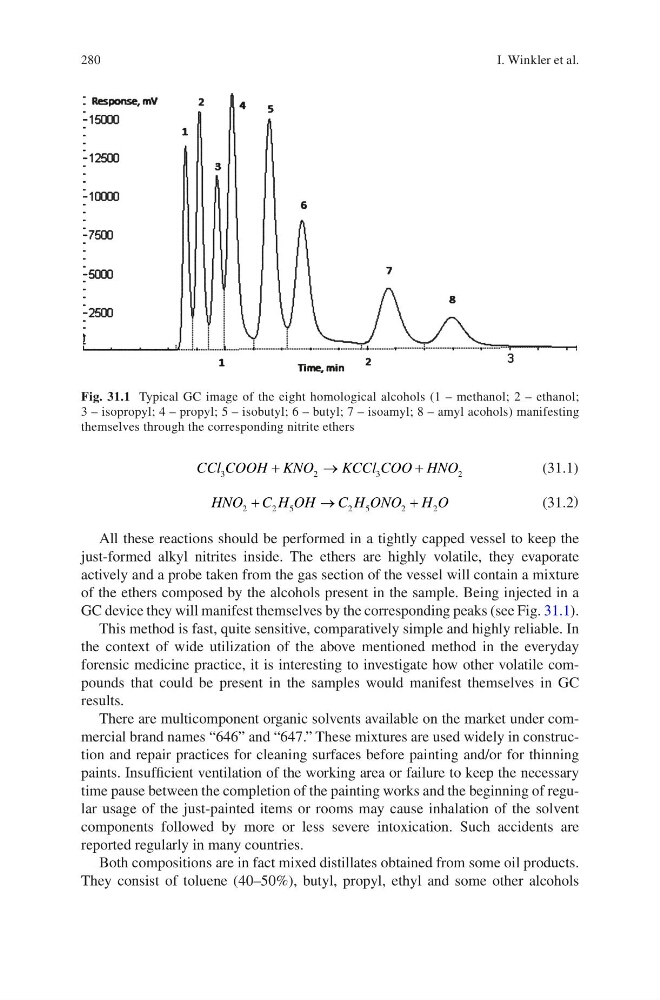
of the ethers composed by the alcohols present in the sample. Being injected in a
GC device they will manifest themselves by the corresponding peaks (see Fig. 31.1).
This method is fast, quite sensitive, comparatively simple and highly reliable. In
the context of wide utilization of the above mentioned method in the everyday
forensic medicine practice, it is interesting to investigate how other volatile compounds that could be present in the samples would manifest themselves in GC
results.
There are multicomponent organic solvents available on the market under commercial brand names “646” and “647.” These mixtures are used widely in construction and repair practices for cleaning surfaces before painting and/or for thinning
paints. Insufficient ventilation of the working area or failure to keep the necessary
time pause between the completion of the painting works and the beginning of regular usage of the just-painted items or rooms may cause inhalation of the solvent
components followed by more or less severe intoxication. Such accidents are
reported regularly in many countries.
Both compositions are in fact mixed distillates obtained from some oil products.
They consist of toluene (40–50%), butyl, propyl, ethyl and some other alcohols
Fig. 31.1 Typical GC image of the eight homological alcohols (1 – methanol; 2 – ethanol;
3 – isopropyl; 4 – propyl; 5 – isobutyl; 6 – butyl; 7 – isoamyl; 8 – amyl acohols) manifesting
themselves through the corresponding nitrite ethers
I. Winkler et al.
CCl COOH KNO
KCCl COO HNO
3
2
3
2
+
→
+
(31.1)
HNO C H OH C H ONO H O
2
2 5
2 5
2
2
+
→
+
(31.2)
All these reactions should be performed in a tightly capped vessel to keep the
just- formed alkyl nitrites inside. The ethers are highly volatile, they evaporate
actively and a probe taken from the gas section of the vessel will contain a mixture
of the ethers composed by the alcohols present in the sample. Being injected in a
GC device they will manifest themselves by the corresponding peaks (see Fig. 31.1).
This method is fast, quite sensitive, comparatively simple and highly reliable. In
the context of wide utilization of the above mentioned method in the everyday
forensic medicine practice, it is interesting to investigate how other volatile compounds that could be present in the samples would manifest themselves in GC
results.
There are multicomponent organic solvents available on the market under commercial brand names “646” and “647.” These mixtures are used widely in construction and repair practices for cleaning surfaces before painting and/or for thinning
paints. Insufficient ventilation of the working area or failure to keep the necessary
time pause between the completion of the painting works and the beginning of regular usage of the just-painted items or rooms may cause inhalation of the solvent
components followed by more or less severe intoxication. Such accidents are
reported regularly in many countries.
Both compositions are in fact mixed distillates obtained from some oil products.
They consist of toluene (40–50%), butyl, propyl, ethyl and some other alcohols
Fig. 31.1 Typical GC image of the eight homological alcohols (1 – methanol; 2 – ethanol;
3 – isopropyl; 4 – propyl; 5 – isobutyl; 6 – butyl; 7 – isoamyl; 8 – amyl acohols) manifesting
themselves through the corresponding nitrite ethers
I. Winkler et al.