

13
the environment, to provide people at risk with the means of rapidly identifying
contaminated air, water, food, and equipment [11–15].
It is well known that antibodies specifically targeting proteins or pathogens, can
be generated to a wide variety of target cell bacterial analytes and are the most
popular choices for the recognition element in many biosensors. Typical
immunoassay formats include competitive, displacement, sandwich, and enzymelinked immunosorbent assays (ELISA) [14]. ELISA, for example, uses colorimetric
or chemiluminescent enzyme substrates for signal transduction and is more suited
to automated instruments because of the multiple incubations and washes required.
The classical approach to detect the bacteria species type or microbe involves the
use of differential metabolic assays, monitored colorimetrically, and on immunochemical routine tests.
In addition, the use of cell culture and electron microscopy are vital for the diagnosis of viruses, bacteria, and intracellular parasites. Consequently, all samples
retrieved from the affected environment must be cultured to obtain enough numbers
of different cell types for reliable identification. Unfortunately, one of the major
drawbacks is that the time required for the microbial outgrowth is long, and some
bacteria obtained cannot be cultured as a result of genetic mutation.
This chapter has been drafted as a quick summary of the novel biodetection
approaches using luminescence biosensing approaches, published recently, for the
detection of warfare potential BA weapons; it will exclude all the conventional
approaches. The readers are encouraged to peruse the references included within the
text, to search for the applied commercial used biosensors, that for simplification
reasons, we did not discuss herewith.
2.2 What Is the Definition of Biosensors?
The IUPAC definition of a biosensor is “a self-contained integrated device that is
capable of providing specific quantitative or semi-quantitative analytical information
using a biological recognition element (biochemical receptor) which is in direct
spatial contact with a transducer element [15]. A biosensor should be clearly
differentiated from a bioanalytical system, which requires additional processing
steps, such as reagent addition. The term “biosensor” is the short form of “biological
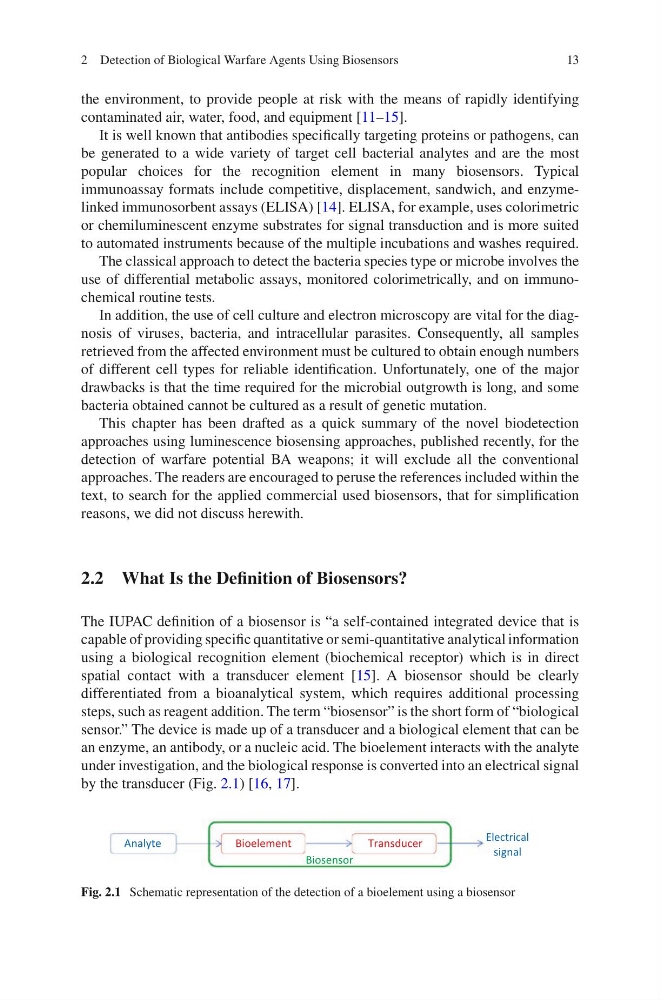
sensor.” The device is made up of a transducer and a biological element that can be
an enzyme, an antibody, or a nucleic acid. The bioelement interacts with the analyte
under investigation, and the biological response is converted into an electrical signal
by the transducer (Fig. 2.1) [16, 17].
Analyte
Bioelement
Transducer
Electrical
signal
Biosensor
Fig. 2.1 Schematic representation of the detection of a bioelement using a biosensor
2 Detection of Biological Warfare Agents Using Biosensors
the environment, to provide people at risk with the means of rapidly identifying
contaminated air, water, food, and equipment [11–15].
It is well known that antibodies specifically targeting proteins or pathogens, can
be generated to a wide variety of target cell bacterial analytes and are the most
popular choices for the recognition element in many biosensors. Typical
immunoassay formats include competitive, displacement, sandwich, and enzymelinked immunosorbent assays (ELISA) [14]. ELISA, for example, uses colorimetric
or chemiluminescent enzyme substrates for signal transduction and is more suited
to automated instruments because of the multiple incubations and washes required.
The classical approach to detect the bacteria species type or microbe involves the
use of differential metabolic assays, monitored colorimetrically, and on immunochemical routine tests.
In addition, the use of cell culture and electron microscopy are vital for the diagnosis of viruses, bacteria, and intracellular parasites. Consequently, all samples
retrieved from the affected environment must be cultured to obtain enough numbers
of different cell types for reliable identification. Unfortunately, one of the major
drawbacks is that the time required for the microbial outgrowth is long, and some
bacteria obtained cannot be cultured as a result of genetic mutation.
This chapter has been drafted as a quick summary of the novel biodetection
approaches using luminescence biosensing approaches, published recently, for the
detection of warfare potential BA weapons; it will exclude all the conventional
approaches. The readers are encouraged to peruse the references included within the
text, to search for the applied commercial used biosensors, that for simplification
reasons, we did not discuss herewith.
2.2 What Is the Definition of Biosensors?
The IUPAC definition of a biosensor is “a self-contained integrated device that is
capable of providing specific quantitative or semi-quantitative analytical information
using a biological recognition element (biochemical receptor) which is in direct
spatial contact with a transducer element [15]. A biosensor should be clearly
differentiated from a bioanalytical system, which requires additional processing
steps, such as reagent addition. The term “biosensor” is the short form of “biological
sensor.” The device is made up of a transducer and a biological element that can be
an enzyme, an antibody, or a nucleic acid. The bioelement interacts with the analyte
under investigation, and the biological response is converted into an electrical signal
by the transducer (Fig. 2.1) [16, 17].
Analyte
Bioelement
Transducer
Electrical
signal
Biosensor
Fig. 2.1 Schematic representation of the detection of a bioelement using a biosensor
2 Detection of Biological Warfare Agents Using Biosensors