

262
mineralisation of the contaminant and its derivatives to avoid the diffusion of more
toxic products to the environment. In any case, the developed photocatalysis system
solves two fundamental problems:
1. eliminates the contaminant that with the filtration and adsorption systems would
only be moved from one environment to another;
2. eliminates the need to recover titanium dioxide powder once the process is
complete
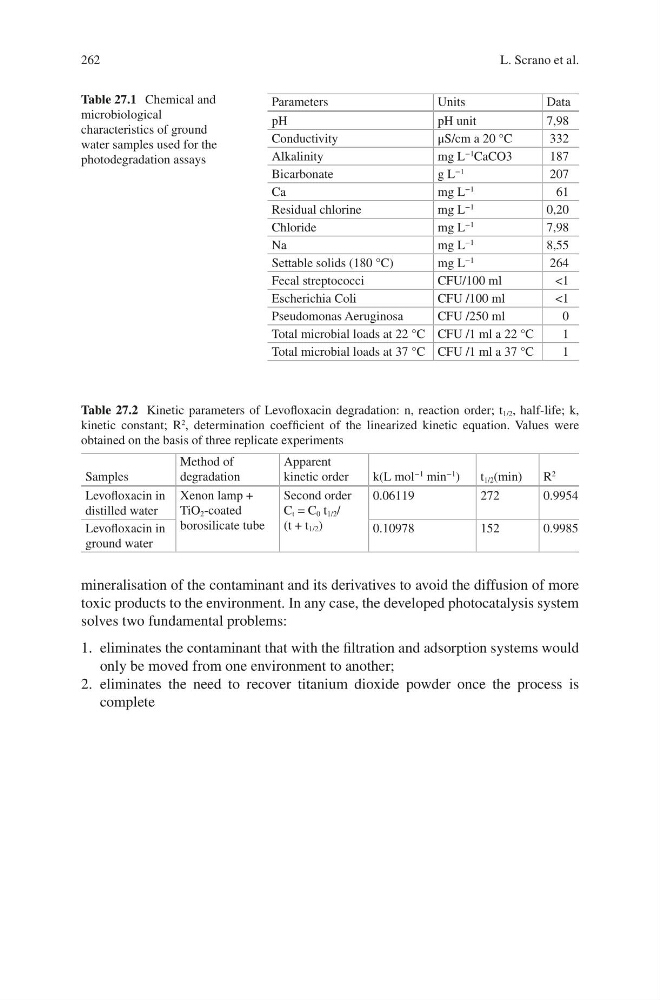
Table 27.1 Chemical and
microbiological
characteristics of ground
water samples used for the
photodegradation assays
Parameters
Units
Data
pH
pH unit
7,98
Conductivity
μS/cm a 20 °C
332
Alkalinity
mg L
−1 CaCO3
187
Bicarbonate
g L
−1
207
Ca
mg L
−1
61
Residual chlorine
mg L
−1
0,20
Chloride
mg L
−1
7,98
Na
mg L
−1
8,55
Settable solids (180 °C)
mg L
−1
264
Fecal streptococci
CFU/100 ml
<1
Escherichia Coli
CFU /100 ml
<1
Pseudomonas Aeruginosa
CFU /250 ml
0
Total microbial loads at 22 °C CFU /1 ml a 22 °C
1
Total microbial loads at 37 °C CFU /1 ml a 37 °C
1
Table 27.2 Kinetic parameters of Levofloxacin degradation: n, reaction order; t 1/2 , half-life; k,
kinetic constant; R
2 , determination coefficient of the linearized kinetic equation. Values were
obtained on the basis of three replicate experiments
Samples
Method of
degradation
Apparent
kinetic order
k(L mol
−1
min
−1
)
t 1/2 (min)
R
2
Levofloxacin in
distilled water
Xenon lamp +
TiO 2 -coated
borosilicate tube
Second order
C t = C 0 t 1/2 /
(t + t 1/2 )
0.06119
272
0.9954
Levofloxacin in
ground water
0.10978
152
0.9985
L. Scrano et al.
mineralisation of the contaminant and its derivatives to avoid the diffusion of more
toxic products to the environment. In any case, the developed photocatalysis system
solves two fundamental problems:
1. eliminates the contaminant that with the filtration and adsorption systems would
only be moved from one environment to another;
2. eliminates the need to recover titanium dioxide powder once the process is
complete
Table 27.1 Chemical and
microbiological
characteristics of ground
water samples used for the
photodegradation assays
Parameters
Units
Data
pH
pH unit
7,98
Conductivity
μS/cm a 20 °C
332
Alkalinity
mg L
−1 CaCO3
187
Bicarbonate
g L
−1
207
Ca
mg L
−1
61
Residual chlorine
mg L
−1
0,20
Chloride
mg L
−1
7,98
Na
mg L
−1
8,55
Settable solids (180 °C)
mg L
−1
264
Fecal streptococci
CFU/100 ml
<1
Escherichia Coli
CFU /100 ml
<1
Pseudomonas Aeruginosa
CFU /250 ml
0
Total microbial loads at 22 °C CFU /1 ml a 22 °C
1
Total microbial loads at 37 °C CFU /1 ml a 37 °C
1
Table 27.2 Kinetic parameters of Levofloxacin degradation: n, reaction order; t 1/2 , half-life; k,
kinetic constant; R
2 , determination coefficient of the linearized kinetic equation. Values were
obtained on the basis of three replicate experiments
Samples
Method of
degradation
Apparent
kinetic order
k(L mol
−1
min
−1
)
t 1/2 (min)
R
2
Levofloxacin in
distilled water
Xenon lamp +
TiO 2 -coated
borosilicate tube
Second order
C t = C 0 t 1/2 /
(t + t 1/2 )
0.06119
272
0.9954
Levofloxacin in
ground water
0.10978
152
0.9985
L. Scrano et al.